Most conversations about pets and air purifiers start in one place: your allergies, your sneezing, your irritated eyes. The pet is cast as the villain — a walking dander machine — and the purifier is your defense. But a quieter, more emotionally charged category of buyer is reading this right now: someone whose pet is the one struggling. Their dog scratches until it bleeds. Their cat wheezes through the night. And the vet just said the words “environmental allergens.” An air purifier is not a veterinary treatment, but it can meaningfully reduce the airborne particles — dust mite fragments, mold spores, and yes, even the animal’s own shed skin cells — that trigger and sustain allergic responses in sensitive animals. This guide is for you. We’ll walk through which purifier specs actually matter for this use case, what real owners report seeing in their pets, and how to build a cost-honest decision.
The Lead Story Nobody Expected: Dogs With Dust Mite Allergies Are Real, and Common
One of the most detailed owner accounts circulating in aggregated reviews of the LEVOIT Core 200S-P describes a dog with a severe dust mite allergy so acute that the symptoms read like a clinical case study: significant hair loss, dandruff described as falling “like a blizzard,” and a full-body secondary yeast infection driven by the chronic skin inflammation. The owner had tried everything — prescription shampoos, dietary changes, vet visits — before introducing an air purifier as part of a broader environmental management strategy. The account is careful not to claim the purifier alone reversed the condition, but the owner reports a meaningful reduction in symptom severity after consistent use.
This is worth pausing on, because it reframes the entire buying decision. When your pet is the primary allergy sufferer, you are not buying for particle aesthetics. You are buying to reduce a measurable allergen load in the airspace your animal occupies most. That changes which specs matter and where you place the unit.
Per the American College of Allergy, Asthma & Immunology’s pet allergy overview, dust mite allergies in dogs are among the most common environmental allergies diagnosed in veterinary dermatology — and unlike pollen allergies (which have seasons), dust mites are year-round. The airborne fraction of dust mite allergen — primarily fragments of mite bodies and fecal particles, ranging from roughly 1 to 10 microns in diameter — is exactly what HEPA filtration is rated to capture.
A secondary owner account, this time for a MOOKA air purifier, describes a household with an 18-year-old asthmatic cat alongside human members with their own distinct respiratory conditions. The owner explicitly frames the purifier as a whole-household tool, not a single-user device — a framing that turns out to be practically important when we get to placement strategy.
What the Specs Actually Mean When Your Pet Is the Patient
Here’s where the practitioner framing matters. You’ve read enough reviews to know “True HEPA” is on every box. What you need is the decision logic underneath that claim.
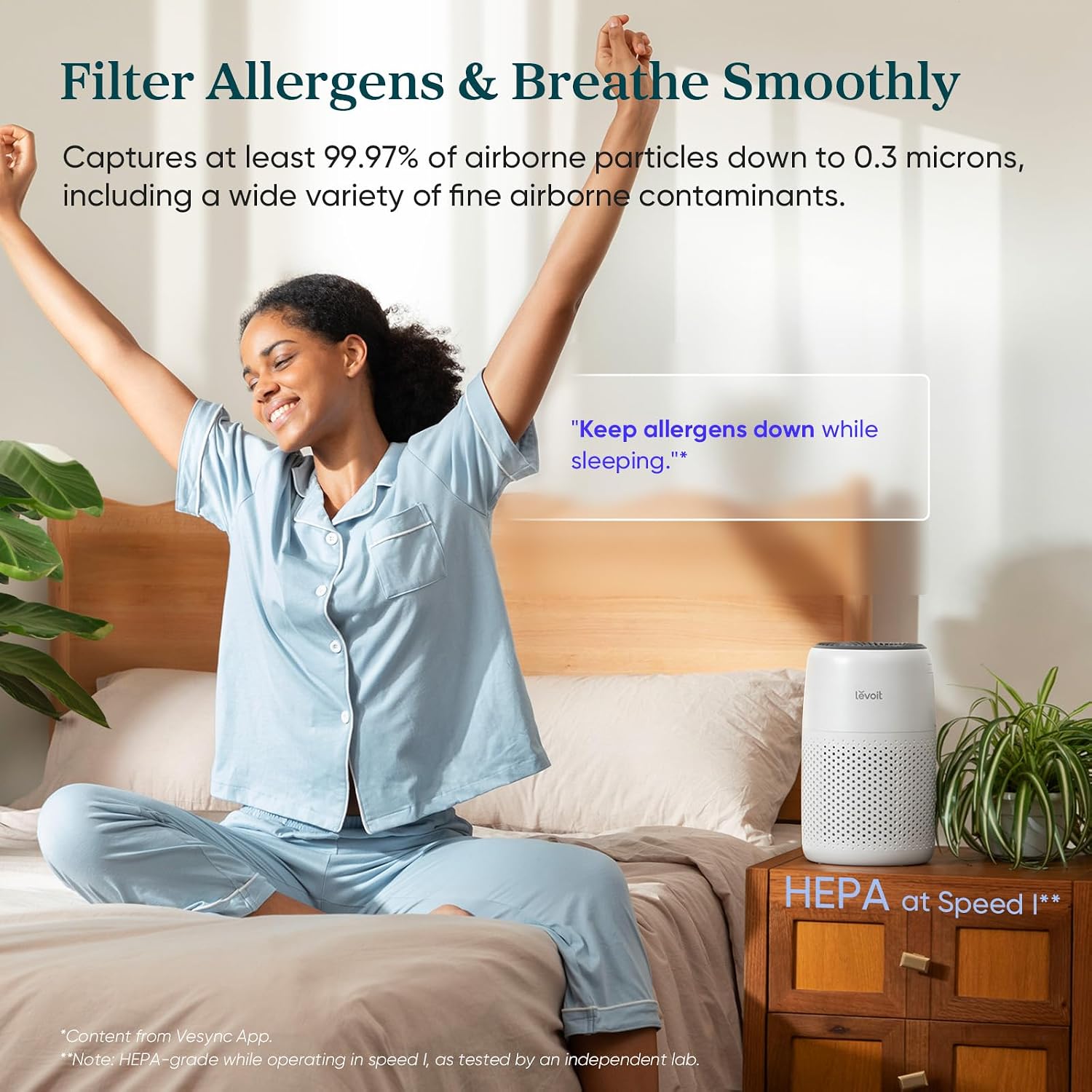
HEPA grade and particle size: True HEPA filtration — defined under standards including ASHRAE Standard 52.2 as capturing at least 99.97% of particles at 0.3 microns — is sufficient for dust mite allergen fragments, pet dander (typically 2.5–10 microns), mold spores (1–30 microns), and the sub-micron skin cell fragments that carry allergen proteins. The 0.3-micron benchmark is actually the hardest particle size to capture (the “most penetrating particle size”); HEPA filters perform better at both larger and smaller sizes. For the allergen profile relevant to a dust-mite-allergic dog or an asthmatic cat, True HEPA is not overkill — it’s the floor.
CADR and room coverage: CADR (Clean Air Delivery Rate) is the metric that tells you how many cubic feet of air per minute the purifier cleans at a given efficiency. The Association of Home Appliance Manufacturers publishes CADR ratings that are independently verified. For a pet that sleeps in a bedroom, you generally want a CADR that can cycle the room’s air volume at least 4–5 times per hour. For a 150 sq ft bedroom with 8-foot ceilings (1,200 cubic feet of air), that’s a CADR of roughly 80–100 cfm minimum. For a living room where a larger dog spends most of the day, you’re looking at significantly more.
By the numbers — quick sizing guide:
| Room size (8 ft ceiling) | Air volume | Target CADR (4–5 ACH) |
|---|---|---|
| 100 sq ft (small bedroom) | 800 cu ft | 55–70 cfm |
| 150 sq ft (standard bedroom) | 1,200 cu ft | 80–100 cfm |
| 300 sq ft (living room) | 2,400 cu ft | 160–200 cfm |
| 500 sq ft (open plan) | 4,000 cu ft | 270–335 cfm |
ACH = air changes per hour. Higher is better for allergy load reduction.
Which Purifiers Come Up Most in Pet-Allergy-Specific Owner Accounts
Let’s be direct about what we know and don’t know: no manufacturer has published peer-reviewed clinical data showing their purifier reduces allergy symptoms in dogs or cats. What we have is a consistent, high-motivation pattern of owner-reported improvement — and that pattern is worth taking seriously, even while noting its limits.
LEVOIT Core 200S-P is the unit with the most detailed pet-as-primary-patient owner narrative in aggregated review data. The “P” designation indicates a pet-focused variant with a specialized filter combining activated carbon (for odor) with HEPA. Owners specifically report buying the pet-edition replacement filters rather than the standard ones — a signal that this audience is actively seeking allergen-specific filtration and not just defaulting to what’s cheapest. The Core 200S-P’s relatively compact CADR (rated for rooms up to about 175 sq ft) makes it most appropriate for the room where your pet sleeps, not a whole-home solution.
LEVOIT Core 300 appears repeatedly in the same buyer segment, with reviewers purchasing the pet-specific replacement filter series as an add-on. Published specs put its CADR at 141 cfm for dust — meaningful step-up coverage for a master bedroom or medium living space.
GermGuardian AC5250P draws a different category of owner comment: reviewers mention pets seeming more comfortable — less scratching, more settled sleep — without necessarily connecting it to a specific mechanism. These are softer signals than the LEVOIT dust-mite account, but they represent a secondary pattern worth noting. The AC5250P also incorporates UV-C light in addition to HEPA; evidence for UV-C’s effectiveness against allergens (as opposed to pathogens) is limited, per EPA’s indoor air quality guidance, so the core filtration spec should remain your primary evaluation criterion.
IQAir HealthPro Plus sits at a significantly higher price point — typically $800–$900 — but its HyperHEPA filtration is rated to capture particles down to 0.003 microns, substantially exceeding standard HEPA. For a household where a pet has severe, documented environmental allergies and the owner wants the highest available particle capture efficiency, this is the unit Consumer Reports has consistently placed at the top of performance rankings. The tradeoff is filter cost: replacement filters run roughly $200–$300 per cycle, and IQAir recommends replacement every 12–18 months depending on usage. Five-year TCO on the HealthPro Plus can approach $1,500–$1,700 including unit cost — a real number to enter before committing.
Placement Strategy When Your Pet Is the Target User
This is where the MOOKA asthmatic-cat owner’s framing is instructive. When the animal is the primary allergen-sensitive resident, placement logic shifts.
Rule of thumb: Place the purifier in the room your pet occupies during the highest-exposure hours, not necessarily where you sit. For most dogs, that’s wherever they sleep at night (often a bedroom or crate space). For cats, it may be a perch near a window with sun — a location that also tends to accumulate dust.
If your pet moves freely between rooms, a single-room unit will address only a fraction of their exposure. This is the honest case for a higher-CADR unit that can handle larger spaces, or for a two-unit strategy (one in the sleeping space, one in the primary daytime space).
Running the purifier continuously on a low-to-medium setting — rather than cycling it on at full speed only when the room seems dusty — keeps the particle count suppressed rather than reactive. Most purifiers with auto-mode and PM2.5 sensors will manage this automatically; owners consistently report that auto-mode is adequate for allergen management without requiring manual adjustment.
Pet-Specific Filters: Worth It or Marketing?
Several LEVOIT units ship with a “pet” filter variant that adds a layer of activated carbon and sometimes a pre-filter optimized for pet hair. The honest answer: for odor control, the activated carbon layer adds measurable value. For allergen capture, the HEPA layer is doing the same work regardless of whether the box says “pet edition.” The pre-filter matters more than the marketing — a coarser outer layer that catches fur before it loads the HEPA extends HEPA filter life, which directly reduces your cost-per-year.
If you are buying replacement filters, check whether the manufacturer offers a version with a more robust pre-filter. With a heavy-shedding dog undergoing allergy-related fur loss, pre-filter loading can be significant — some owners in aggregated reviews report pre-filter replacement every 3–4 weeks rather than the manufacturer’s stated schedule.
Frequently Asked Questions
Can an air purifier actually help a dog with dust mite allergies, or do I need to do more than that? Both. A purifier reduces the airborne fraction of dust mite allergen — which is real and meaningful — but dust mites live in bedding, upholstery, and carpet, not primarily in the air. Washing your pet’s bedding weekly in hot water (per EPA indoor air quality guidance), using dust-mite-proof covers on beds, and vacuuming with a HEPA-filter vacuum are complementary steps. An air purifier is not a substitute for surface management; it’s one layer of a multi-front strategy.
What HEPA grade do I need to capture dust mite particles that affect pets? True HEPA (99.97% at 0.3 microns) is sufficient. Dust mite allergen particles are typically 1–10 microns — well within True HEPA’s capture range. You do not need HyperHEPA or ULPA filtration specifically for dust mite allergens; those grades become relevant for submicron pathogen concerns.
Should I run the purifier in the room where my pet sleeps, or the room they spend the most time in during the day? Start with wherever your pet spends the most continuous hours. For most dogs, that’s overnight in the sleeping space. If your pet roams freely, prioritize the room with the highest soft-surface density (carpet, upholstered furniture) — these are the highest allergen reservoirs and generate the most airborne load.
Are there purifiers with pet-specific filters, and are they worth the extra cost? They exist — LEVOIT is the clearest example in the mid-range. The pet filter variant adds activated carbon (odor benefit, genuine) and often a better pre-filter (filter-life benefit, genuine). The HEPA allergen capture is the same. If odor from skin infections or yeast is part of your pet’s allergy picture, the activated carbon layer earns its price premium.
How often will I need to replace the filter if my pet sheds heavily and has allergy-related dander? Plan to inspect monthly and replace more frequently than the manufacturer’s stated schedule. Owners with heavy-shedding, allergy-affected dogs commonly report needing pre-filter replacement every 3–6 weeks and HEPA replacement every 4–8 months rather than the 6–12 months stated on the box. Budget accordingly: for a unit with $30–$50 annual filter costs at normal use, assume $60–$120 per year in this scenario.
Does running an air purifier actually reduce the amount of fur and dander that settles on surfaces? Partially and indirectly. A purifier captures airborne particles before they settle, which can reduce the rate of surface accumulation over time — but it cannot remove what has already settled, and it cannot address particles that never become airborne. Regular vacuuming with a HEPA-equipped vacuum remains necessary. Owners consistently report surfaces feeling “less dusty” over time with continuous purifier use, which aligns with the mechanism: if particles are captured in the air column, fewer reach the surface.
The Decision Rule
If your pet has a diagnosed or strongly suspected environmental allergen condition: prioritize CADR coverage for the room they occupy longest, True HEPA filtration as a minimum, and a pre-filter system robust enough to handle elevated shedding. LEVOIT Core 300 or Core 200S-P with pet-edition filters cover the entry-to-mid range; IQAir HealthPro Plus covers the maximum-performance tier if budget and five-year TCO are acceptable.
If your budget is constrained: one well-sized, well-placed True HEPA unit in your pet’s primary space will outperform two undersized units spread across the house. Get the CADR math right for one room before expanding.
If your pet’s condition is severe: an air purifier is a legitimate environmental management tool — but it belongs in a conversation with your veterinarian about the full allergen reduction protocol, not as a standalone intervention. The owner accounts are compelling and the mechanism is sound; the honest framing is that purifiers are a meaningful component, not a cure.