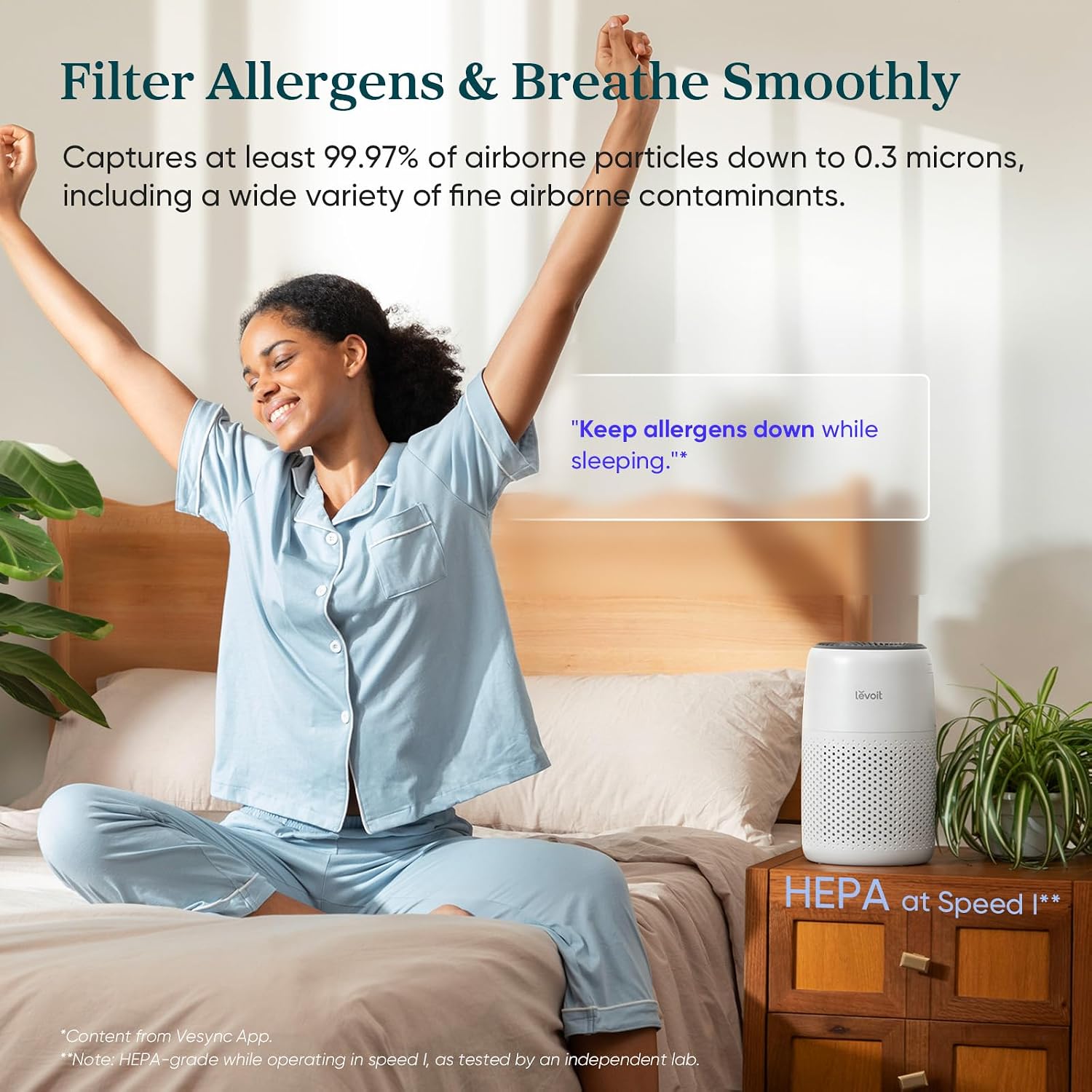
If you’ve ever woken up congested when you slept just fine the night before, or noticed your allergies are worst the moment you climb into bed, there’s a good chance your bedroom air is the culprit. An air purifier is a standalone device that pulls room air through a series of filters — most importantly a HEPA filter (High Efficiency Particulate Air, a standard that captures at least 99.97% of airborne particles down to 0.3 microns) — then returns cleaner air to the room. It doesn’t cure allergies or guarantee eight perfect hours, but it removes the particulate load your airways are fighting all night. This guide is for buyers who already understand the basics and are now trying to make the right call: which unit to actually put in a bedroom, what to prioritize, and what to ignore.
The short version: the single most important specification for a bedroom purifier isn’t maximum CADR (Clean Air Delivery Rate — how many cubic feet of air the unit cleans per minute). It’s the noise floor on the speed you’ll actually run it overnight. Everything else flows from that.
| EDITOR'S PICK[Shark Air Purifier for Home wit…](https://www.amazon.com/dp/B0CBQRTQ6D?tag=greenflower20-20) | Mid-tier[Pure Enrichment PureZone Air Pu…](https://www.amazon.com/dp/B08HGJKCDS?tag=greenflower20-20) | Budget pick[LEVOIT Air Purifiers for Bedroo…](https://www.amazon.com/dp/B07VVK39F7?tag=greenflower20-20) | |
|---|---|---|---|
| Coverage | 1400 sq ft | — | — |
| Filter type | HEPA | H13 HEPA | 3-in-1 |
| Filter life | 5-Year | — | — |
| Stages | — | 4-Stage | 3-in-1 |
| UV-C light | — | ✓ | — |
| Aroma pad | — | — | ✓ |
| Price | $299.00 | $99.99 | $39.97 |
| See on Amazon → | See on Amazon → | See on Amazon → |
Why Sizing for Low Speed Matters More Than Peak Performance
Here’s the tradeoff most buyers miss: a unit sized too small for your room will be running at high or medium all night to keep up. A unit sized correctly — or slightly oversized — for the room can run on its lowest speed setting and still turn the air over the recommended four to five times per hour. That’s the entire game for bedroom use.
A reviewer of the GermGuardian tower series put it plainly, describing high speed as sounding like “a typhoon.” That’s not a defect — that’s physics. Tower-format purifiers that are undersized for a larger bedroom get pushed to speeds that generate 55–65 dB of white-noise-adjacent roar. Some sleepers genuinely don’t mind; most do. The EPA’s guidance on indoor air quality notes that continuous low-level noise is a documented sleep disruptor, even when the sleeper doesn’t consciously register it as noise.
The practical rule: Take the room’s square footage, find a unit rated for 1.5–2× that area, and you’ll almost always be able to run it on low — which typically lands between 24 and 38 dB, well inside the range most people find conducive to sleep.
By the numbers — bedroom sizing at low speed:
| Room size | Minimum CADR target | Recommended unit coverage |
|---|---|---|
| Up to 150 sq ft | ~100 CFM | Rate for 200–250 sq ft |
| 150–250 sq ft | ~150 CFM | Rate for 300–400 sq ft |
| 250–400 sq ft | ~200 CFM | Rate for 500+ sq ft |
Units in the Levoit Core 300-series consistently draw owner reports of being used specifically as white noise machines — an accidental benefit that became the primary reason many buyers keep them on even after their air quality concern resolved. That’s the low-speed noise floor working in your favor. When multiple independent reviewers describe the same unintended behavior, it’s worth treating as a validated use case, not a fluke.
The Real Bedroom Use Cases — And What Each One Demands
Dust mite allergies and pet dander. This is the highest-stakes bedroom air quality problem, and the one where unit selection genuinely matters. One Levoit Core 300-series owner documented buying the unit because their dog developed severe dust mite allergies — manifesting as full-body hair loss and secondary yeast infections — a visceral, credible story that illustrates how bad particulate load in a bedroom can get before people intervene. HEPA filtration is non-negotiable here; ionizers and UV-C alone don’t capture particles in the 2–10 micron range that include dust mite fecal matter and dander.
For dust mite allergies specifically, air filtration is one layer of a system. Wirecutter’s air purifier guidance notes that mattress encasements, pillow covers, and washing bedding in hot water weekly remain the highest-impact interventions — the purifier handles airborne particles that escape those barriers. Treat the purifier as a complement, not a replacement, for encasement-based dust mite control.
Odor penetration from neighbors or building systems. A Levoit BNDM2RNG owner described moving into an apartment with a persistent stale odor plus marijuana smell migrating from neighboring units. They tried charcoal deodorizer bags and air fresheners first — both are passive and low-flow, and neither moves enough air volume to meaningfully dilute VOCs (Volatile Organic Compounds, gas-phase pollutants that include odor molecules). The purifier solved it where the passive products didn’t. The key spec for this use case is activated carbon weight — look for units with at least 1–2 lbs of granular activated carbon, not the thin carbon-coated foam pads found in entry-level units. Carbon foam sheets have a fraction of the surface area and exhaust quickly.
Respiratory sensitivity in older adults. A PureZone H13 reviewer documented purchasing specifically for an elderly spouse with documented allergy sensitivities. H13 designation means the filter meets the HEPA standard at the most demanding tested particle size — the same filtration grade used in hospital settings. For buyers in this situation, filter replacement consistency matters as much as initial filtration performance; a degraded filter in month 14 isn’t doing what it did in month 1. ASHRAE Standard 62.1 on ventilation for acceptable indoor air quality recommends tracking filter condition rather than relying solely on time-based replacement schedules.
Travel and temporary use. A Canopy bedside purifier reviewer described staying in a guesthouse with questionable air quality, using the unit’s onboard sensor to confirm what their nose already suspected, and becoming — their word — “obsessed” with the real-time air quality data. This is a different buyer psychology than the home-allergy use case: the sensor feedback loop creates active engagement with the unit. For buyers who want behavioral feedback, a purifier with a real-time particle sensor and visible AQI (Air Quality Index) display changes how you interact with the space. It’s not just cleaning air; it’s giving you information you’d otherwise be guessing at.
Features That Actually Matter Overnight — And the Ones You Can Ignore
Sleep mode and auto-dimming indicators. If you’ve ever had a purifier’s blue LED status ring light up your ceiling at 2 a.m., you already know the answer to “will the lights keep me awake?” — yes, absolutely, unless the unit has a display-off or sleep mode. This is a genuine differentiator between units. Consumer Reports’ air purifier testing notes that auto/sleep modes vary significantly in how completely they suppress indicator lighting. Before purchasing, confirm: does sleep mode turn the display fully off, or does it just dim the ring? Full off is the standard worth insisting on.
App integration and auto-mode. For overnight use specifically, reliable auto-mode (the unit adjusting fan speed based on its own particle sensor) matters more than HomeKit integration. A unit that wakes to high speed at 3 a.m. because a sensor triggered — then doesn’t return to low — defeats the purpose of a bedroom-optimized setup. Wirecutter’s long-run review notes flag this as a real failure mode in several mid-range units: the sensor is sensitive but the return-to-low logic is slow. Look for units with configurable sensitivity thresholds if this is a concern.
UV-C and ionizer features. UV-C sanitization and negative ion generators are frequently marketed as premium bedroom features. The EPA’s indoor air quality guidance is measured on both: UV-C can inactivate some microorganisms but requires meaningful exposure time (most pass-through UV-C systems offer limited dwell time at rated airflow). Ionizers can produce trace ozone, which is a respiratory irritant. For a bedroom — a small space with prolonged occupancy — the case for running an ionizer overnight is weak. HEPA + activated carbon handles the particle and odor load; the extras add complexity and potential downsides without well-documented sleep-specific benefits.
Placement: nightstand vs. floor. The most common instinct is to put a small unit close to the bed — on the nightstand or dresser — so the clean air reaches you first. The counterargument is that floor placement typically captures more of the particle-heavy lower air layer where dust mite allergens settle. In practice: for small rooms under 150 square feet, placement matters less than running the unit consistently at low speed all night. For larger rooms, floor placement near the bed — not directly pointed at your face, but in the general airflow path — tends to perform better on dust particle capture. Either way, don’t place it in a corner behind furniture; you’ll restrict intake airflow and reduce effective CADR significantly.
The “If X, Then Y” Decision Framework
If your primary concern is dust mite or pet dander allergies: prioritize a true HEPA-rated unit (H13 or H14) oversized for your room so you can run low all night, and pair it with mattress and pillow encasements. The Levoit Core 300-series is the validated entry point for small bedrooms; move up in CADR for anything over 200 square feet.
If you’re dealing with odor from neighbors, smoke, or building systems: HEPA alone won’t do it. You need a unit with substantial activated carbon mass — not foam sheet carbon — and enough CADR to turn the room over multiple times per hour. Don’t buy a small-room unit and expect it to handle a studio apartment’s odor load.
If you want sensor feedback and behavioral engagement (the Canopy use case): pay for the particle sensor and visible AQI display. The data changes how you use the space and, for many owners, justifies the price premium in itself.
If you’re buying for an older adult with respiratory sensitivity: H13 filtration, a simple interface, and a reliable filter-replacement reminder are the spec priorities. Complexity is a liability here — the unit needs to be easy to maintain consistently.
If noise is the absolute constraint: verify the dB rating at low speed, not just the noise range. Manufacturer specs sometimes list only the high-speed figure. Owner reviews are the most reliable source for real-world low-speed noise floors; look for multiple independent reports, not just one outlier.
Frequently Asked Questions
Is it safe to run an air purifier in a bedroom all night, every night? Yes — for standard HEPA and activated carbon units, continuous operation is both safe and the intended use case. The EPA’s indoor air quality guidance supports ongoing filtration as beneficial for particle reduction. The one exception: avoid running ionizer-equipped units on a continuous overnight cycle in small, enclosed bedrooms if you have any respiratory sensitivity, as trace ozone accumulation is a documented concern with some ionizer designs.
Will the indicator lights on a purifier keep me awake? They can, and this is a legitimate deal-breaker for light-sensitive sleepers. Always verify that the unit’s sleep mode or display-off function fully extinguishes indicator LEDs, not just dims them. Owner reviews are more reliable than spec sheets on this specific point — manufacturers don’t always disclose what “dim” actually means in practice.
Should I put the purifier on the nightstand close to my head or on the floor across the room? For rooms under 150 square feet, consistent operation matters more than exact placement. For larger rooms or allergy-focused use, floor placement near the bed (but not aimed directly at your face) tends to capture more of the settled-particle-heavy lower air. Keep it away from corners and never block the intake grille with furniture.
Does running an air purifier on low speed all night actually filter enough air to make a difference? Yes — if the unit is appropriately sized. A purifier rated for 300–400 square feet running on low in a 150-square-foot bedroom will still turn the air over four or more times per hour, which meets the standard threshold for meaningful particle reduction. The mistake is running an undersized unit on low, which delivers inadequate air changes regardless of the filter quality.
Can a bedroom air purifier help with dust mite allergies, or do I also need mattress covers and other interventions? Both, not one or the other. Mattress encasements and pillow covers directly limit your contact with the mite reservoir in bedding — that’s the highest-impact intervention. A HEPA air purifier handles the airborne fraction: particles disturbed by movement, HVAC circulation, and general airflow. Wirecutter’s guidance on dust mite management treats filtration and physical barrier methods as complementary, not interchangeable. For severe allergy sufferers, running both is the standard of care.