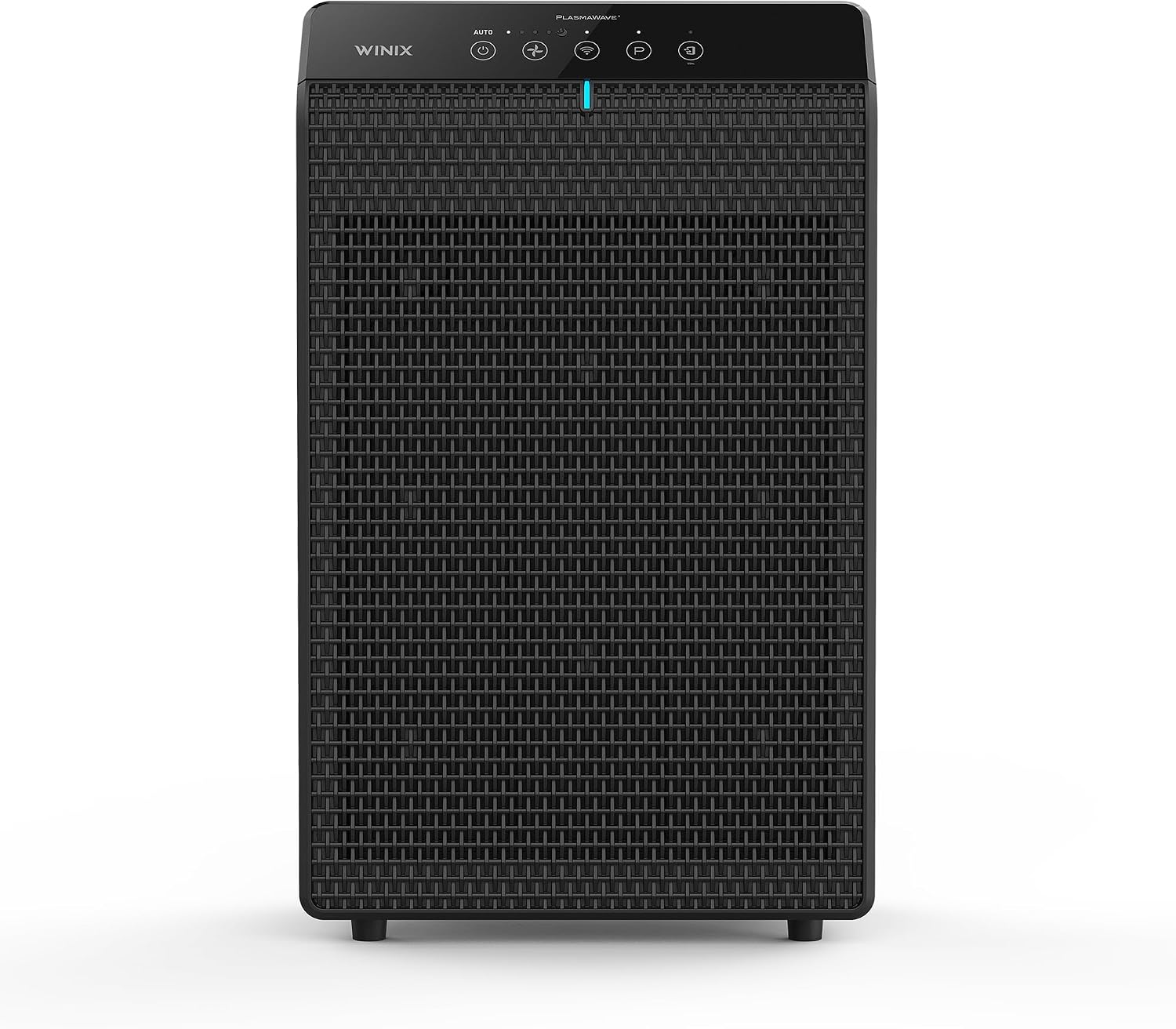
Most air purifiers sold in 2025–2026 come with an “auto mode” — a setting where the unit reads the air on its own, speeds up when pollution rises, and slows back down when things clear. The sensor doing that reading is typically a laser particle counter (a tiny optical device that shines light through a chamber and counts how many specks scatter back). When particles are dense — from cooking smoke, pet dander, or construction dust — the sensor logs a spike, the fan ramps up, and a color-coded ring or LED shifts from green to orange or red. When particles clear, everything relaxes back to low speed. It’s a genuinely smart concept, and for many owners it works exactly as advertised. But “smart” has limits, and this article is about mapping those limits honestly — because if you’re running auto mode overnight, or relying on it in a space with unusual pollution sources, you need to know where the system can fail you before you find out the hard way.
By the end, you’ll have a clear model for which scenarios auto mode handles well, which ones it misses entirely, and what that means for how you configure your unit day to day.
| EDITOR'S PICKLEVOIT Air Purifiers for Home L… | Mid-tierLEVOIT Air Purifiers for Home L… | Budget pickGermGuardian 5-In-1 HEPA Air Pu… | |
|---|---|---|---|
| Coverage | 1733 ft² | 1875 ft² | 743 ft² |
| Filter type | 3-in-1 | Washable pre | 5-in-1 |
| Auto mode | ✓ | — | — |
| Air quality sensor | ✓ | ✓ | — |
| Smart WiFi | ✓ | — | — |
| UV-C light | — | — | ✓ |
| Price | $181.93 | $139.98 | $95.75 |
| See on Amazon → | See on Amazon → | See on Amazon → |
What the Sensor Actually Measures (and What It Doesn’t)
The built-in sensors in most consumer purifiers — including the Winix 5520, Winix 5510, and Levoit Core 400S — are laser particle sensors calibrated primarily for PM2.5, which is the shorthand for fine particulate matter smaller than 2.5 micrometers (about 1/30th the diameter of a human hair). Per the U.S. EPA’s “Guide to Air Cleaners in the Home,” PM2.5 is the pollutant category most directly linked to respiratory and cardiovascular harm, which is why it’s the right thing to measure. These sensors are reasonably good at catching:
- Cooking smoke and grease aerosols
- Pet dander and fine dust
- Candle soot and incense particles
- Construction or renovation dust (the kind kicked up by drywall cutting or sanding)
Where they fall short is everywhere outside the particle category. Specifically:
VOCs (volatile organic compounds) — the chemical gases released by paint, cleaning products, new furniture, adhesives, and yes, many cooking processes — are invisible to a particle sensor. VOCs don’t scatter laser light. Some higher-end units include a separate MOX (metal oxide) gas sensor for VOCs, but even those are broadband detectors that can’t distinguish between a harmless ethanol spike from hand sanitizer and a genuinely harmful formaldehyde spike from new flooring.
CO2 (carbon dioxide) — the clearest single-number proxy for whether a space is adequately ventilated — is measured by zero purifiers. A review of the BREATHE Airmonitor Plus, a standalone air quality monitor, documented CO2 hitting 4,500 ppm in a small office with the door closed. At that concentration (ASHRAE’s ventilation guidelines flag anything above 1,100 ppm as a sign of inadequate fresh air), cognitive impairment is measurable. No purifier auto mode in any product category would have flagged this, because no purifier sensor reads CO2. This is a structural gap, not a brand-level flaw.
Radon, carbon monoxide, and NO2 — similarly absent from any purifier sensor suite. These require dedicated monitors.
The practical implication: auto mode is a particle-response system. Treat it as one, not as a whole-home air quality guardian.
Where Auto Mode Delivers Real-World Value
Within its lane, auto mode performs well enough that the pattern across owner reviews is consistently positive. Owners of Winix 5520 and 5510 units frequently describe watching the color ring cycle from blue through orange to red and back as the unit responds to an activity — a detail that Consumer Reports’ air purifier coverage identifies as one of the more effective forms of feedback in consumer IAQ devices, precisely because it closes the loop for the owner and builds usage habit.
The Levoit Core 400S shows up repeatedly in aggregated review analysis for its speed responding to kitchen smoke. Owners report the fan ramping to high within seconds of visible smoke appearing near a stovetop, which aligns with its laser sensor placement and the relatively small interior volume the sensor needs to sample.
The most concrete remediation data in any single owner account comes from PuroAir 400 users during home remodeling. Multiple owners describe a documented three-hour cycle — starting at maximum red-sensor output when active dusty work was underway, and gradually stepping down to green over roughly three hours as the unit ran continuously. That’s a useful real-world benchmark: if you’re dealing with renovation-level particulate loading in a room sized for the unit, expect three hours to full recovery on auto at high speed. That number will scale up with room size or down with a more aggressive unit.
The KNKA unit, notable for displaying a live particle count rather than just a color band, gets specific praise for making the number-drop visible in real time. Owners describe watching counts fall from several hundred micrograms per cubic meter down to single digits over 20–30 minutes after a pollution event — which maps to what the unit is actually doing rather than just inferring it.
Where Auto Mode Fails — and Why
Dead zones and sensor placement. GoveeLife standalone air quality monitor owners report a recurring pattern: vacuuming causes clear, large PM2.5 spikes on the monitor while the purifier’s own color indicator stays green or shows only mild orange. This isn’t a flaw in the GoveeLife — it’s a geometry problem. Built-in purifier sensors sample air at the unit’s intake. If you’re vacuuming on the opposite side of a large room, or in a connected room with the door open, the particle cloud may dissipate or settle before it reaches the purifier’s sensor. The purifier’s built-in sensor is always reporting conditions at the purifier, not conditions at you.
Odor without particles. This is the most common owner complaint, framed as confusion: “Why does my air quality ring stay green when I can still smell something?” The answer is that odors — whether from cooking, cleaning products, or off-gassing materials — are largely chemical events, not particle events. A green ring means low PM2.5. It says nothing about VOC concentration. If your unit has an activated carbon layer, it may be absorbing some of those compounds regardless of fan speed, but at low auto-mode speed, airflow through the carbon is minimal. Running auto mode at low speed in a room that smells of fresh paint is exactly the wrong configuration.
Humidity interference. High humidity causes particle sensors to read high because water droplets scatter laser light the same way fine dust does. On a very humid day, auto mode may spin up unnecessarily — a phenomenon documented in the Lawrence Berkeley National Laboratory’s indoor environment research on low-cost particle sensor accuracy. This is more of a nuisance than a health risk, but it explains why some owners notice auto mode cycling more aggressively on humid summer evenings without an obvious pollution source.
By the Numbers
| Sensor type | What it catches | What it misses |
|---|---|---|
| Laser particle (PM2.5) | Smoke, dust, dander, soot | VOCs, CO2, radon, humidity artifacts |
| MOX gas (broadband VOC) | General gas spike | Specific compound ID, CO2, particles |
| Dedicated CO2 (NDIR) | CO2 only | Particles, VOCs, humidity |
| Standalone IAQ monitor | 2–5 parameters combined | Varies by model — no single unit covers all |
The clear takeaway: no single sensor type covers the full IAQ picture. A purifier with both a particle sensor and a MOX VOC sensor — the Molekule Air Pro includes a PECO sensor array with VOC sensitivity, and several Blueair Pro models include dual-sensing — is meaningfully more capable than a particle-only unit. But even those miss CO2 and radon. Per Healthline’s overview of PM2.5 health effects, particle reduction is the highest-priority intervention for most households, which is the correct framing for what auto mode is actually optimizing.
How to Configure Auto Mode Intelligently
Given the above, here’s the decision framework that follows from the evidence:
If you’re home and active during the day: Auto mode is appropriate as a base state. Let it respond to cooking events, cleaning activity, and general movement. Consider running on medium manually for 15–20 minutes before and after high-VOC activities (cooking with oil, using cleaning sprays) rather than relying on the sensor to catch the chemical component.
Overnight: The strongest owner pattern in aggregated reviews is running a dedicated sleep speed — typically the lowest quiet setting — rather than auto mode. The reason is asymmetric: auto mode at night may either fail to ramp up in response to a gradual VOC buildup (which won’t spike the particle sensor) or ramp up suddenly to high speed in response to a humidity shift, waking you up. A steady, low, quiet setting delivers continuous air circulation through the filter media without the noise variability. New York Times Wirecutter’s air purifier coverage consistently recommends manual sleep speed for this reason.
If you’ve just had painting, flooring, or renovation work: Don’t trust auto mode. Run on high manually, keep windows open where possible, and use a standalone monitor with VOC sensing to track the off-gassing curve. Auto mode will read normal particle levels and may never escalate — while your VOC load is the actual concern.
If you want honest sensor feedback: Pair your purifier’s auto mode with a standalone IAQ monitor placed in the room’s center at breathing height. Devices like the Govee or AirThings models give you an independent reference that isn’t constrained by the purifier’s intake geometry or sensor limitations. The two readings together — purifier color ring plus standalone monitor — give you a much more honest picture than either alone.
Frequently Asked Questions
Does auto mode really save energy compared to running on high constantly? Yes, meaningfully. A purifier running on high continuously draws its full rated wattage — often 40–60W for mid-range HEPA units. Auto mode, in a reasonably clean space, will spend most of its time at low speed (often 5–15W). Per published spec sheets and Consumer Reports’ efficiency analysis methodology, the savings across a year of typical use can represent 50–70% reduction in electricity draw for the fan motor. The filter lasts longer too, since high-speed airflow degrades filter media faster.
Can the built-in sensor detect cooking smoke and VOCs or only particles? It depends on the unit. Particle-only sensors (the majority of mid-range purifiers) detect smoke as a particle event but miss the VOC component entirely. Units with an additional MOX gas sensor — increasingly common in the $300+ range — will detect a broadband VOC spike from cooking, but can’t tell you which compounds are elevated. For the particle portion, yes: cooking smoke reliably triggers auto mode escalation in most well-reviewed units.
Why does my purifier’s air quality light stay green when I can still smell odors? Because the sensor measures particles, and odors are chemicals — two different things. A green light means the particle count at the intake is low. It says nothing about VOC, formaldehyde, or other gas-phase compounds. If you can smell something and the light is green, run the unit on a higher manual speed and trust your nose over the indicator.
How accurate are the colored ring indicators compared to a real air quality monitor? Directionally useful, not quantitatively reliable. The color transitions (green/yellow/orange/red) generally track PM2.5 direction correctly — they go up when pollution rises and down when it clears. But the specific thresholds and the absolute numbers behind each color band vary by manufacturer and aren’t independently certified. For decisions that matter — a child’s room, a space for someone with asthma — a standalone calibrated monitor is worth the additional cost.
Should I trust auto mode overnight or set a manual sleep speed? Set a manual sleep speed. Auto mode’s value is responsiveness; overnight, you don’t need fast response, you need quiet continuous filtration. A fixed low speed delivers steady airflow through the filter without the noise variability of fan ramps triggered by humidity shifts or minor particle events. Most owners who’ve run both configurations settle on manual sleep speed as the better overnight choice.