If you’ve been shopping air purifiers and noticed that nearly every box promises “odor elimination,” you’re already asking the right question: which ones actually mean it? An air purifier works by pulling room air through a series of filters. HEPA (High Efficiency Particulate Air) filters — the gold standard for capturing dust, pollen, and pet dander — are excellent at trapping solid particles. But odors are a different problem entirely. Smells come from gases and volatile organic compounds (VOCs) — airborne chemical molecules that slip straight through HEPA media without being captured. The material that catches gases is activated carbon, a porous form of carbon with an enormous surface area that chemically binds odor molecules as air passes through. The catch: the amount of activated carbon in a purifier determines almost everything about how well it controls odors, and the range across consumer units runs from “nearly nothing” to “genuinely industrial.” This article maps that range, names real units at each tier, and gives you a clear decision framework.
| EDITOR'S PICKPuroAir 400 HEPA Air Purifier L… | Mid-tierPuroAir 240 HEPA Air Purifiers… | Budget pickGermGuardian HEPA Air Purifier… | |
|---|---|---|---|
| Room size | Up to 2,000 ft² | Up to 1,000 ft² | — |
| Carbon filter | CarbonTech | CarbonTech | — |
| Sensor | ✓ | — | — |
| Auto mode | ✓ | ✓ | — |
| Sleep mode | ✓ | ✓ | — |
| Price | $259.99 | $149.99 | $76.69 |
| See on Amazon → | See on Amazon → | See on Amazon → |
Why the Carbon Layer on Most Budget Purifiers Doesn’t Cut It
The frustration is common enough that it keeps surfacing in aggregated owner reviews. A user of a popular compact LEVOIT purifier put it plainly: the unit works fine for dust but shouldn’t be marketed for odor control because there is no dedicated carbon filter — just a carbon-infused HEPA layer. That single sentence frames the whole problem. (Note: no ASIN or product code is cited here; the pattern is widespread across the compact-unit category.)
Here’s the engineering reality: activated carbon is sold by weight. The more pounds of carbon media air has to pass through, the more residence time odor molecules spend in contact with adsorption sites, and the more gets captured. A carbon-infused or carbon-coated HEPA filter might contain a few grams of activated carbon distributed across the filter surface. A dedicated carbon bed filter in a mid-range unit typically contains 100–500 grams. A purpose-built gas-phase filtration unit like the IQAir GC Multigas XE ships with kilograms of specialty carbon and chemisorption media. These are not variations on the same product — they are qualitatively different tools.
Per the EPA’s guidance document Volatile Organic Compounds’ Impact on Indoor Air Quality, the indoor concentration of VOCs can routinely run 2–5× higher than outdoor levels, with cooking, cleaning products, and off-gassing building materials as primary contributors. A filter that can’t capture VOCs isn’t solving the problem the EPA is warning about.
By the numbers — carbon payload across product tiers:
| Tier | Typical carbon payload | Odor use case |
|---|---|---|
| Carbon-infused HEPA (budget) | < 20 g | Mild background odor only |
| Dedicated carbon pre-filter (mid) | 100–500 g | Cooking, pet, light VOC |
| Thick pelletized carbon bed (upper-mid) | 500 g – 2 kg | Strong persistent odors, litter, smoke |
| Gas-phase / chemisorption systems | 2 kg+ specialty media | Chemicals, formaldehyde, industrial VOCs |
Mid-Range Units That Actually Deliver: The Evidence from Owners
GermGuardian AC4825: A Surprising Over-Performer on Extreme Odor
GermGuardian
$76.69
In stock on Amazon
Check price on AmazonThe GermGuardian AC4825 doesn’t look like an odor powerhouse on paper, but one of the more striking owner reports in its review corpus describes deploying it after days-old indoor skunk odor — after multiple other interventions had failed. The owner reports complete elimination within hours of continuous operation. As Scientific American has explained in its coverage of activated-carbon filtration science, skunk spray contains thiols — sulfur-based compounds — that bond effectively to activated carbon’s surface adsorption sites. The GermGuardian’s carbon layer isn’t the thickest on the market, but the consistent pattern in owner reports is that it punches above its price point for strong, acute odors — likely because the carbon it does include is genuine pelletized media rather than a simple coating.
The practical implication: if you’re dealing with an episodic but severe odor event (skunk, smoke intrusion, a cooking accident), the GermGuardian AC4825 is a cost-effective tool. If you need persistent daily odor suppression, you’ll want more carbon mass behind it.
Winix 5520: The Cooking-Smell Case Study
PuroAir
$149.99
In stock on Amazon
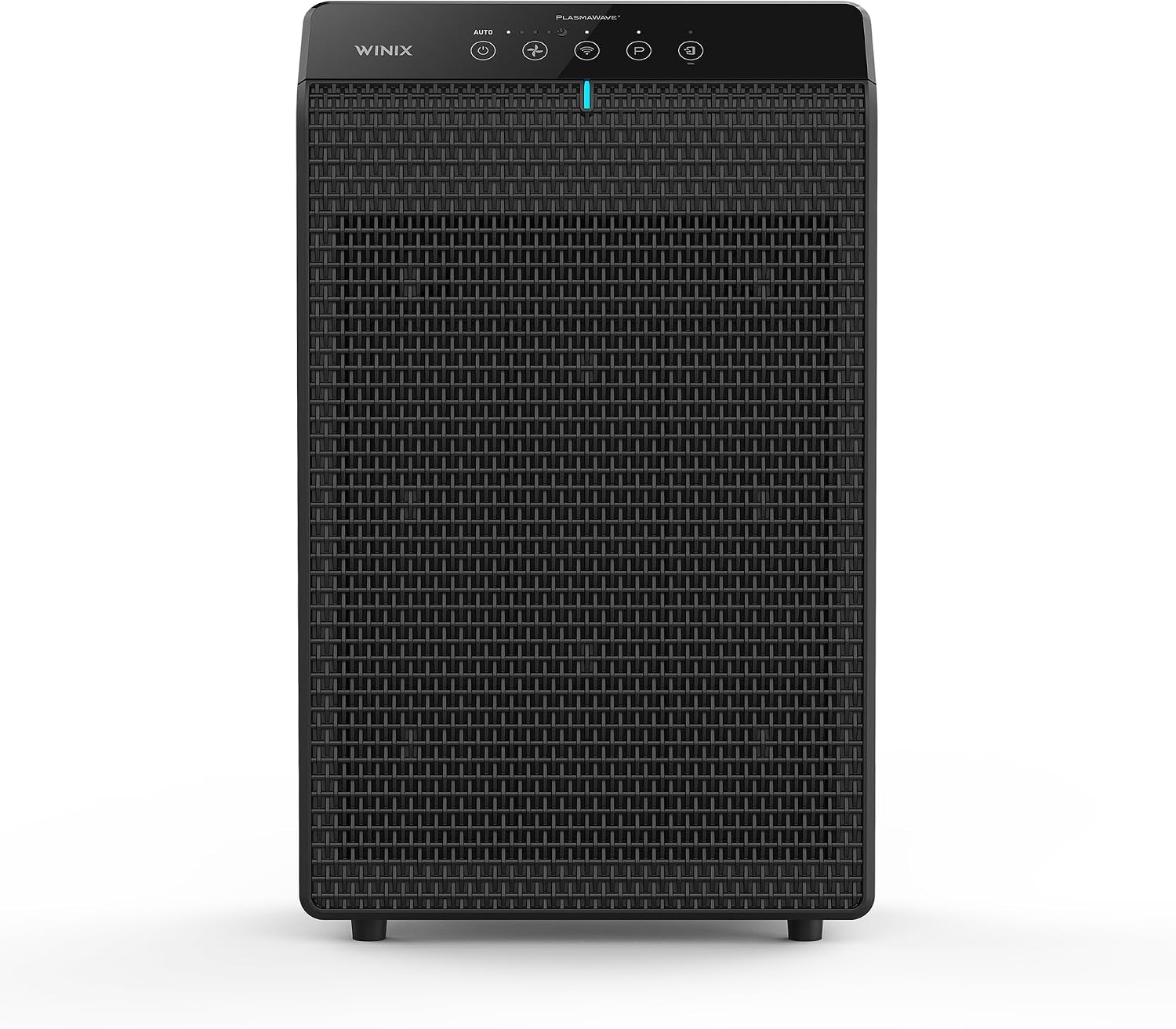
Check price on AmazonWinix 5520 owners return to the same scenario repeatedly in aggregated reviews: cooking smells — particularly from fish, garlic, and high-heat wok cooking — that a standard range hood can’t fully clear. The pattern across long-run owner reports is that the Winix’s dedicated activated carbon filter, paired with its plasma wave technology, handles residual cooking odor in ways the range hood alone doesn’t.
Two details worth pulling out for anyone making a purchasing decision:
-
The air quality sensor responds to organic molecules, not just dust. Multiple Winix 5520 owners specifically note watching the unit’s auto mode trigger during cooking — before visible smoke appears. This suggests the sensor is picking up VOC-range compounds. Healthline’s health reference coverage of volatile organic compounds notes that cooking-generated VOCs include acrolein, formaldehyde, and nitrogen dioxide — compounds a sensor calibrated for gaseous organics will catch earlier than one tracking only PM2.5 (fine particulate matter). A sensor that catches this and throttles the fan up automatically is meaningfully different from one calibrated only for particulates.
-
The carbon filter requires honest replacement cycles. Carbon adsorption sites saturate over time. Once saturated, the carbon stops capturing new molecules. Owners who note the Winix’s odor performance degrading after 6–8 months and then recovering after filter replacement are observing exactly this chemistry. Factor replacement cost into your total cost of ownership: Winix replacement filter packs run roughly $40–$60 per set, with carbon filters recommended for replacement every 3 months in high-odor environments or every 12 months in low-odor settings. Your actual cycle will land somewhere in that range depending on load.
PuroAir 240: The Litter-Box Benchmark
PuroAir
$149.99
In stock on Amazon
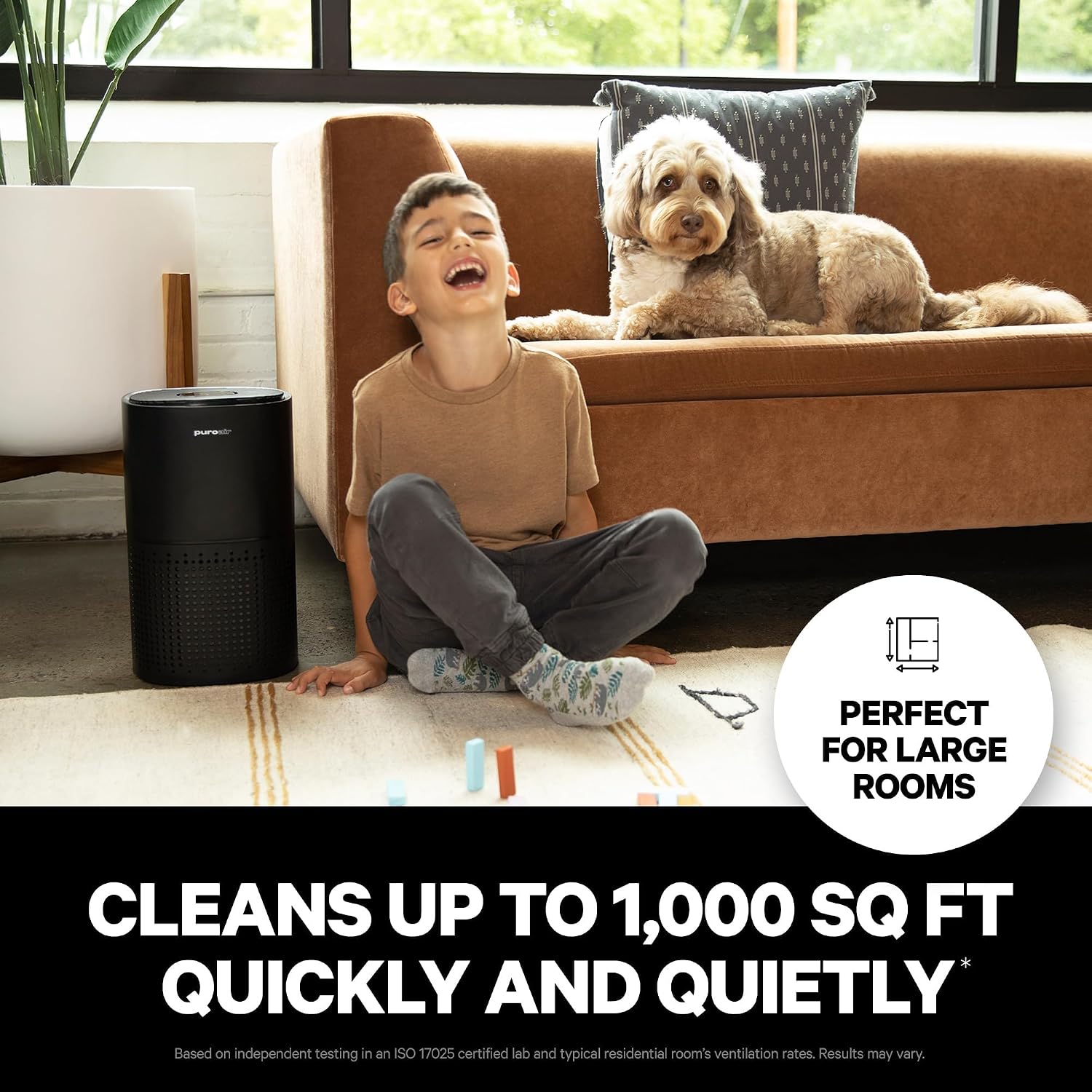
Check price on AmazonThe litter box is the standard stress test for residential odor filtration, and PuroAir 240 owners treat it as the primary use case. The pattern across aggregated reviews is consistent: units placed in rooms with one or multiple litter boxes report complete or near-complete odor elimination as the dominant outcome. This isn’t a one-off data point — it’s the most common unprompted praise in the review corpus.
Why does litter-box odor matter as a benchmark? Litter boxes produce ammonia (from urine), hydrogen sulfide, and various mercaptans — a mix of small, reactive gas molecules that challenge carbon filters more than simple cooking odors. A unit that genuinely handles this odor profile has enough carbon mass and sufficient air turnover rate (measured in ACH — air changes per hour) to stay ahead of the continuous emission source. Based on published specs and owner-reported room sizes, the PuroAir 240 appears to be hitting at least 4–5 ACH in the small-to-medium rooms where owners are deploying it for litter control. ASHRAE Standard 62.1, Ventilation for Acceptable Indoor Air Quality, identifies adequate air change rates as a key lever for contaminant dilution in occupied spaces; 4–5 ACH in a dedicated pet room represents meaningful odor management, not just marginal improvement.
The Premium Ceiling: IQAir GC Multigas XE
PuroAir
$259.99
In stock on Amazon
Check price on AmazonThe IQAir GC Multigas XE needs to be positioned explicitly as a different product category, not just a more expensive version of the units above. Where mid-range purifiers use activated carbon to adsorb common odor molecules, the GC Multigas XE uses a layered media system — multiple pounds of specialty granular media including activated carbon and impregnated alumina — designed for chemical-class gas-phase filtration. The targets include formaldehyde, nitrogen dioxide, ozone, and chlorine compounds, not just cooking smells.
The typical buyer profile here is medically motivated (chemical sensitivities, post-renovation off-gassing, occupants with reactive airways) or professionally required (labs, medical offices, print shops). If your odor problem is “the kitchen smells after stir-fry,” the GC Multigas XE is a $1,500+ solution to a $300 problem. If your odor problem is “we renovated with new cabinetry and flooring and someone in the house has formaldehyde sensitivity,” it becomes the correct specification.
Consumer Reports’ air purifier testing methodology documentation makes clear that gas-phase filtration performance is not captured in standard CADR ratings — CADR measures particle removal only. This means no CADR number tells you anything about a unit’s odor performance. You’re buying on carbon mass, media type, and owner-reported outcomes. The GC Multigas XE’s owner corpus confirms sustained chemical-odor control in contexts where nothing else worked — exactly the use case IQAir built it for.
Decision Framework: If X, Then Y
You’re either buying the wrong category of product for your odor problem, or the right one. Here’s how to route the decision:
If your odor problem is mild and intermittent (background “house smell,” occasional cooking residue, light pet presence): A mid-range unit with a genuine dedicated carbon filter — the Winix 5520 or GermGuardian AC4825 sized correctly for your room — will handle this. Budget $150–$300 upfront and $40–$80 per year in replacement filters.
If your primary use case is litter-box or persistent pet odor: The PuroAir 240 owner record is the most consistent data set for this specific application in its price tier. Size the unit for the actual room, not the maximum rated square footage on the box.
If you’re dealing with acute, severe, one-time odors (skunk, smoke intrusion, post-event remediation): Carbon filter mass matters less than ACH rate for acute events. Run whatever you have at max speed continuously for 12–24 hours. The GermGuardian AC4825 data on skunk odor shows even modest carbon can clear severe events given enough air throughput and time.
If the odor source is chemical or industrial (new construction, formaldehyde off-gassing, solvent use, medical environment): Don’t buy a standard carbon filter and expect it to perform. Specify gas-phase filtration explicitly — the IQAir GC Multigas XE is the correct product class. Budget accordingly and verify media type in the spec sheet before purchasing.
If a unit you’re evaluating does not list a separate, replaceable carbon filter: Assume it cannot control meaningful odors, regardless of marketing copy. The pattern noted across compact-unit owners applies broadly: carbon-infused HEPA layers are a checkbox feature, not functional odor control.
Frequently Asked Questions
Do all HEPA air purifiers also filter odors? No. HEPA filters capture particles — dust, pollen, pet dander, mold spores — down to 0.3 microns. Odors are gaseous molecules far smaller than this and pass through HEPA media without being captured. Only activated carbon or other gas-phase media remove odors.
How much activated carbon does a purifier need to actually eliminate pet or cooking smells? There’s no single universal answer, but owner-reported outcomes consistently suggest that less than 100 grams of carbon provides only marginal odor control. Units praised for real-world odor performance in aggregated reviews tend to carry 200 grams or more of pelletized or granular carbon. For persistent, high-load sources like litter boxes, more is always better.
Why does my air purifier remove dust but not odors? Because it almost certainly has a HEPA filter and little to no functional activated carbon. Dust is a particle; odor is a gas. The filters that capture each are physically different, and many air purifiers are optimized — and tested, per Consumer Reports air purifier testing methodology — for particle removal only.
Can an air purifier eliminate skunk smell? Based on owner-reported outcomes — including the GermGuardian AC4825 case of eliminating days-old indoor skunk odor — yes, with caveats. Skunk thiols bind well to activated carbon, as Scientific American’s coverage of adsorption chemistry explains. You need enough carbon mass, adequate ACH for the room, and continuous operation. Severe intrusion events may require 12–24 hours of sustained max-speed operation. It’s not guaranteed, but it’s documented as achievable.
What is the difference between a carbon pre-filter and a true activated-carbon filter bed? A carbon pre-filter is a thin layer — often foam or fabric with carbon dust or granules bonded to it — positioned before the HEPA filter primarily to extend HEPA filter life by capturing larger particles. A true activated-carbon filter bed is a separate, thick media layer — often pelletized or granular carbon packed in a frame — designed specifically for gas adsorption. The pre-filter contains far less carbon mass and provides far less odor control. When evaluating any unit, ask whether the carbon filter is a separate, user-replaceable component with its own replacement part number. If it’s integrated into the HEPA layer, treat odor control claims skeptically.