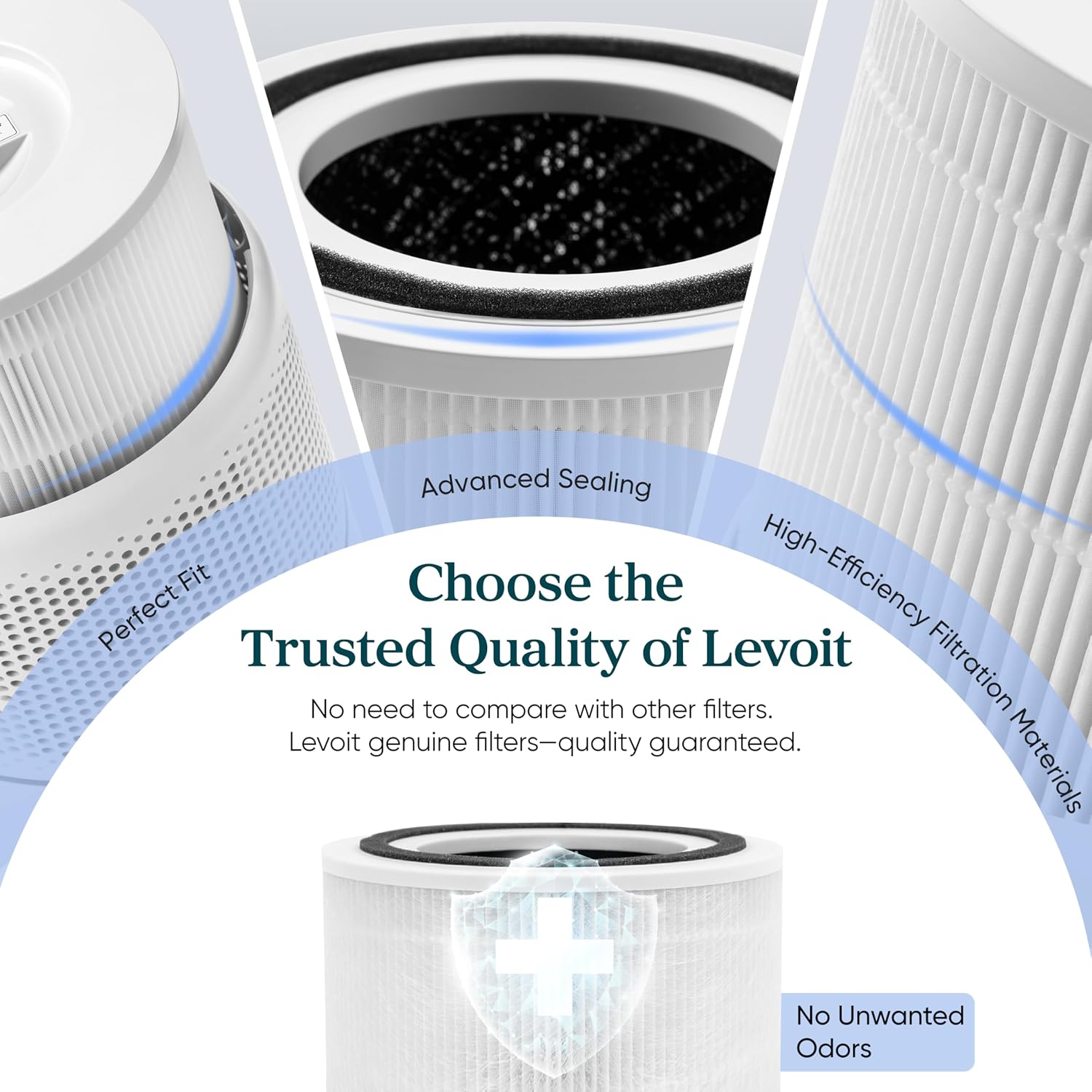
Every air purifier box carries a filter replacement timeline — typically six months to a year. That number is a manufacturer estimate built around a standardized “average home” scenario that probably doesn’t match your home. A HEPA filter (High-Efficiency Particulate Air — a physical mesh that traps particles 0.3 microns and larger, including dust, pollen, mold spores, and pet dander) degrades based on what it catches, not how long it runs. A carbon layer (the activated charcoal section that absorbs gases and odors) behaves on an entirely different clock. Understanding the gap between label claims and lived reality isn’t a minor detail — it’s the difference between budgeting $60 a year for filter replacements and actually spending $180, or between a purifier that performs and one that quietly recirculates dirty air while its indicator light stays green.
This article walks through what owners across multiple brands actually experience, where the math diverges from marketing, and how to build a smarter replacement cadence for your specific environment.
Why the Label Number Is Almost Always Optimistic
Manufacturers test filter lifespan under controlled conditions that the U.S. Environmental Protection Agency’s Guide to Air Cleaners in the Home describes as “typical residential conditions” — a specific particle concentration, a consistent run time, and a moderate room size. The problem is that “typical” is doing a lot of heavy lifting.
Owners consistently report a wide divergence based on three variables: runtime speed, ambient particle load, and whether pre-filter maintenance is happening at all.
Speed matters more than hours. A unit running on its highest CADR (Clean Air Delivery Rate — the volume of filtered air the machine produces per minute) setting continuously isn’t just moving more air; it’s loading the HEPA layer faster per hour. Blueair 211+ owners who ran their units at max speed continuously during Canadian wildfire smoke events report what amounts to filter saturation in weeks rather than months — without always flagging it in those terms. The implication is clear: a filter rated for 12 months at moderate speed may be functionally exhausted in 6–8 weeks under smoke-event conditions.
Particle load is the other lever. The EPA’s indoor air quality guidance notes that homes with multiple shedding pets, active cooking, or proximity to wildfire smoke can carry two to five times the baseline particle concentration. That multiplier applies directly to how fast the HEPA mesh clogs.
By the numbers:
| Environment | Manufacturer Claim | Reported Owner Reality |
|---|---|---|
| Single-occupant apartment, low pollution | 12 months | 12–18 months (with pre-filter cleaning) |
| Multi-pet suburban home | 12 months | 6–9 months |
| Wildfire smoke zone (seasonal max speed) | 12 months | 6–10 weeks of heavy exposure |
| Studio apartment, moderate use | 6 months | 7–8 months |
Consumer Reports’ air purifier filter cost analysis reinforces this pattern: across the models it evaluates, real-world filter replacement costs run 20–40% higher annually than the manufacturer’s suggested cadence implies, once actual usage conditions are factored in.
What Owners Are Actually Reporting, Brand by Brand
Levoit Core 300 owners offer one of the more instructive data sets available. One reviewer who cleaned pre-filters with a dry brush every two months across four separate units across different environments reports filters lasting up to three years in a lightly loaded studio — but that same cleaning routine only got two years out of a unit running under heavier continuous use. The pattern here is significant: consistent pre-filter maintenance can substantially extend HEPA life, but it’s not a magic equalizer. High particle load eventually wins.
GermGuardian replacement filter buyers have flagged a more troubling quality-control issue: multiple reviewers across aggregated product feedback note receiving replacement filters that are visibly thinner than previous orders. This isn’t a minor cosmetic complaint — filter thickness directly affects the density of the filtration media and the effective surface area available for particle capture. New York Times Wirecutter’s air purifier coverage has noted that third-party and even OEM replacement parts can vary in manufacturing consistency across production runs, and a thinner filter will load to full resistance faster, cutting functional life shorter than the label implies regardless of your environment.
AirDoctor replacement filter buyers make an interesting counterargument. Many justify the brand’s premium OEM pricing explicitly: they cite confidence that both the carbon and UltraHEPA layers are manufactured to the same spec as what shipped in the original unit. That trust premium is real — these buyers are paying for certainty that the filter will perform as designed, not betting on a third-party approximation. Whether that premium is worth it depends on your risk tolerance and how medically motivated your purchase is, but the reasoning is sound.
PuroAir 240 owners present a clean case study in TCO friction. The unit earns consistent praise for performance — its large filter surface area and CADR output at lower fan speeds draw favorable owner commentary. But a recurring note in long-run reviews is that replacement filters are “a little pricey.” That’s a soft signal worth taking seriously. When owners love the hardware but consistently flag replacement cost, it usually means the five-year total cost of ownership wasn’t part of the initial purchase decision. ASHRAE Standard 52.2’s testing methodology, which underpins CADR ratings, says nothing about ongoing filter cost — that gap is entirely on the buyer to calculate before committing.
Pre-Filter Maintenance: The Underrated TCO Lever
Pre-filter cleaning is the one maintenance action with a strong and consistent owner-reported return. A pre-filter is the outer mesh layer that catches large particles — pet hair, dust bunnies, visible debris — before they reach the HEPA layer. When that pre-filter clogs, the HEPA layer works harder and loads faster.
The Levoit Core 300 case above is instructive: the owners who reported three-year HEPA lifespans were all doing regular pre-filter maintenance. Those who weren’t were replacing HEPA filters on the standard 6-month schedule or faster.
The practical rule that emerges from aggregated owner reports: clean or vacuum your pre-filter every 2–4 weeks in a moderate environment, every 1–2 weeks in a high-load environment (multiple pets, visible dust accumulation). Do not use water on a HEPA filter itself — dampness damages the fibrous media and can promote mold growth. Dry methods only: a soft brush or low-suction vacuum pass.
Consumer Reports’ filter maintenance guidance aligns with this: it identifies pre-filter cleaning as the single most cost-effective maintenance action available to owners, with the potential to meaningfully extend HEPA filter replacement intervals.
Third-Party Filters: The Warranty and Performance Tradeoffs
This is the decision most intermediate buyers face eventually, because the math is tempting. Third-party replacement filters for popular units like the Levoit Core 300 or GermGuardian can run 30–50% below OEM pricing. The tradeoffs are real and worth naming explicitly.
Warranty exposure. Most manufacturers include language in their warranty terms stating that damage resulting from non-OEM consumables may void coverage. In practice, proving causation is difficult, but the risk is not zero — especially on higher-end units where a warranty claim could be worth several hundred dollars.
Performance variance. The GermGuardian thickness issue noted above is a real-world example of what happens when manufacturing specifications aren’t consistently maintained. A thinner filter has less filtration media. Less media means lower particle capture efficiency and faster saturation. The CADR rating on your unit is calibrated for a specific filter resistance — a filter that doesn’t match that spec changes the airflow dynamics and may reduce effective CADR.
The medically motivated buyer calculation. If air quality is managing an asthma trigger, post-surgery recovery, or immunocompromised household member, the risk-adjusted case for OEM filters is stronger. The AirDoctor buyer base’s reasoning — paying the premium because certainty about filter performance has real value — applies most directly here. If you’re running a purifier because it looks nice and reduces general dust, the third-party math is more favorable.
The EPA’s guide to home air cleaners recommends following manufacturer filter replacement guidelines and using manufacturer-specified replacement parts specifically to maintain rated performance — a position that aligns with caution on third-party substitution.
Frequently Asked Questions
How do I know when my filter actually needs replacing versus when the indicator light is just being conservative?
Indicator lights are timer-based, not sensor-based, on most units. They count run hours and signal at the manufacturer’s estimated replacement interval — not when the filter is actually saturated. A better check: hold the filter up to a light source. A HEPA filter that’s visibly gray and opaque across its surface area is loaded. Also pay attention to airflow — if your unit’s output at max speed feels noticeably weaker than when it was new, the filter is restricting air delivery. Owners running particle meters (like an AirVisual Node or similar sensor) can cross-reference: if indoor PM2.5 rises without an obvious source change, the filter is likely degraded.
Does cleaning the pre-filter regularly meaningfully extend HEPA filter life?
Yes, consistently and meaningfully. Owner-reported data across multiple brands shows pre-filter maintenance extending HEPA life by 30–100% in moderate environments. The mechanism is simple: a clean pre-filter lets the HEPA layer catch only fine particles, which are its actual job. Without pre-filter maintenance, the HEPA layer does double duty and loads faster.
Will third-party filters void my warranty or hurt performance?
Both risks are real but not absolute. Warranty language in most major brands reserves the right to deny claims for damage related to non-OEM parts — read your specific warranty before switching. Performance variance in third-party filters is well-documented, particularly in thinner or lower-density versions. For allergy management or medically driven use, OEM is the safer call. For general-purpose household use, a reputable third-party filter from a verified seller carries lower risk.
Why did my new filter look different or thinner than my previous one?
Manufacturing consistency in filter media is not uniform across production runs, even within the same brand. The GermGuardian feedback is a clear example — multiple buyers flagged visible thickness differences in successive orders. If your replacement filter looks noticeably different (thinner, less dense, different color of media), that’s a legitimate quality concern worth raising with the retailer or manufacturer. A thinner filter will saturate faster, regardless of what the label says.
How much faster do filters wear out during wildfire season or in a multi-pet home?
Wildfire smoke is the most acute accelerant. Owners running units at max speed during active smoke events effectively compress months of normal particle loading into days or weeks. A filter rated for 12 months under standard conditions may need replacement after a single prolonged smoke event. Multi-pet homes with two or more shedding animals typically see filter life reduced by 30–50% relative to label claims, even with regular pre-filter maintenance. Budget accordingly: if you’re in a wildfire-prone region, keep a spare filter on hand before fire season, not during it.
The Decision Frame
If you’re managing a single moderate-use environment with consistent pre-filter cleaning, manufacturer replacement intervals are a reasonable starting point — calibrate toward the longer end and use airflow and particle count as your actual signal.
If you’re in a high-load environment — multiple pets, wildfire exposure, urban particulate, or medically motivated use — halve the manufacturer estimate and build a filter budget that reflects actual conditions. For a unit like the PuroAir 240 where filter cost is already a noted friction point, that math shift may change the TCO calculus enough to favor a different unit with lower per-filter cost.
If your purchase is medically motivated or you’re specifying for a commercial environment where documented clean-air delivery matters, third-party filters introduce unnecessary uncertainty. Pay the OEM premium, log your replacement dates, and treat filter cost as a fixed operating line item — not a variable to optimize away.
The label is a starting point. Your environment writes the actual schedule.