If you’ve ever woken up at 3 a.m. with a swollen throat or spent a full spring afternoon sneezing inside your own living room, you already understand the core problem: outdoor allergens don’t stop at the front door. An air purifier is exactly what it sounds like — a device that pulls room air through one or more filters to trap the particles that trigger allergy and asthma symptoms. The most important filter type is a HEPA filter (High-Efficiency Particulate Air), a mechanical filter rated to capture at least 99.97% of airborne particles as small as 0.3 microns — small enough to catch pollen, pet dander, dust mite debris, and mold spores. The number that tells you how fast a purifier cleans a room is the CADR (Clean Air Delivery Rate), measured in cubic feet per minute. This guide cuts through the spec-sheet noise to show you what allergy and asthma patients actually report, what the tradeoffs look like in real dollars, and how to match the right machine to your specific situation.
| EDITOR'S PICK[Coway Airmega AP-1512HH(W) True](https://www.amazon.com/dp/B01728NLRG?tag=greenflower20-20)… | Mid-tier[GermGuardian 5-In-1 HEPA Air Pu](https://www.amazon.com/dp/B00895ICIK?tag=greenflower20-20)… | Budget pick[GermGuardian HEPA Air Purifier](https://www.amazon.com/dp/B004VGIGVY?tag=greenflower20-20)… | |
|---|---|---|---|
| Filter Type | True HEPA | HEPA | HEPA |
| Coverage | — | 743 Sq. Ft. | — |
| UV-C Light | — | ✓ | — |
| Timer | ✓ | — | — |
| Auto Mode | ✓ | — | — |
| Filter Indicator | ✓ | — | — |
| Price | $149.99 | $95.75 | $76.69 |
| See on Amazon → | See on Amazon → | See on Amazon → |
What Real Patients Are Reporting — and Why It Matters More Than Lab Numbers
Published spec sheets will tell you a unit has a CADR of 200 cfm and covers 400 square feet. They will not tell you whether a parent’s toddler stopped waking up with itchy eyes, or whether a cat-allergic partner was finally able to share a home with the cat. Aggregated owner feedback — synthesized across thousands of verified purchasers — tells a different story than spec comparisons alone, and for allergy buyers, that story is the decision.
The pattern across owner reviews in this category is striking in its consistency:
GermGuardian AC4825 and AC5350 series: Owners with severe seasonal pollen reactions and smog sensitivity repeatedly describe doing extensive research before purchase, then reporting meaningful, noticeable symptom reduction — particularly in bedrooms. The caveat that appears just as consistently: on maximum speed, multiple owners describe the sound as “a typhoon in the room.” This is not hyperbole — at high CADR settings, GermGuardian units measure in the 55–65 dB range per the manufacturer’s own published acoustics data. For a bedroom allergy sufferer who needs the unit on all night, that’s a real constraint. The practical workaround owners land on: run it on high for 30–45 minutes before bed to bring particulates down, then drop to medium or low for sleep.
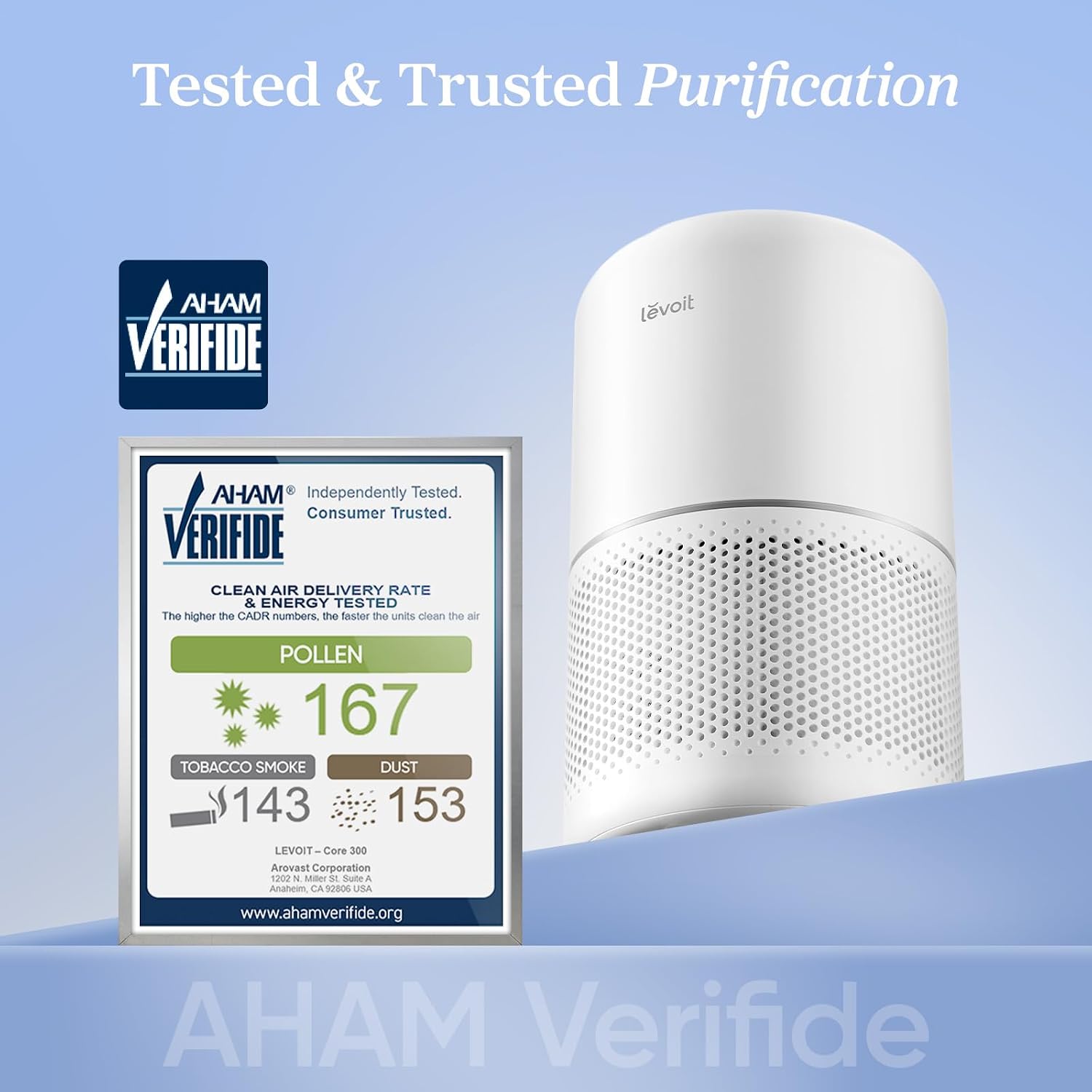
Levoit Core 300 and Core 400S: The quieter-than-a-fan-on-low comparison comes directly from owners using these units for nighttime allergy and asthma relief, and it holds up against published noise ratings — Levoit lists sleep mode at 24 dB for the Core 300, which puts it near the threshold of ambient room noise. One owner documented a case that underlines how high the stakes can be in this category: a dog with a veterinarian-confirmed severe dust mite allergy — producing full-body yeast infection and hair loss — showed measurable improvement after a Levoit unit was placed in the room where the dog slept. If a purifier moves the needle on that severity of allergic response, the mechanism is real. Per Healthline’s overview of HEPA filtration and allergen exposure, consistent reduction of airborne dust mite debris is clinically associated with symptom reduction in both human and animal subjects.
Pure Enrichment PureZone Elite: The emotionally specific claim from one owner says it directly: the unit enabled a cat-allergic partner to live comfortably with the cat they’d otherwise have had to rehome. That’s a high bar — pet dander is a particularly sticky allergen that settles on surfaces and recirculates continuously. The EPA’s Guide to Air Cleaners in the Home notes that while no purifier eliminates settled surface allergens, continuous operation in a room where a pet spends significant time can meaningfully reduce the airborne fraction that drives acute reactions.
Coway AP-1512HH (Mighty) and Airmega series: The COPD-motivated buyer switching to Coway is notable for a reason that goes beyond product preference — the previous brand’s filters became unreliable to source. Supply chain risk is a real, underappreciated factor for medically dependent buyers. If you or a family member needs the unit running (not just prefers it), filter availability is a tier-one purchasing criterion, not an afterthought. Coway’s filter ecosystem is among the most broadly distributed in North America as of mid-2026, available through major retail and direct channels. Consumer Reports’ 2025 air purifier ratings consistently place Coway in the upper tier for both filtration performance and long-term owner satisfaction.
Winix 5500-2 and HR900: Multiple owners cite the auto mode air quality indicator — specifically the color shift from blue (clean) to red (pollutant detected) and back to blue — as providing visible, satisfying proof that the unit is actually responding to real conditions. This isn’t just a comfort feature; for an allergy buyer who’s spent years dealing with invisible triggers, seeing the machine react to cooking smoke, a pet entering the room, or an open window is functionally reassuring. Per the New York Times Wirecutter’s 2025 air purifier coverage, Winix auto mode performance is considered among the most reliable in the sub-$300 tier.
The Math That Changes the Decision: Noise, CADR, and 5-Year Filter Cost
The three variables that actually drive allergy buyer outcomes are rarely weighed together. Here’s what the numbers look like side by side:
By the Numbers — Mid-Range Allergy Purifiers (2026 market pricing)
| Unit | CADR (dust, cfm) | Noise on High (dB) | Annual Filter Cost | 5-Year Filter TCO |
|---|---|---|---|---|
| GermGuardian AC4825 | ~100 | ~55 dB | ~$35 | ~$175 |
| Levoit Core 400S | ~260 | ~52 dB | ~$50 | ~$250 |
| Winix 5500-2 | ~243 | ~55 dB | ~$60 | ~$300 |
| Coway AP-1512HH | ~246 | ~53 dB | ~$55 | ~$275 |
| Pure Enrichment PureZone Elite | ~150 | ~50 dB | ~$45 | ~$225 |
Sources: Manufacturer published specs; filter pricing from major retail channels as of Q2 2026. CADR figures are manufacturer-rated; independent lab results may vary by 5–15%.
The insight this table surfaces: the GermGuardian’s lower filter cost looks attractive at entry, but its CADR-per-decibel ratio is the weakest in the group. If you need performance and quiet — the actual allergy-bedroom constraint — spending $30–$50 more per year on filters to get a Coway or Winix pays back in usability.
For COPD or severe asthma buyers stepping up to the $500–$1,200 tier, the IQAir HealthPro Plus (CADR ~300 cfm, HyperHEPA filtration rated to 0.003 microns) and the Blueair Pro series represent a different category of commitment. IQAir’s filter replacement cost runs approximately $200–$350 per year depending on usage; over five years, you’re looking at $1,000–$1,750 in consumables on top of the unit price. That’s not a reason to avoid them — for a buyer with documented reactive airway disease or COPD, the filtration depth matters. It’s a reason to build the TCO into the decision explicitly.
Supply Chain Risk: The Factor Allergy Buyers Miss
The Coway COPD case bears more examination. The buyer’s previous unit didn’t fail. The filters became unreliable to source — and for someone dependent on the machine for respiratory function, that’s equivalent to product failure.
This is a real, growing risk in the air purifier category. Several mid-tier brands that had strong 2021–2023 U.S. market presence have seen filter supply interrupted by import logistics shifts, retailer delisting, or manufacturer consolidation. Before committing to any unit for a medically critical application, verify:
- Filter availability across at least two independent channels (not just one retailer)
- Filter model longevity — has this exact filter been in production for 3+ years?
- Generic/compatible filter availability — for brands like Winix and Coway, aftermarket options are well-established and generally validated; for proprietary systems like IQAir, you’re locked to OEM supply
The EPA’s guidance on air cleaner maintenance notes that a HEPA filter running past its replacement interval can become a particulate source rather than a sink. For allergy buyers, an unavailable filter isn’t just an inconvenience — it’s a health event.
Frequently Asked Questions
Will an air purifier actually reduce allergy medication needs, or are the benefits just comfort-level improvements?
Both outcomes are real, and the research supports both. Per Healthline’s overview of air purifiers and allergy management, consistent reduction of indoor airborne allergen load is associated with decreased symptom severity in clinical studies — some participants report reduced need for antihistamines or rescue inhalers over time. That said, purifiers work on airborne particles only; settled allergens on bedding, carpet, and upholstery require separate intervention. Owners who combine purifier use with allergen-proof mattress covers and regular HEPA vacuuming report the strongest medication-reduction outcomes.
How long does it take to notice a difference in allergy symptoms after starting an air purifier?
Most owners reporting symptom improvement describe noticing a change within 2–7 days for acute symptoms (congestion, eye irritation) in the room where the purifier runs. Full benefit for chronic symptoms — especially dust mite or pet dander driven — typically takes 2–4 weeks of continuous operation, because the unit needs time to pull down the cumulative allergen load in the room’s air and on nearby surfaces through repeated air cycling.
Does running a purifier in one room help with allergies in other parts of the house?
Minimally. Air purifiers are room-specific devices — the CADR rating applies to the room where the unit sits. Per the EPA’s Guide to Air Cleaners in the Home, placing the unit in the room where you spend the most time (typically the bedroom, given 7–8 hours of sleep exposure) delivers the most clinical benefit. If whole-home coverage is the goal, HVAC-integrated solutions like the Aprilaire 5000 or Lennox PureAir S are the appropriate category.
Can an air purifier help with a pet’s allergies, not just the owner’s?
Yes — the Levoit case involving a dog with severe dust mite allergy is a documented example, and it follows logically: pets breathe the same indoor air humans do, and share the same vulnerability to high airborne allergen concentrations. Veterinary allergists increasingly recommend HEPA filtration in homes with allergy-diagnosed pets, particularly in the rooms where the animal sleeps.
Is a purifier with auto mode better for allergy sufferers than a manually controlled unit?
For most allergy buyers, yes — with a specific caveat. Auto mode units (Winix, Coway, Levoit 400S) use onboard particle sensors to increase fan speed when airborne particle counts rise, then reduce speed (and noise) when the air clears. This means you get high-CADR response to real-time triggers — an open window during high-pollen conditions, a pet entering the room — without manual intervention. The caveat: some onboard sensors are more sensitive to PM2.5 (fine particles) than to larger allergen particles like pollen. The Winix color indicator owners describe is responding primarily to fine particulate matter. For most allergy sufferers, this is still highly useful; for buyers whose trigger is specifically large-particle allergens, confirm the sensor’s particle size sensitivity range in the published specs before relying on auto mode as your primary strategy.
The Decision Rule
If your primary constraint is bedroom quiet + consistent overnight filtration, the Levoit Core 400S or Coway AP-1512HH are the clearest fits — both deliver CADR above 240 cfm at noise levels that don’t disrupt sleep, with well-established filter supply chains.
If your constraint is pet allergen in a shared living space, prioritize continuous operation in the room where the pet spends the most time, combine with surface allergen control, and treat filter replacement as a non-negotiable calendar item — not an optional maintenance task.
If you or a family member has COPD, severe asthma, or physician-documented respiratory vulnerability, filter supply chain resilience and filtration depth (true HEPA at minimum, HyperHEPA for IQAir) move to the top of the criteria stack — above price. The TCO math changes when the alternative to a working purifier is a health event.
The noise-versus-CADR tradeoff is real and is where most allergy buyers make their most consequential mistake — choosing a unit that can clean the room quickly but only when run at a speed that prevents them from sleeping. Match the CADR you need to the noise level you can tolerate, and verify both figures in the same published source before you buy.