If you’ve ever woken up the morning after a big stir-fry session and felt like your bedroom was marinating in sesame oil, you already understand the problem. Cooking generates two distinct categories of indoor pollution: particulate matter (tiny solid and liquid particles — think visible smoke and grease aerosols) and VOCs, or volatile organic compounds (the invisible chemical odor molecules that linger long after the pan cools). A standard HEPA filter — the dense fiber mesh that catches particles down to 0.3 microns — is excellent at the first category. It does almost nothing about the second. That’s why an air purifier that works beautifully for dust and pet dander can completely fail in a kitchen context. This guide focuses specifically on what the filter stack, the carbon load, and the auto-sensor behavior need to look like if your primary enemy is cooking odors and smoke — and which models hold up under daily real-world cooking pressure.
| EDITOR'S PICK[LEVOIT Air Purifiers for Home L…](https://www.amazon.com/dp/B0BGPF71Q6?tag=greenflower20-20) | Mid-tier[PuroAir 240 HEPA Air Purifiers…](https://www.amazon.com/dp/B0B286BFZQ?tag=greenflower20-20) | Budget pick[LEVOIT Air Purifier for Home Al…](https://www.amazon.com/dp/B07VVK39F7?tag=greenflower20-20) | |
|---|---|---|---|
| Coverage | 1733 ft² | 1000 ft² | 1073 ft² |
| Filter type | 3-in-1 HEPA | HEPA + CarbonTech | 3-in-1 HEPA |
| Smart features | ✓ | ✗ | ✗ |
| Auto mode | ✓ | ✓ | — |
| AHAM verified | ✓ | ✗ | ✓ |
| Price | $181.93 | $149.99 | $79.98 |
| See on Amazon → | See on Amazon → | See on Amazon → |
Why Most “Good” Air Purifiers Underperform in Kitchens
The core mismatch is carbon quantity. Activated carbon — a highly porous form of carbon that traps gas molecules through a process called adsorption — is the only passive filtration technology that meaningfully captures VOCs and odor compounds. Almost every air purifier on the market includes some activated carbon. The problem is that budget and mid-range units often use a thin carbon mesh or a few grams of loose granules, enough to absorb light background odors but nowhere near sufficient for heavy daily cooking loads. Per Consumer Reports’ air purifier buying guide, the meaningful threshold for odor control is substantial activated carbon weight — typically measured in pounds, not grams — and most sub-$150 units don’t get close.
The EPA’s guidance on indoor air quality and cooking notes that gas cooking specifically releases nitrogen dioxide and fine particulates at concentrations that can exceed outdoor air quality standards within minutes of burner ignition. Frying in oil adds a complex mix of aldehydes and acrolein to the mix. The takeaway: kitchen air is genuinely challenging chemistry, not just a mild odor problem.
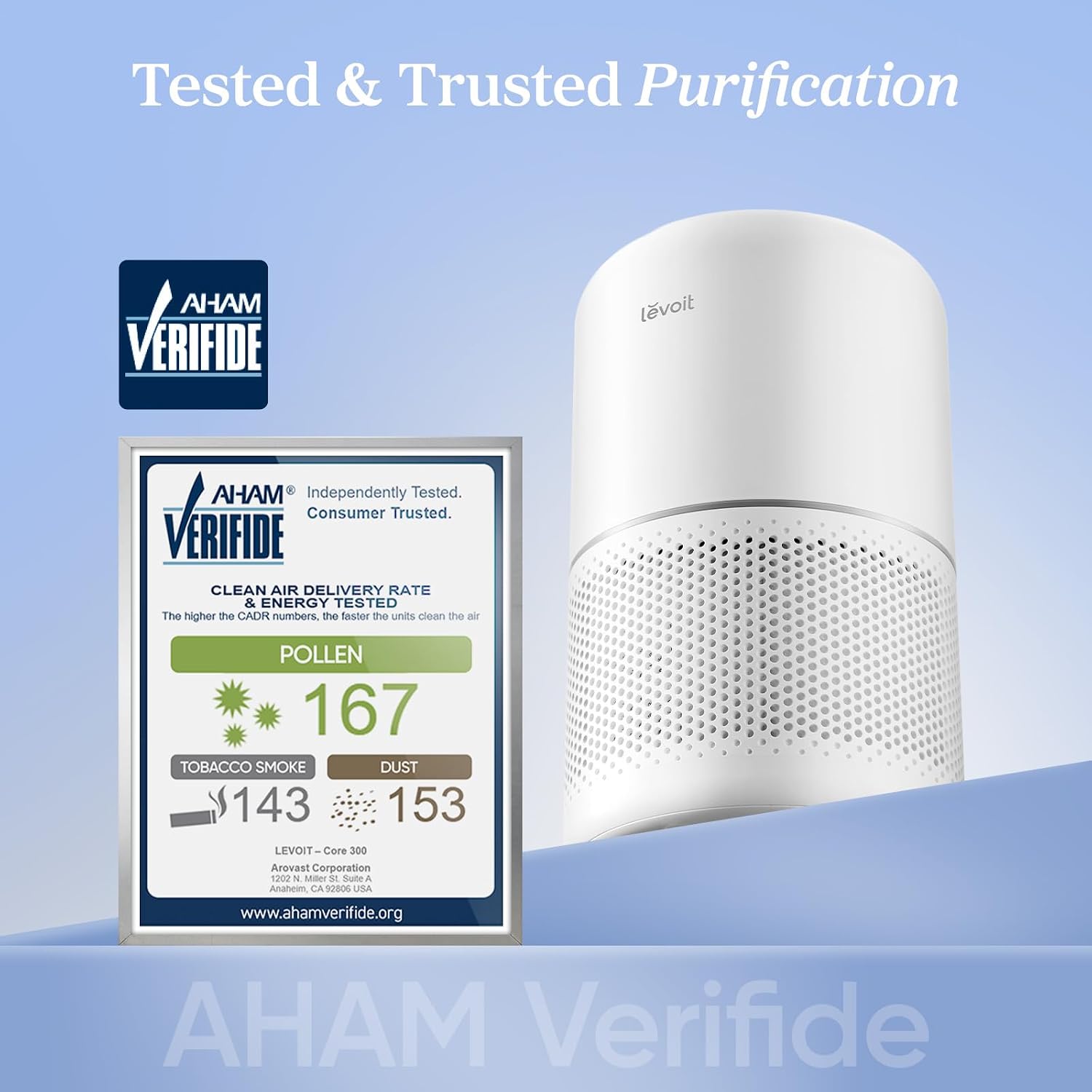
There’s a second failure mode: CADR mismatch. CADR (Clean Air Delivery Rate) is the standardized metric — set by the Association of Home Appliance Manufacturers — that measures how much filtered air a unit delivers per minute. Most open-concept kitchen/living spaces run 400–800 square feet. A purifier with a smoke CADR of 150 is technically “sufficient” for a 250-square-foot bedroom. Drop it into an open-concept 600-square-foot space and you’re running continuous source pollution against a unit that was never sized for the room. The math doesn’t work.
The third variable — sensor responsiveness — is the one most buyers overlook until they own the product. Several reviewers across brands report watching their purifier’s auto mode visibly kick fan speed up during active cooking without any manual intervention, which is exactly the behavior you want. That real-time response requires a PM2.5 sensor (particulate matter sensor rated at 2.5 microns) and ideally a VOC sensor built into the unit. Without both, auto mode is essentially guessing.
The Spec Framework That Actually Matters for Kitchens
Before naming specific units, here’s the decision matrix worth applying:
By the numbers — kitchen-use filter spec minimums:
| Spec | Minimum for kitchen use | Why it matters |
|---|---|---|
| Activated carbon weight | 1+ lb (ideally 3–5 lb) | More carbon = longer saturation time before odors break through |
| Smoke CADR | ≥ 0.67× room sq footage | AHAM’s sizing guideline; bump 1.5× for open-concept |
| Sensor type | PM2.5 + VOC | Enables meaningful auto-mode response to both smoke and odors |
| Pre-filter access | Washable or cheap-replace | Grease aerosols hit the pre-filter hardest; clogging here tanks airflow |
That last row deserves more attention than it gets. No reviewer in the aggregated feedback patterns mentions pre-filters clogging quickly from grease — but this is a known real-world failure mode. Grease aerosols are sticky and hydrophobic. Over time they coat pre-filter fibers, restrict airflow, and cause the unit to underperform even when the HEPA and carbon layers still have capacity left. If you’re frying daily, budget for pre-filter inspection every 4–6 weeks and replacement more frequently than the manufacturer’s annual recommendation.
Models Worth Knowing at Each Kitchen-Use Tier
Apartment and Smaller Kitchen Spaces (Up to ~350 sq ft)
The LEVOIT Core 300 has built a strong reputation specifically for kitchen odor control in apartment settings. Owners consistently report that the unit keeps bedrooms and adjacent living areas from absorbing heavy cooking smells — one frequently cited pattern in long-run reviews describes daily heavy cooking that used to leave the whole apartment smelling like a fry joint, with the Core 300 effectively interrupting that spread. The caveat: LEVOIT’s standard carbon filter uses a modest carbon layer, and owners doing serious high-heat frying report the filter needing replacement in 3–4 months rather than the rated 6. The VortexAir Technology 360° intake design is a genuine advantage in smaller kitchens where placement is constrained.
The LEVOIT Core 200S-P extends that track record with smart app integration. The “P” variant includes a pet-allergen-focused filter with enhanced carbon, which, counterintuitively, also performs better for cooking odors than the standard filter stack. Owners specifically cite cooking odors and frying smoke as the top reason they recommend it to apartment dwellers — smells that used to linger for hours are described as resolving within 20–30 minutes of the unit running on high. App control via the VeSync platform is functional, though Healthline’s overview of air purifier features for cooking applications notes that VOC auto-response is limited without a dedicated gas sensor, which the Core 200S-P lacks.
Mid-Range Open-Concept Spaces (350–600 sq ft)
The Winix 5520-E earns consistent high marks specifically for speed of reaction to cooking odors. Reviewers describe it as “fast acting” — a characterization that aligns with the unit’s PlasmaWave technology (a form of bipolar ionization that breaks down gaseous pollutants) combined with a HEPA and carbon stack. The auto mode behavior is a genuine differentiator here: multiple owners report the unit visibly increasing fan speed during active cooking without manual input, validating that the onboard sensor is actually detecting the event rather than just cycling on a timer. Wirecutter’s air purifier coverage notes Winix’s sensor responsiveness as above average in its category.
The tradeoff: PlasmaWave generates trace ozone as a byproduct of its ionization process. The EPA’s indoor air quality guidance flags ozone as a respiratory irritant. Winix allows PlasmaWave to be disabled, running the unit as a pure HEPA/carbon system, which is the configuration most practitioners recommend for kitchen-adjacent use.
Heavier Carbon Load for Daily Frying (Any Size Room, Carbon-Priority)
The PuroAir 240 and PuroAir 400 have accumulated documented performance data around cigarette smoke — a meaningful proxy for stubborn cooking odors because cigarette smoke VOCs are chemically dense and persistent in similar ways. Owners report clearing active cigarette smoke in small rooms, which suggests the carbon layer has meaningful capacity. The 400 is specifically sized for larger open-concept spaces and uses a higher-volume carbon bed than most competitors in its price range. For households where daily frying is the norm rather than the exception, the PuroAir line’s carbon architecture is a more durable choice than thin-carbon units that saturate quickly.
When to Step Up to HVAC-Integrated Solutions
If your kitchen is the architectural center of a large open-concept floor plan — or you’re managing a boutique hotel kitchen, a yoga studio with adjacent food prep, or a clinic breakroom — standalone portable units start running into physics. No portable purifier can adequately address a space where the cooking source is continuously producing both particulates and VOCs faster than a single unit can process them. Systems like the Aprilaire 5000 (whole-home HEPA-grade HVAC integration) or RGF Environmental REME HALO (in-duct photohydroionization for VOC and odor reduction) operate at a fundamentally different capacity level. They treat the entire air volume of the home on every HVAC cycle. The REME HALO specifically targets VOCs and odor compounds through its photohydroionization process, which is directly applicable to cooking odor chemistry. These systems are installer-coordinated and involve meaningful upfront cost, but the five-year total cost of ownership — factoring in eliminated portable filter replacements and whole-home coverage — frequently closes the gap with a fleet of mid-range portables.
Frequently Asked Questions
Can an air purifier actually remove cooking odors, or does it just mask them? It removes them — specifically, activated carbon adsorbs (chemically binds) odor molecules rather than masking them with fragrance. HEPA handles the particulate smoke. The caveat is that carbon has finite capacity; once saturated, it releases those molecules back into the air, which is why filter replacement timing matters.
Should I run the purifier on high while cooking or let auto mode handle it? If your unit has a VOC sensor driving auto mode, let it work — reviewer patterns confirm that well-designed auto modes visibly respond to cooking events. If your unit only has a PM2.5 sensor (particle-only), manually switch to high at the start of cooking, because odor VOCs may not trigger the auto response until visible smoke is already present.
How quickly do carbon filters get saturated with heavy cooking smells — will I need to replace them more often? Yes, meaningfully more often than the manufacturer’s estimate if you cook heavily. Thin-carbon units (under 100g of carbon) may saturate in 3–4 months under daily frying conditions versus the rated 6–12 months. Budget for this in your TCO calculation.
Is one large purifier better than two smaller ones for an open-concept kitchen/living area? Generally yes. One properly sized unit — CADR at 1.5× your square footage for kitchen use — delivers more consistent air turnover than two undersized units fighting dead-air zones. The exception is a very elongated floor plan where a single central unit can’t reach both ends.
Does a purifier near the kitchen help with grease residue on surfaces? Indirectly and partially. A purifier captures grease aerosols before they deposit, which reduces (not eliminates) surface accumulation over time. It doesn’t clean what’s already settled. Source control — range hood venting to the exterior — remains the primary defense against grease surface buildup.
Are there any purifiers with enough carbon capacity to handle daily frying without filter changes every few months? The PuroAir 400 and the IQAir HealthPro Plus (which uses a granular carbon/mineral media bed rated at several pounds of capacity) are the strongest candidates in the portable category. HVAC-integrated VOC systems like the REME HALO don’t use consumable carbon at all — their media cells last 2+ years. For daily serious frying, the honest answer is that portables require acceptance of accelerated filter costs or a move to integrated systems.
The Decision Rule
If your primary concern is apartment-scale cooking odors and you want a set-and-forget auto mode → the LEVOIT Core 200S-P or Winix 5520-E (PlasmaWave off) represents the best balance of sensor responsiveness and carbon capacity at their price points.
If you’re running a larger open-concept space with heavy daily frying → prioritize carbon volume over brand loyalty; the PuroAir 400 or a unit with a documented multi-pound carbon bed is the correct choice, and budget 3–4× the annual filter cost the box claims.
If you’re managing a commercial kitchen-adjacent space or a whole-home scenario where portable units are clearly undersized → the conversation shifts to HVAC-integrated systems, and the ROI math on Aprilaire or REME HALO installation closes faster than most buyers expect when they model the five-year filter and maintenance savings against a fleet of portables.
The range hood is your first line of defense — no purifier substitutes for exterior venting at the source. The purifier handles what escapes. Size for the room, prioritize carbon weight, watch the auto-mode sensor spec, and plan your filter budget honestly. That’s the framework.