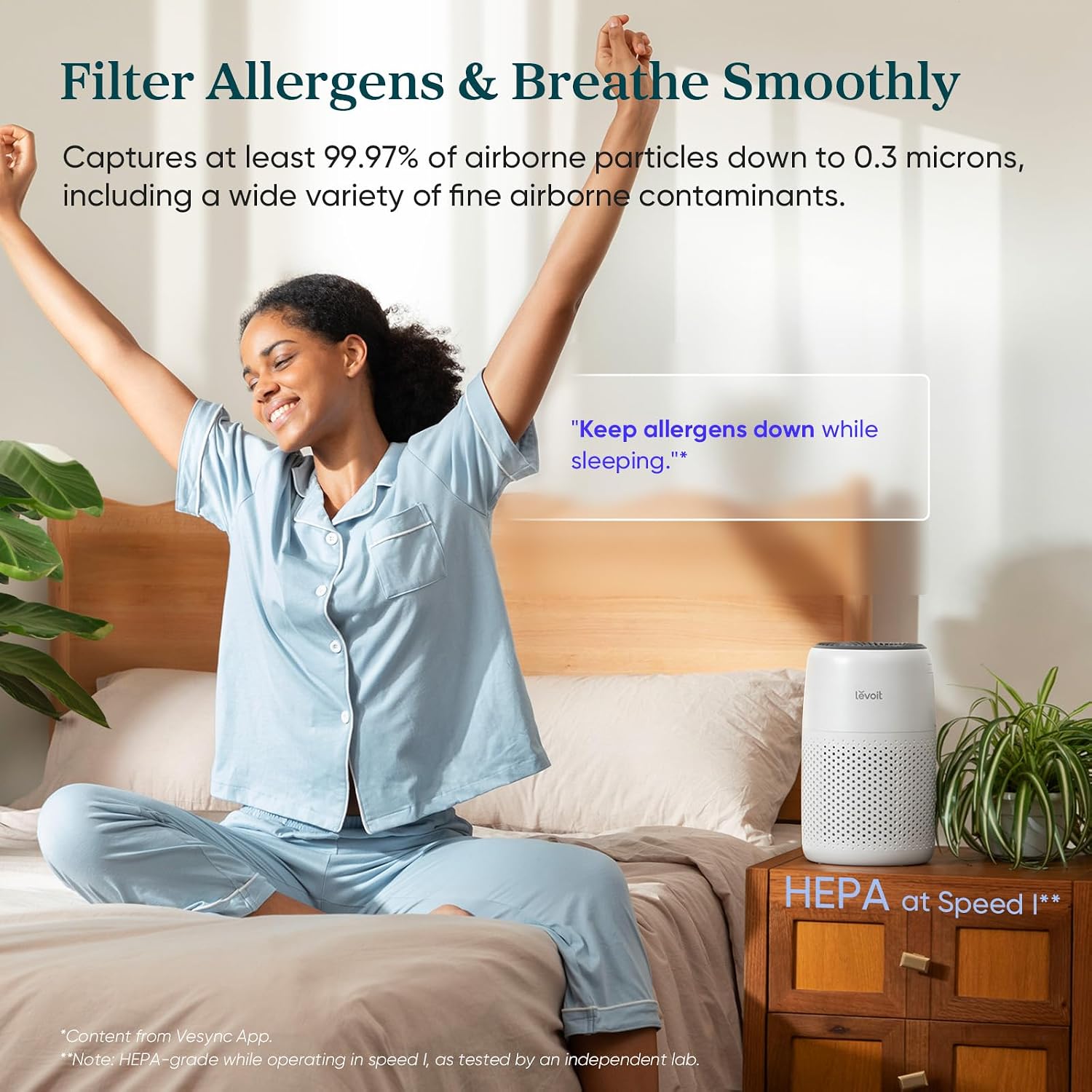
If you’ve ever caught a whiff of your neighbor’s cooking — or something stronger — drifting through the wall and wondered whether there’s anything you can do about it without calling your landlord, you’re in exactly the right place. A portable air purifier is a plug-in appliance that pulls room air through a series of filters, captures particles and some gases, and returns cleaner air to the room. No drilling, no lease violations, no security deposit at risk. The most effective ones use a HEPA filter — High-Efficiency Particulate Air, a standardized filter type that captures at least 99.97% of particles 0.3 microns in diameter — paired with an activated carbon layer that adsorbs (traps onto its surface) odors and volatile organic compounds. Understanding those two layers is most of what you need to shop smartly. This guide will walk you through the real renter use cases, the tradeoffs that actually matter, and a clear decision framework for whatever situation you’re in right now.
The Renter Use Cases That Actually Drive These Purchases
Manufacturer marketing tends toward generic claims — “cleaner air for your family!” — but the purchase stories from real apartment dwellers are far more specific, and more useful as a decision framework.
Shared-duct smoke and odor infiltration. One of the most commonly described scenarios among ADU (accessory dwelling unit) and garden-apartment renters is exactly this: smelling marijuana, cigarette smoke, or cooking odors coming through shared ventilation ducts from an adjacent unit or main house. The EPA’s Introduction to Indoor Air Quality document is candid that infiltration through shared HVAC systems is one of the harder IAQ problems to solve at the source — you can’t control what your neighbor burns. A purifier won’t seal the duct, but a unit with a substantial activated carbon bed placed near the vent or the primary living area can meaningfully reduce the concentration of those odor molecules before you’re breathing them. The key word is reduce, not eliminate — more on that realistic expectation in the FAQ.
Pet dander when someone visits — or moves in. Among the most emotionally resonant real-world reviews comes from PureEnrichment PureZone owners: one renter described a partner with severe cat allergies finally being able to spend time in her apartment because of consistent purifier use. Pet dander particles are large enough that a true HEPA filter catches them readily; the more important variable is whether the unit’s CADR (Clean Air Delivery Rate — a standardized cubic-feet-per-minute measure of how fast a purifier cleans a room) is matched to the room size where the cat actually lives.
Creative use cases renters don’t advertise. Purivortex owners report using compact purifiers next to 3D printers in small home offices or studios to capture the volatile fumes that off-gas during printing — a genuinely smart application of activated carbon filtration in a rented space where you can’t install ventilation hoods. It’s a good reminder that the “renter use case” isn’t just dust and pet hair; it’s any situation where you need air quality intervention without infrastructure.
Aesthetics as a real purchase driver. Here’s something that shows up repeatedly in small-space reviews and rarely in spec sheets: multiple buyers explicitly cite the appearance of the unit — “doesn’t look ugly,” “blends in with my decor” — as a meaningful factor. In a carefully decorated studio or one-bedroom, a hospital-gray appliance squatting on the floor reads as an intrusion. Manufacturers have noticed. The LEVOIT Core 300 series and the Coway Airmega AP-1512HH (the “Mighty,” as it’s widely known) are frequently called out by apartment owners for having clean, unobtrusive profiles. This isn’t vanity; it’s the practical reality that a purifier you find ugly gets put in a closet and stops working.
The Room-by-Room Expansion Strategy Most Renters Land On
Here’s a pattern that emerges clearly from aggregated reviews of compact units: renters who buy a LEVOIT Core 300 for their bedroom frequently come back to buy a second or third unit for the living room and home office rather than replacing the first with a larger unit. This isn’t accidental — it reflects a real tradeoff.
By the numbers:
| Approach | Upfront cost | Coverage | Flexibility |
|---|---|---|---|
| One large unit (CADR ~300 CFM) | $180–$350 | Whole open-plan space | Low — fixed location |
| Two compact units (CADR ~140–180 CFM each) | $120–$240 total | Two separate rooms | High — move them |
The room-by-room strategy wins on flexibility for renters specifically because you’re not in a permanent space. When you move, two small units adapt to whatever the next floor plan looks like. A single large unit sized for 600 square feet may be oversized for your next studio or undersized for your next two-bedroom.
The practical rule from Wirecutter’s air purifier coverage: match the unit’s CADR to roughly two-thirds of the room’s square footage for effective air changes. A 150-square-foot bedroom needs a CADR of about 100 CFM — well within a compact unit’s range. A 400-square-foot open-plan living area needs CADR in the 250–300 range, where a single mid-size unit earns its keep.
Noise, Sleep, and the Speed Setting You’ll Actually Use
LEVOIT Core 200S-P reviewers — particularly the dorm and studio apartment crowd — are effusive about the bottom two fan speeds, specifically calling the unit “perfect for sleeping” because the noise floor is low enough not to interrupt conversation or light sleep. This matters more than it might seem.
Most air purifiers are rated at their highest CADR on their maximum fan speed. That’s also their loudest speed. The marketing number and the real-world number diverge precisely when you want clean air most — at night or on video calls. When comparing units, the question to ask isn’t just “what’s the CADR?” but “what’s the CADR on speed 2, and what’s the decibel rating there?”
Per the Association of Home Appliance Manufacturers’ CADR documentation, CADR is tested at maximum fan speed. There’s no standardized quiet-mode CADR, which means you’re relying on owner reports and, where available, third-party measurements. Apartment Therapy’s small-space air purifier coverage consistently flags this gap and recommends checking manufacturer decibel specs at the lowest setting — anything under 30 dB is genuinely sleep-compatible for most people.
Practical decision rule: if your primary use case is bedroom air quality during sleep, weight the low-speed noise spec more heavily than the max CADR. A unit rated at 28 dB on low that delivers 60 CFM at that speed will serve you better than a unit rated at 200 CFM max that runs at 52 dB on its quietest setting.
What to Spend, What to Expect, and How to Think About Filter Costs
Renters often underweight filter replacement cost because the upfront number is what shows up on a product page. Here’s the five-year total cost of ownership math for the segment most renters land in:
Entry tier ($30–$80 units): Proprietary filter cartridges often run $15–$25 and need replacing every 3–6 months. Over five years, filter cost can exceed the original purchase price. Check whether replacement filters are readily available and not discontinued — a real risk with off-brand units.
Mid-tier ($80–$200 units, LEVOIT Core 300, Coway AP-1512HH): Replacement filters run $18–$35 and are rated for 6–8 months with typical use. Five-year filter cost: approximately $120–$250. These units have established replacement filter availability, which matters.
Mid-premium ($200–$400, Winix 5500-2, Blueair Blue Pure 311i+): Filters run $35–$60, typically lasting 12 months. Five-year filter cost: $175–$300. The longer filter life partially offsets the higher per-filter cost.
The TCO math generally favors mid-tier units for renters — the combination of established filter availability, reasonable replacement cost, and strong real-world owner satisfaction in compact apartments makes the $100–$160 purchase price the sweet spot for most one-bedroom or studio situations.
Frequently Asked Questions
1. Can a portable air purifier actually block smoke or smells coming in from a neighbor’s apartment?
Partially — and honestly, that’s the right expectation to set. A purifier with a substantial activated carbon layer will reduce the concentration of odor molecules and some smoke particles in the air of your room, but it cannot stop new infiltration at the source. Think of it as a continuous cleanup effort rather than a seal. The faster the unit’s air-change rate relative to the infiltration rate, the more effective it is. Placing the unit near the primary infiltration point — the shared vent or the gap under the door — helps.
2. Should I buy one larger purifier or two smaller ones for a one-bedroom apartment?
For most one-bedrooms (650–900 square feet), two compact units — one in the bedroom, one in the living area — outperform a single large unit on flexibility and noise. You run each on a moderate speed appropriate to the room rather than one unit straining to cover the whole apartment. The exception: if your floor plan is genuinely open and the bedroom door stays open most of the time, a single mid-size unit centrally placed can work.
3. How noisy are these purifiers on the lowest setting — will it bother me while sleeping or on calls?
The best compact units run at 25–30 dB on their lowest speed, which is roughly the ambient noise level of a quiet library. Reviewers consistently describe LEVOIT Core 200S-P and Core 300 as inaudible on low during sleep. On video calls, speed 1 is generally fine; speed 2 is occasionally picked up by sensitive microphones. If calls are a real concern, look for units with a “sleep mode” that locks to the lowest speed automatically.
4. Are there purifiers that look good in a small apartment without being an eyesore?
Yes, and aesthetics are a legitimate shopping criterion in a space you’ve invested in decorating. The LEVOIT Core 300’s cylindrical profile and matte finish read as intentional design rather than appliance. The Blueair Blue Pure 311i+ has fabric pre-filter sleeves available in multiple colors, which owners consistently cite as making it feel like a design object. The Coway AP-1512HH’s compact footprint is frequently mentioned in apartment reviews as “surprisingly unobtrusive.” If appearances matter to you, they should factor into your shortlist.
5. Do I need to tell my landlord I’m running an air purifier, and will it affect my electricity bill noticeably?
No disclosure is typically required — portable air purifiers are appliances in the same category as a fan or lamp. Consult your lease if it restricts appliances, but this is unusual. On electricity cost: most compact purifiers draw 15–45 watts on medium speed. Running one 24 hours a day at an average U.S. electricity rate of roughly $0.16/kWh (per U.S. Energy Information Administration 2025 residential averages) costs $0.85–$2.60 per month. Two units doubles that. The annual impact is $20–$60 — real, but not a budget concern for most renters.
The Decision Rule
If your primary problem is odor infiltration from a neighbor or shared duct: prioritize activated carbon bed depth over CADR. Look for units that specify the weight of activated carbon (more than 1 lb is meaningful), and place it near the infiltration point.
If your primary problem is allergens or pet dander: CADR matched to room size is the main variable. Any true HEPA unit in the right size range will perform; spend the decision-making energy on filter TCO and noise at low speed.
If you’re furnishing a multi-room apartment incrementally: start with the bedroom (sleep quality and allergen exposure overnight matter most), then expand room by room with matching compact units. The flexibility advantage of two small units over one large one is real, and it compounds when you move.
The renter’s air quality problem is solvable. It just requires matching the tool to the specific infiltration or particle source you’re dealing with — and choosing a unit you’ll actually keep running because it’s quiet enough to live with and good-looking enough to leave out.