You’ve probably seen a home air quality monitor with a screen full of numbers — CO2 at 1,200 ppm, PM2.5 at 18 µg/m³, VOCs flashing amber — and wondered which one to actually worry about. These three readings are measuring completely different things happening in your air at the same time. CO2 (carbon dioxide) is a gas produced whenever people breathe in an enclosed space, and high levels make you sluggish and foggy. PM2.5 refers to fine particles — tiny specks of dust, smoke, and combustion byproducts small enough to reach your lungs — measured in micrograms per cubic meter of air. VOCs (volatile organic compounds) are gases off-gassed by paints, furniture, cleaning products, and cooking, and they’re the chemical category that gives “new car smell” its edge. Each sensor requires a different response from you: better ventilation, a different type of air purifier, or simply tracking the source. This guide breaks down what each sensor actually tells you, where the readings become actionable, and how to avoid buying more monitor than your situation needs.
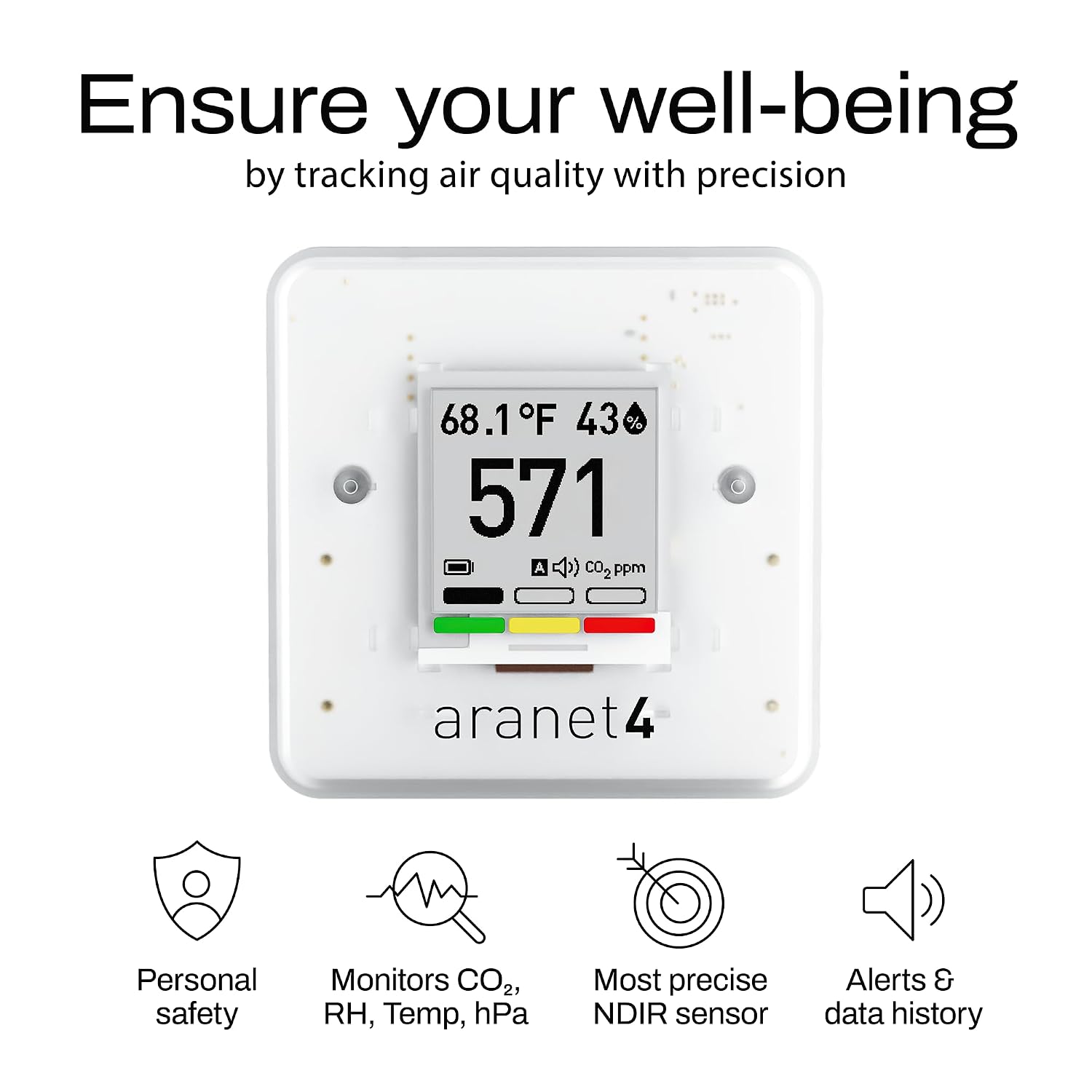
| EDITOR'S PICK[Airthings 2960 View Plus - Batt…](https://www.amazon.com/dp/B097YW5Q72?tag=greenflower20-20) | Mid-tier[Aranet4 Home: Wireless Indoor A…](https://www.amazon.com/dp/B07YY7BH2W?tag=greenflower20-20) | Budget pick[Amazon Smart Air Quality Monito…](https://www.amazon.com/dp/B08W8KS8D3?tag=greenflower20-20) | |
|---|---|---|---|
| Sensor suite | PM, CO2, VOC, RH, T, P | CO2, T, RH | — |
| Battery powered | ✓ | ✓ | — |
| Display | — | E-Ink | — |
| Alexa support | — | — | ✓ |
| Portable | — | ✓ | — |
| Radon sensor | ✓ | — | — |
| Price | $263.99 | $159.00 | $44.99 |
| See on Amazon → | See on Amazon → | See on Amazon → |
CO2: The Ventilation Proxy You Didn’t Know You Needed
CO2 is the sleeper sensor — it’s measuring something most homeowners didn’t know was degrading their air quality. It’s not toxic at typical indoor levels, but the Lawrence Berkeley National Laboratory’s research on indoor CO2 concentrations found measurable impairment in decision-making performance when levels exceeded 1,000 ppm, with significant effects above 2,500 ppm. Outdoor air sits around 420–430 ppm in 2025–2026; a well-ventilated home typically holds 600–800 ppm.
The reason CO2 matters as a practical metric is that it’s a proxy for ventilation rate, not just occupancy. If you’re in a sealed bedroom with two people and CO2 climbs past 1,200 ppm within an hour, that’s telling you the room doesn’t exchange air frequently enough — and whatever else is in that air (VOCs, pet dander, cooking byproducts) is also accumulating. Per ASHRAE Standard 62.1-2022, acceptable indoor air quality requires maintaining CO2 levels within roughly 700 ppm above outdoor ambient — so roughly 1,100–1,150 ppm max as a working ceiling before you should intervene.
Where CO2 readings become actionable:
- Below 800 ppm: Ventilation is adequate. No action needed.
- 800–1,000 ppm: Acceptable, but open a window if it’s trending upward during occupied hours.
- 1,000–1,500 ppm: Ventilation is insufficient. Open windows, run an ERV/HRV if you have one, or reduce occupancy density.
- Above 1,500 ppm: Poor air quality by any IAQ standard. This room needs a structural ventilation fix, not just a purifier.
The tradeoff practitioners often miss: a HEPA air purifier does nothing for CO2. This is one of the most common misalignments between symptom and solution. If your home office reads 1,400 ppm at 3 p.m. and you feel foggy, running your Coway Airmega harder won’t help — cracking a window will. CO2 sensors are the cheapest, most reliable sensors in multifunction monitors; NDIR (non-dispersive infrared) technology — the gold-standard measurement method for CO2 — is now available in monitors under $200 from Aranet, Airthings, and Amazon Basics-tier competitors. Owners of the Aranet4 consistently report readings that align closely with professional instrument calibrations, a detail reviewers at The New York Times Wirecutter have noted in their IAQ coverage.
PM2.5: The Particle Reading That Drives Most Purifier Decisions
If CO2 is the ventilation sensor, PM2.5 is the filtration sensor. Fine particulate matter at 2.5 micrometers or smaller — abbreviated PM2.5 — is the pollution metric most directly tied to cardiovascular and respiratory health outcomes. Healthline’s overview of PM2.5 health effects summarizes the epidemiological consensus: long-term exposure above 12 µg/m³ annual average (the EPA’s current National Ambient Air Quality Standard) is associated with increased risk of heart disease, asthma exacerbation, and lung cancer.
Indoors, PM2.5 sources include cooking (especially high-heat sautéing or frying), candles, incense, wildfire smoke infiltrating through gaps, and resuspended dust from vacuuming or foot traffic. The U.S. EPA’s Introduction to Indoor Air Quality notes that indoor PM2.5 can exceed outdoor levels when there are strong indoor sources — cooking a steak in a poorly ventilated kitchen can temporarily spike PM2.5 past 100 µg/m³.
The PM2.5 thresholds that matter in practice:
| Reading (µg/m³) | AQI Category | Practical Response |
|---|---|---|
| 0–12 | Good | No action needed |
| 12.1–35.4 | Moderate | Investigate source if sustained |
| 35.5–55.4 | Unhealthy for sensitive groups | Run HEPA purifier; reduce source |
| 55.5+ | Unhealthy | High-output HEPA + ventilation audit |
The critical nuance for buyers evaluating monitors: consumer-grade PM2.5 sensors vary significantly in accuracy. Most sub-$100 monitors use laser particle counters (optical sensors) that count particle scatter — they’re estimating PM2.5, not measuring mass concentration directly. Consumer Reports’ 2025 air quality monitor review found that the best consumer optical sensors tracked regulatory reference monitors within 20–30% under typical indoor conditions, but could read 2–4× high in high-humidity environments because the sensor mistakes water droplets for particles. If you’re in a coastal or humid climate, this matters: a monitor showing 40 µg/m³ during a humid July night may actually reflect 15–20 µg/m³ of real particulate.
For practitioners making decisions based on PM2.5 data — home office users, allergy-driven buyers, anyone managing an immunocompromised household member — the recommendation is to calibrate expectations around humidity and to choose monitors with documented humidity compensation algorithms. Airthings View Plus and IQAir AirVisual Pro are among the monitors whose specifications explicitly address this; reviewers and owners report meaningfully more stable readings than budget alternatives under variable humidity.
VOCs: The Most Misunderstood Number on Your Monitor
VOC readings are where consumer monitors most frequently mislead buyers — and where decision-making is most likely to go wrong if you don’t understand what the sensor actually sees.
VOC sensors in consumer monitors are almost universally MOX (metal oxide semiconductor) sensors. They detect a broad basket of gases — ethanol, formaldehyde, acetone, toluene, isoprene — and report a single aggregate number, often in ppb (parts per billion) or as a generic “TVOC” (total VOC) index. The critical limitation: these sensors cannot distinguish between a glass of wine on your counter and a freshly painted wall. Both spike the VOC reading. Isoprene from your own exhaled breath spikes it. Cooking oils spike it. The sensor knows something chemical is happening; it cannot tell you whether it’s harmless or harmful.
Per the EPA’s indoor air quality guidance, the VOCs of genuine health concern — formaldehyde from pressed-wood furniture, benzene from attached garages, certain glycol ethers from cleaning products — require photoionization detectors (PIDs) or electrochemical sensors to measure with meaningful specificity. PIDs are found in professional industrial hygiene instruments costing $1,000+, not in $150 home monitors.
What your VOC index is actually useful for:
- Trend detection: A baseline reading for your home, then anomalies — a spike when you bring in new furniture, when you use a particular cleaning product, or when a window is opened to a polluted street — are meaningful even if the absolute number isn’t precise.
- Source hunting: Cook with the monitor in the kitchen, bring furniture into the bedroom, swap cleaning products. Track which activities move the needle.
- Ventilation confirmation: Post-painting or post-renovation, a sustained high VOC reading tells you the space needs more air changes before safe reoccupancy. ASHRAE’s ventilation standards support this use case.
- What it’s NOT useful for: Comparing absolute VOC ppb numbers between different monitor brands, or using the number to conclude “this room is safe/unsafe” without source identification.
If VOC exposure is a genuine health concern — chemically sensitive individuals, households with new construction materials, or commercial operators in spaces like nail salons or yoga studios using cleaning products — the appropriate tool is professional IAQ monitoring with PID instrumentation or at minimum a dedicated formaldehyde sensor (electrochemical type), not a consumer TVOC index.
Reading the Three Numbers Together: Decision Framework
The sensors’ real value is how they work in combination. Here’s the practical matrix practitioners should internalize:
CO2 high, PM2.5 low, VOC low → Pure ventilation problem. The room is occupied and sealed. No purifier needed; more air changes needed. Intervention: open windows, check mechanical ventilation, consider an ERV.
CO2 normal, PM2.5 high, VOC low → Active particle source — cooking, candles, outdoor smoke infiltration. Intervention: HEPA purifier at appropriate CADR for room size, identify and reduce the source.
CO2 normal, PM2.5 low, VOC high → Chemical off-gassing or product use. Intervention: ventilate to dilute, identify the source, avoid repeated exposure until source is removed. A HEPA purifier won’t help with gases.
All three elevated → Ventilation is inadequate and there are active pollutant sources. This is the scenario most common post-renovation, in tightly sealed new construction, or in below-grade spaces. Intervention requires both ventilation and filtration, and possibly professional IAQ assessment.
What This Means When You’re Choosing a Monitor
If your decision is pending right now, the framework is straightforward:
- If your primary concern is ventilation / stuffiness / cognitive performance in a home office: A dedicated CO2 monitor (Aranet4 or similar NDIR-based device) is more accurate and more actionable than a multifunction unit with a mediocre CO2 sensor.
- If wildfire smoke, cooking particulates, or allergy management are your driver: PM2.5 optical sensor quality is what to evaluate; pick a monitor with documented humidity compensation and cross-reference its readings against EPA AirNow data for your zip code to establish baseline accuracy.
- If you’re managing a multi-room commercial or residential property and need trend data across zones: A networked sensor platform — Airthings for Business, IQAir AirVisual Pro with API access, or Awair Omni for commercial spaces — gives you the dashboard infrastructure that single-room monitors can’t.
- If VOC is your stated concern: Be honest about whether you need source identification (which requires professional instruments) versus trend awareness (which a consumer TVOC sensor can genuinely provide).
The one rule that cuts across all three sensors: a monitor only earns its purchase price if it changes your behavior. If you read the number and don’t know whether to open a window, run a purifier, or call an HVAC technician, the sensor is decorating your shelf. Match the sensor to the specific question you’re trying to answer, and the answer becomes obvious.