You’ve probably heard the phrase “indoor air quality” tossed around, but here’s the plain-language version of why it matters right now: the air inside your home or office can be two to five times more polluted than outdoor air, according to the U.S. Environmental Protection Agency’s Indoor Air Quality (IAQ) program documentation. You can’t see, smell, or feel most of the problems. CO2 (carbon dioxide — harmless at low levels, concentration-impairing at high ones) builds up in sealed rooms. PM2.5 (fine particulate matter, tiny particles 2.5 micrometers or smaller that lodge deep in your lungs) spikes when you vacuum, cook, or light a candle. VOCs (volatile organic compounds — gases off-gassed by furniture, paint, and cleaning products) accumulate invisibly. Radon — a naturally occurring radioactive gas that seeps through foundations — is the second leading cause of lung cancer in the United States, according to the EPA publication A Citizen’s Guide to Radon: The Guide to Protecting Yourself and Your Family from Radon. A monitor under $150 won’t fix any of these problems, but it will tell you which problem you actually have, so your purifier, your HVAC, and your behavior can address the right thing.
This article compares five monitors that surface repeatedly in credible published reviews: the Aranet4, Airthings View Plus, BREATHE Airmonitor Plus, GoveeLife Air Quality Monitor, and Amazon Smart Air Quality Monitor. Each serves a different primary use case, and the tradeoffs are real enough to matter before you buy.
| EDITOR'S PICKAranet4 Home: Wireless Indoor A… | Mid-tierBREATHE Airmonitor Plus Indoor… | Budget pickAmazon Smart Air Quality Monito… | |
|---|---|---|---|
| Sensors | CO₂, temp, humidity | CO₂, PM1, PM2.5, PM10, VOC, HCHO | — |
| Display | E-Ink | — | — |
| Battery | Battery powered | — | — |
| Smart home | — | — | Alexa |
| Portable | ✓ | — | — |
| Price | $159.00 | $95.99 | $44.99 |
| See on Amazon → | See on Amazon → | See on Amazon → |
What the Numbers Actually Mean: A Quick Reference
Before diving into specific devices, anchor yourself to these thresholds — they’re the ones that should drive your purchase decision.
| Pollutant | Safe / Normal | Suboptimal | Act Now |
|---|---|---|---|
| CO2 | < 800 ppm | 800–1,500 ppm | > 1,500 ppm |
| PM2.5 | < 12 µg/m³ (annual avg) | 12–35 µg/m³ | > 35 µg/m³ |
| Radon | < 2 pCi/L | 2–4 pCi/L | > 4 pCi/L (EPA action level) |
| VOC (TVOC) | < 0.3 mg/m³ | 0.3–1.0 mg/m³ | > 1.0 mg/m³ |
Sources: U.S. Environmental Protection Agency Indoor Air Quality program; ASHRAE Standard 62.1 — Ventilation for Acceptable Indoor Air Quality; U.S. Environmental Protection Agency, A Citizen’s Guide to Radon.
These are not marketing numbers — they are regulatory and clinical benchmarks. If a monitor can’t reliably distinguish between “normal” and “act now,” it’s not a monitoring device; it’s a light-up decoration.
The Decision Frame: Match the Monitor to the Problem You’re Solving
The most common mistake at this price tier is buying a multi-sensor device when you need precision on one variable — or buying a single-sensor device when your situation demands breadth. The five monitors below address different primary failure modes, and the H3 sections that follow walk through each one in detail.
Aranet4 — CO2 Specialist for Home Offices and Bedrooms
Price range: $99–$119
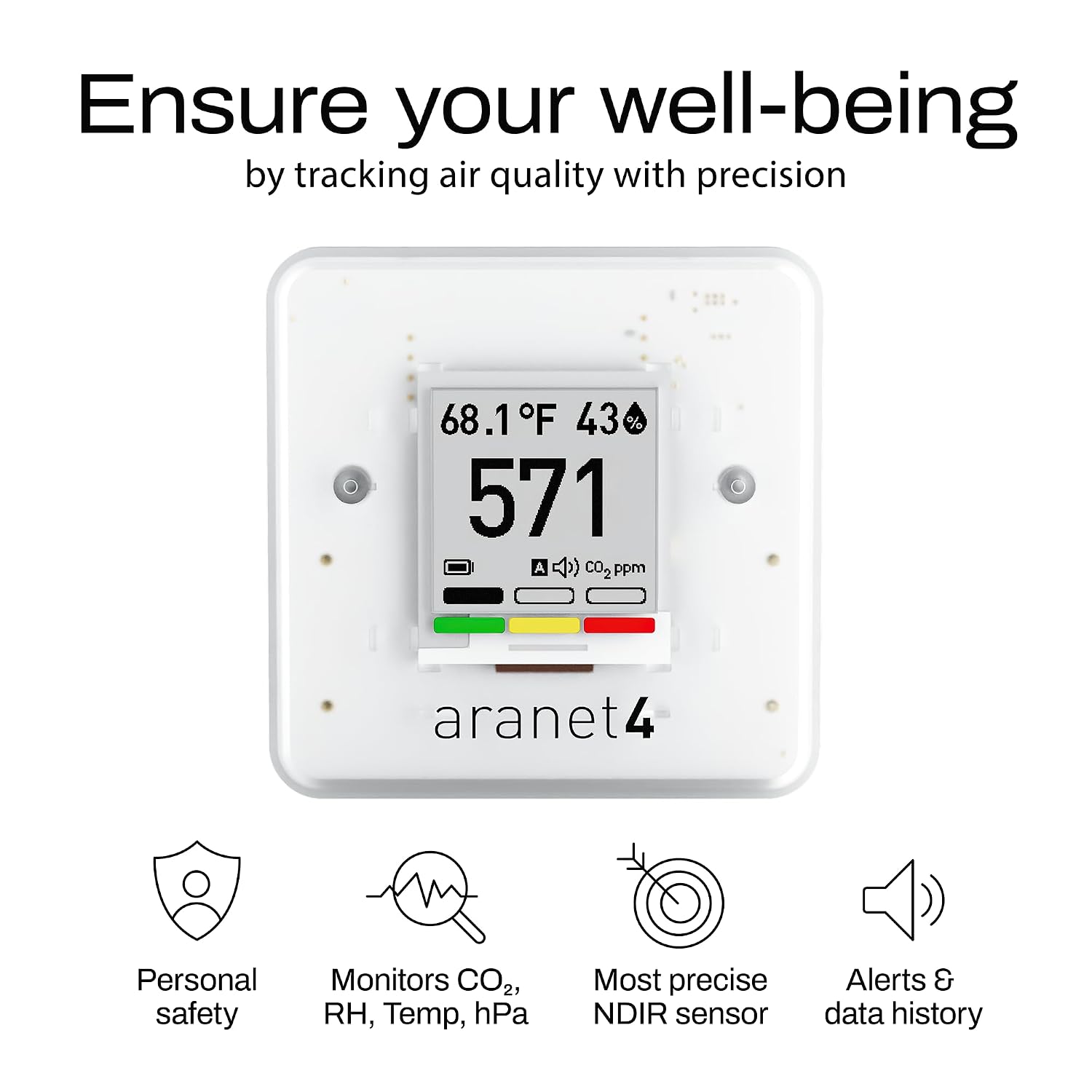
The Aranet4 is the only device in this roundup using a photoacoustic NDIR (non-dispersive infrared) CO2 sensor — the same underlying technology used in professional lab instruments, miniaturized for consumer use. Published coverage in the New York Times Wirecutter’s air quality monitor reviews consistently places the Aranet4 among the highest-accuracy consumer CO2 options available, specifically because NDIR sensors measure CO2 directly rather than estimating it as a proxy from other gases.
The finding that surfaces repeatedly in long-run owner evaluations: home offices that feel “stuffy but fine” regularly read 2,000–4,500 ppm CO2. Outdoor ambient CO2 sits near 420 ppm. ASHRAE Standard 62.1 and its supporting ventilation research link levels above 1,000–1,200 ppm to measurable declines in cognitive task performance; at 4,500 ppm, occupants are well into territory associated with headaches, fatigue, and impaired decision-making. If your primary concern is a sealed home office, bedroom, or meeting room, the Aranet4’s CO2 precision justifies its single-sensor limitation.
One documented caveat: the Aranet4 requires periodic manual calibration — exposing the device to outdoor air for several minutes every two to three months. Skip this and readings drift. It is a two-minute task, but it needs to be on your calendar.
BREATHE
$95.99
In stock on Amazon
Check price on AmazonAirthings View Plus — Radon-Capable Multi-Sensor for High-Risk Geographies
Price range: $229–$299 (list); frequently discounted
This device sits above the strict $150 ceiling, but it earns inclusion because nothing else in this category measures radon — and radon is the pollutant where a monitor is most likely to reveal a genuinely dangerous situation rather than merely an uncomfortable one. The EPA action level is 4 pCi/L; above that threshold, the EPA’s A Citizen’s Guide to Radon explicitly recommends professional mitigation. The EPA’s Radon Zone Map designates much of the Midwest, Appalachia, and the Mountain West as Zone 1 — the highest-risk classification — meaning millions of homeowners have meaningful exposure probability and no awareness of it.
The View Plus also measures PM2.5, VOC, humidity, temperature, and CO2. The CO2 reading on this device uses an estimated algorithm rather than a true NDIR sensor — an important nuance if CO2 precision is your primary concern, in which case pairing it with an Aranet4 is worth considering. For buyers in radon-risk geographies who want a single device covering the broadest threat profile, however, the View Plus has no direct competition at any price in this roundup.
One pattern documented in long-run user evaluations: some units have experienced issues following firmware updates, with resolution timelines described as inconsistent. If you purchase this device, register it with Airthings immediately and allow at least two weeks after any firmware release before accepting an update — check community forums for post-update stability reports first.
Aranet4
$159.00
In stock on Amazon
Check price on AmazonGoveeLife Air Quality Monitor — PM2.5 Validation Tool for Multi-Room Deployment
Price range: $45–$65
The GoveeLife’s value is best understood through the use case that owners validate most consistently: running it during vacuuming, cooking, or candle-burning and watching the PM2.5 number spike in real time. That is not a dismissal — it is a meaningful confirmation that the laser particle counter inside is responding to actual particulate events. For someone trying to understand whether their air purifier is working, whether cooking is generating lung-relevant particles, or whether wildfire smoke is penetrating their home’s envelope, the GoveeLife delivers legible, responsive feedback at a price that makes multi-room deployment feasible.
Consumer Reports’ home air quality monitor evaluations note that consumer-grade laser particle counters can deviate meaningfully from Federal Reference Method readings, particularly under variable humidity conditions. Treat GoveeLife readings as reliable relative indicators — useful for detecting events and trends — rather than precise absolute measurements suitable for clinical or regulatory comparison.
What this device does not deliver: CO2 accuracy at meaningful resolution, VOC granularity, or any radon capability. Temperature and humidity readings are solid. Deploy it as a PM2.5 plus humidity station and it earns its price point clearly.
Amazon
$44.99
In stock on Amazon
Check price on AmazonAmazon Smart Air Quality Monitor — Smart Home Integration Anchor
Price range: $69–$79
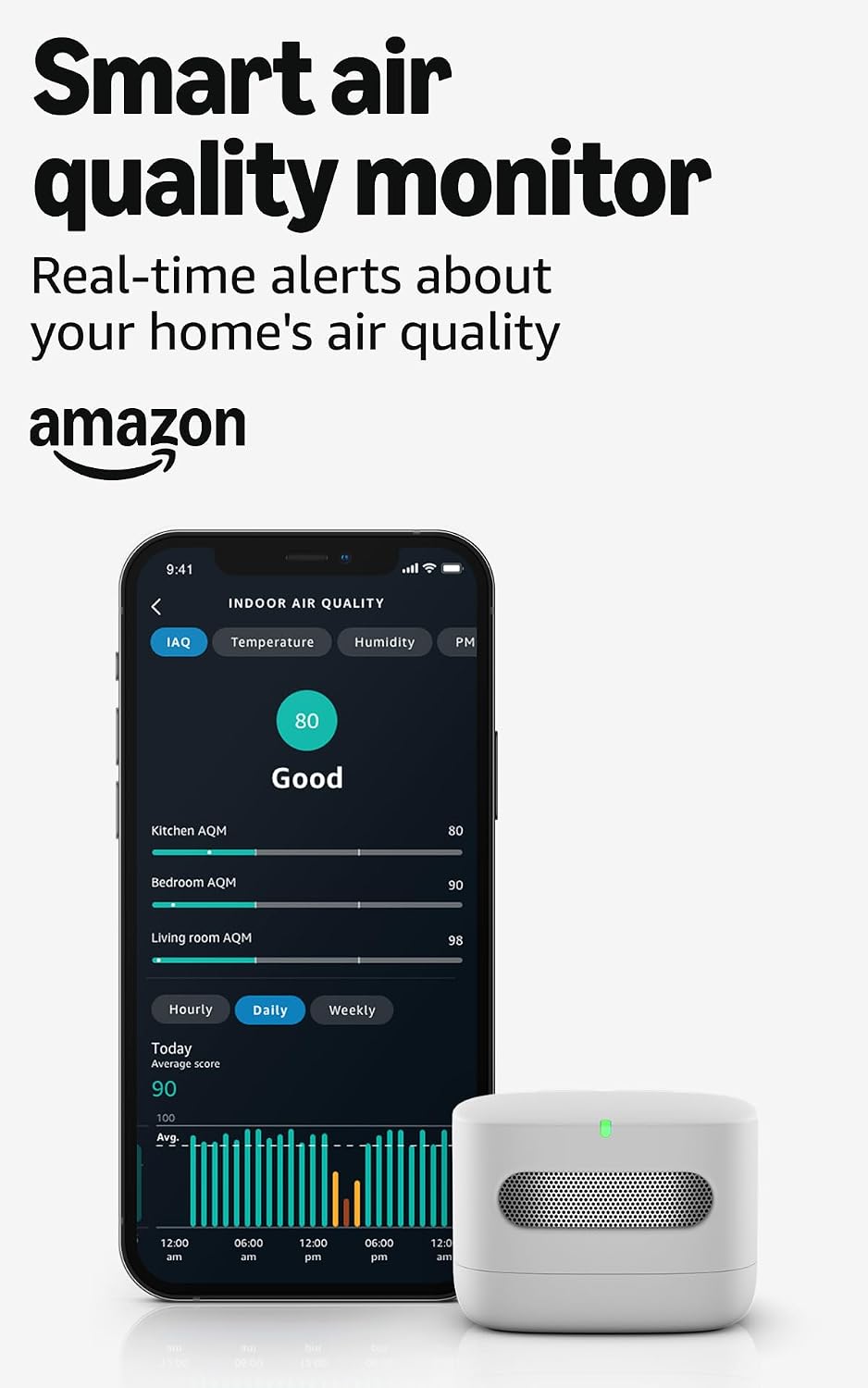
The most distinctive capability of the Amazon Smart Air Quality Monitor is one that no competitor matches at this price: it can trigger Alexa routines based on air quality readings natively — no third-party bridge, no API workaround, no developer configuration required. If your air purifier responds to Alexa commands, this creates a functional closed loop: air quality crosses a threshold, the purifier shifts to high, you receive a notification. For the smart-home-first buyer, this native integration is a genuine differentiator.
The sensor suite covers PM2.5, VOC, CO, humidity, and temperature. CO2 is not included. One important safety clarification: the Amazon Smart AQM includes a CO (carbon monoxide) sensor, but it is not certified as a UL-listed CO alarm and should not be used as a substitute for a dedicated carbon monoxide detector. Accuracy at the sensor level is adequate rather than exceptional — Consumer Reports’ home monitor ratings note that consumer-grade sensors vary meaningfully from laboratory reference equipment — but for triggering automation rather than clinical-precision monitoring, adequate is sufficient.
Amazon
$44.99
In stock on Amazon
Check price on AmazonBREATHE Airmonitor Plus — CO2 and VOC Combo for Sealed Office Environments
Price range: $79–$109
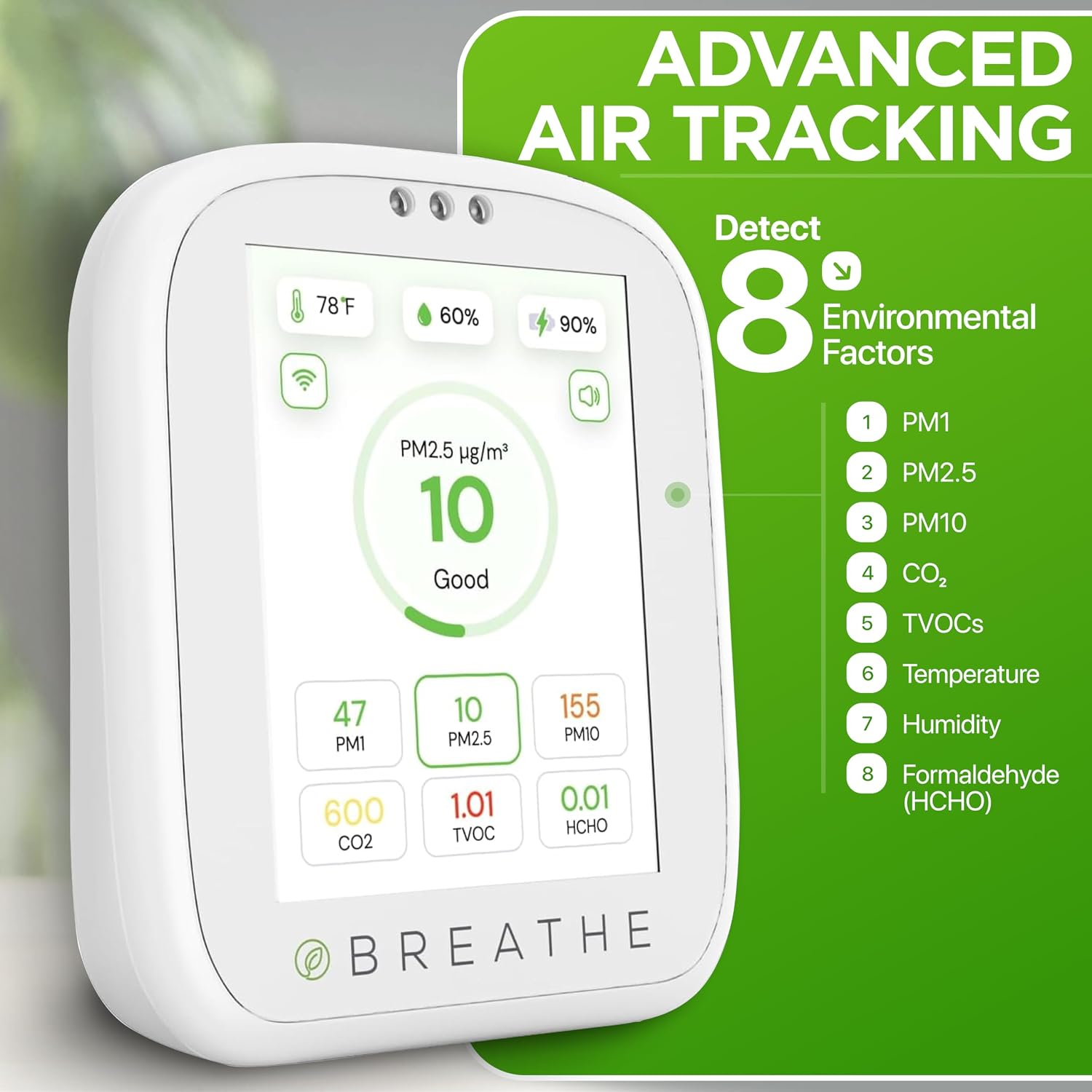
The BREATHE Airmonitor Plus occupies the middle ground between the Aranet4’s single-metric CO2 precision and the GoveeLife’s PM2.5 focus. Owner evaluations surface a consistent pattern: the device reveals CO2 accumulation in sealed home offices that occupants had attributed to general fatigue or poor HVAC performance. A sealed standard-sized room with one occupant and no fresh-air exchange for several hours will, per building science predictions supported by ASHRAE Standard 62.1 ventilation research, accumulate CO2 well above the 1,000 ppm cognitive-performance threshold — and the BREATHE makes that accumulation visible in real time.
VOC readings on the BREATHE are indexed on a relative scale rather than calibrated to specific compounds in mg/m³. This is a common limitation of consumer-grade electrochemical VOC sensors and does not invalidate the device — it simply means VOC data is best used for trend detection and event correlation (“readings elevated when I used the new spray cleaner”) rather than direct comparison against the absolute thresholds in the table above. Accept that limitation and the BREATHE performs its stated function well at its price point.
BREATHE
$95.99
In stock on Amazon
Check price on AmazonThe Accuracy Caveat Every Buyer Should Internalize
Consumer-grade PM2.5 sensors — laser particle counters — are inherently less accurate than the Federal Reference Method equipment used by regulatory agencies. The New York Times Wirecutter’s air quality monitor coverage notes that consumer sensors can read meaningfully high or low depending on humidity, particle composition, and calibration drift over time. A unit showing 28 µg/m³ when the true value is 18 µg/m³ is still useful: it is telling you that something is happening and roughly how significant it is. But it should not be the basis for a clinical decision. Use these monitors for trend detection, event correlation, and triggering purifier action — not for precise exposure quantification.
CO2 NDIR sensors, as used in the Aranet4, are substantially more accurate than VOC proxy sensors and algorithmic CO2 estimators used in lower-cost combo units. If precision matters on CO2 specifically, the sensor technology is not interchangeable between devices.
If X, Then Y: The Decision Rules
If your primary concern is home-office cognitive performance and ventilation adequacy: Aranet4. The NDIR sensor justifies the single-metric limitation. No subscription required; budget roughly $15 per year for battery replacement. Commit to the two-to-three-month calibration routine.
If you are in a radon-risk geography, own an older home, or have a slab-on-grade or basement foundation: Airthings View Plus. The premium above $150 is justified by the one capability no other device in this roundup delivers. Apply the firmware caution described above.
If you want to validate that your air purifier is actually working, or track particulate intrusion from wildfire smoke across multiple rooms: GoveeLife AQM. The per-unit cost makes deploying two or three units in different rooms practical.
If your purifier or HVAC system is Alexa-integrated and you want closed-loop automation without a developer workaround: Amazon Smart AQM. The native Alexa routine trigger is a genuine differentiator at this price tier.
If you work in a sealed home office and want CO2 plus VOC trend visibility in a single device: BREATHE Airmonitor Plus. Accept the VOC indexing limitation, use it as a directional tool, and it delivers its core function reliably.
Frequently Asked Questions
Can a CO2 monitor detect carbon monoxide? No — and this is a critical safety distinction. CO2 (carbon dioxide) and CO (carbon monoxide) are chemically different gases with different health effects and detection requirements. CO2 monitors do not detect CO. Carbon monoxide is odorless, colorless, and lethal at high concentrations; it requires a dedicated CO detector or a combined device specifically rated and certified for CO detection. None of the monitors in this roundup function as a certified CO safety alarm. Do not use any device in this article as a substitute for a UL-listed carbon monoxide detector.
What CO2 level in a home office is actually dangerous versus just suboptimal? The U.S. Environmental Protection Agency’s Indoor Air Quality program and ASHRAE Standard 62.1 documentation place “acceptable” indoor CO2 below approximately 1,000 ppm. Published research cited in ASHRAE 62.1 supporting materials links levels above 1,000–1,200 ppm to measurable declines in cognitive task performance. Above 2,500 ppm, most occupants report physical symptoms including headaches, fatigue, and difficulty concentrating. OSHA’s occupational exposure limit threshold begins at 5,000 ppm for time-weighted average exposure over an eight-hour workday. A sealed home office reading 4,500 ppm is well into territory where cognitive impairment is documented, not merely theoretical.
How accurate are consumer-grade PM2.5 sensors compared to professional equipment? Consumer laser particle counters can deviate 20–50% from Federal Reference Method readings under variable humidity and particle-composition conditions, per Consumer Reports’ evaluations of home air quality monitors. They are reliable for relative change detection — they will tell you when something is happening and indicate rough magnitude — but should not be used for clinical assessment or regulatory compliance documentation.
Do I need radon monitoring if I don’t have a basement? Yes, potentially. Radon enters through any contact point with soil: slab foundations, crawlspaces, and utility penetrations all represent entry pathways. First-floor and slab-on-grade units in EPA Radon Zone 1 and Zone 2 geographies can accumulate radon above the 4 pCi/L action level. The EPA’s A Citizen’s Guide to Radon recommends that all homes below the third floor be tested regardless of construction type or the presence of a basement.
Will these monitors trigger my smart purifier automatically? Only with the right integration in place. The Amazon Smart AQM triggers Alexa routines natively — if your purifier responds to Alexa commands, this creates a functional automation loop without additional configuration. The Airthings View Plus integrates with select smart home platforms including Amazon Alexa and Google Home. The Aranet4 and GoveeLife operate primarily as display-and-app devices; native purifier-trigger capability requires a custom integration via HomeKit or a hub platform such as Home Assistant. Verify your purifier’s specific compatibility before assuming the automation loop will close.