If you’ve started shopping for an air purifier that can actually clean a large room — say, an open-plan living area, a master suite over 500 square feet, or a home office you share with a partner — you’ve probably already run into the CADR number. CADR stands for Clean Air Delivery Rate, and it’s the standardized metric (set by the Association of Home Appliance Manufacturers, or AHAM) that tells you how many cubic feet of filtered air a purifier can push through per minute. A higher CADR means the machine can clean a larger space faster. The catch: most purifiers achieve their rated CADR only at their highest fan speed, and that top speed is often loud enough to interrupt a Zoom call, a night of sleep, or a quiet evening. This guide is for buyers who refuse to accept that tradeoff. We’ll walk through which large-room HEPA purifiers — HEPA being the filter standard that captures 99.97% of particles down to 0.3 microns — deliver honest performance at livable noise levels, what the filter costs look like over five years, and how to match the right unit to your actual situation.
Why “Rated CADR” Is Often a Marketing Fiction at Livable Speeds
Here’s the pattern you’ll see across the category: a manufacturer rates a unit at CADR 300+ for smoke, earns a large-room coverage claim of 800–1,000 square feet, and buries the fact that those numbers apply only at the unit’s maximum fan setting — typically 55–65 dB, which is roughly the volume of a normal conversation happening directly next to you. Drop to a sleep-friendly speed (under 40 dB), and the effective CADR can fall by 50–70%.
The U.S. EPA’s Guide to Air Cleaners in the Home notes this directly: “The CADR is measured at the unit’s highest speed setting.” AHAM’s own certification documentation confirms the same. Neither source requires manufacturers to publish CADR at mid- or low-speed settings, which means a 300 CADR unit running quietly might actually be delivering 90–130 CADR — adequate for a small bedroom, not a large open room.
Across aggregated owner reviews and the Wirecutter’s 2025 review cycle, the consistent complaint pattern is exactly this: buyers size a unit to their room using the advertised CADR, run it at a tolerable noise level, and never fully clear particulate load after cooking, a pet sheds, or air quality dips. The math just doesn’t work at low speed.
What to actually look for:
- Published dB ratings at each fan speed, not just max
- CADR-per-dB efficiency as an informal ratio (more on this below)
- Third-party noise verification from Consumer Reports or Wirecutter, not just manufacturer claims
- Auto-mode sensor reliability — a unit that ramps to high only when pollution spikes and drops back quickly spends less time at noisy speeds
The Units That Earn Their Coverage Claims: A Spec-Level Look
Coway Airmega 400 / 400S
The case for it: The Airmega 400 carries an AHAM-certified CADR of 350 (smoke), which is legitimately high for its class. More importantly, owners consistently report that the unit’s mid-speed setting — where it operates most of the time in auto mode — runs at roughly 43–46 dB, well inside the “background noise” threshold for most people. At that speed, published spec data puts effective CADR in the 180–220 range, which is honest performance for rooms up to 500–600 square feet.
The 400S adds Wi-Fi and app control with Alexa and Google Assistant compatibility. The app’s auto-mode logic draws on a dual-sensor array (dust and gas), and owners in long-run reviews on Consumer Reports generally rate the auto-mode responsiveness as reliable — the unit ramps when air quality actually drops, not on a fixed schedule.
Five-year filter cost: The Airmega 400 uses a combined pre-filter/carbon/HEPA pack. At current 2026 pricing, a set runs approximately $90–$110 per replacement, with a recommended replacement cycle of 6–12 months depending on load. Budget $400–$600 in filter costs over five years — call it $80–$120/year as your baseline.
The tradeoff: It’s physically large (roughly 14.8” × 14.8” × 24.4”) and not subtle in a bedroom. The highest speed is genuinely loud — reviewers at Wirecutter document it at 60–63 dB — so if your air quality events are severe and frequent, you’ll hear the unit working.
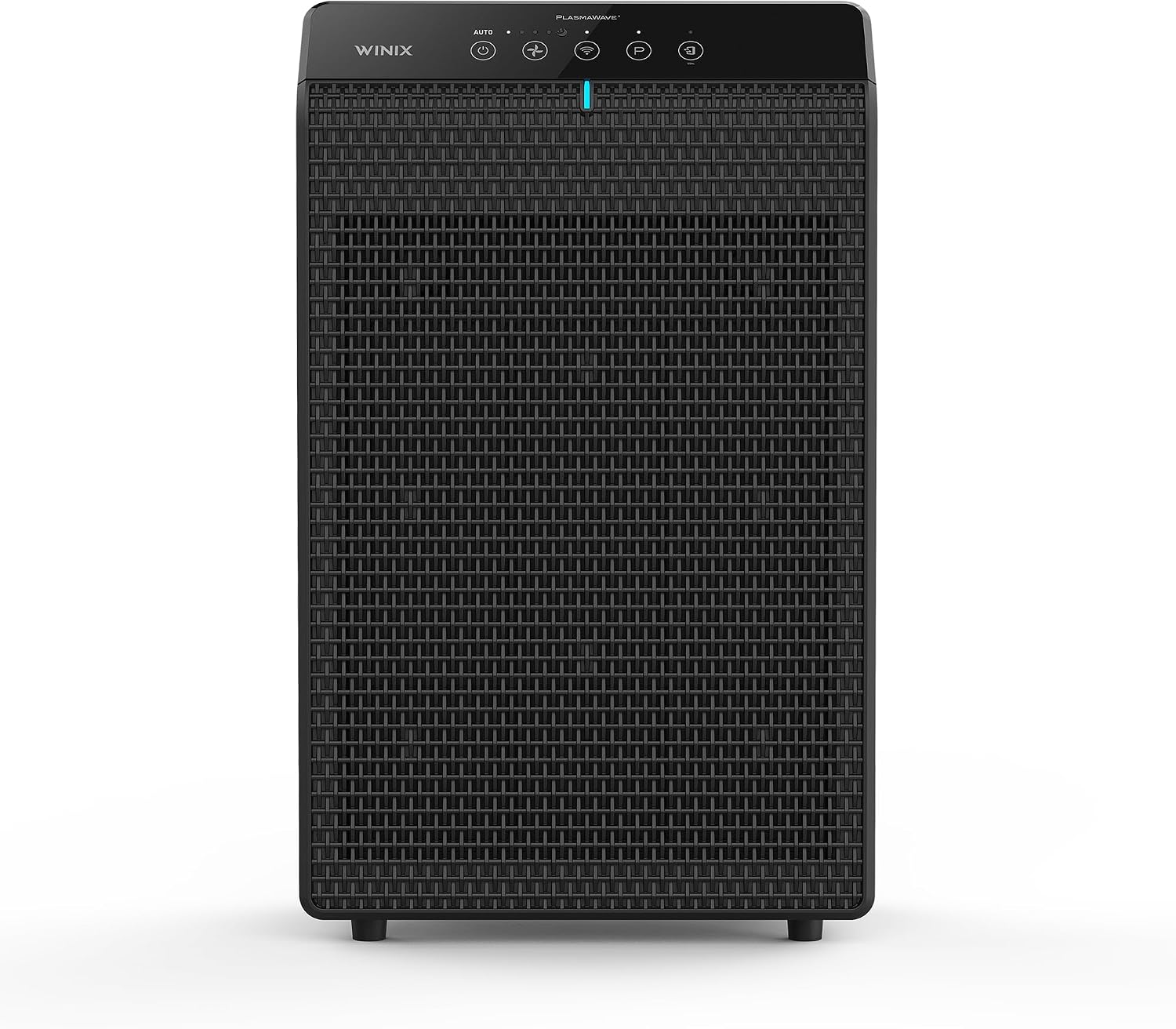
Winix 5500-2
The case for it: Winix has built a strong reputation for honest performance-per-dollar. The 5500-2 is rated at CADR 243 (smoke), which positions it for rooms up to roughly 360 square feet by the standard AHAM two-thirds rule (room volume × 2/3 for air changes). At medium speed, owners consistently report noise levels of 50–52 dB — not whisper-quiet, but workable as background noise. At its lowest “sleep” speed, noise drops to roughly 27–30 dB, though effective CADR at that setting is modest.
The PlasmaWave technology Winix includes is optional (it can be switched off) — relevant for buyers who want pure mechanical filtration without any ionization. Consumer Reports’ air purifier ratings consistently score the 5500-2 well for particulate removal and filter longevity.
Five-year filter cost: Replacement filters (HEPA + carbon pre-filter combo) run $50–$70 per set, with a recommended 12-month cycle under normal conditions. Five-year TCO for filters: approximately $250–$350. This is one of the most cost-transparent filter programs in the category.
The tradeoff: The 5500-2 is not a true large-room performer — it’s mid-room, best suited for rooms up to 400 square feet. Buyers who size it to 600+ square feet based on manufacturer room-size claims (which tend to assume generous air-change standards) will likely see underperformance.
Blueair Blue Pure 311i Max
The case for it: Blueair’s engineering approach prioritizes low-resistance airflow, which translates practically to higher CADR-per-dB efficiency than most competitors. The 311i Max is rated at CADR 240 for smoke and is documented by Wirecutter reviewers at approximately 46 dB on medium — meaningfully quieter than comparable CADR units from other brands at the same setting.
The app integration (Blueair Friend app) supports Alexa and Google Home. Auto-mode behavior draws on an onboard particle sensor, and owners in long-run reviews note that it responds to actual air quality changes rather than running continuously at a fixed speed — which matters for nighttime noise management.
Five-year filter cost: Blueair filter pricing runs higher than most competitors. Replacement filters for the 311i Max are approximately $80–$100 per set, with a 6-month recommended cycle under moderate load. Five-year TCO: roughly $800–$1,000 in filters alone. This is the most significant ownership cost in this tier — worth flagging clearly.
The tradeoff: The filter cost is the honest pain point. Buyers who don’t account for it will feel the sting at the 18-month mark.
IQAir HealthPro Plus (Premium Tier)
For buyers running rooms over 700 square feet, or operating in medical, allergy-sensitive, or high-particulate environments, the IQAir HealthPro Plus operates in a different class. Its HyperHEPA filtration (rated to 0.003 microns — 100× finer than standard HEPA) and manufacturer-rated CADR of 300 (smoke) understates its real-world performance because the filtration standard is more aggressive than AHAM’s test particle size.
Owners in medical and allergy contexts consistently report sustained performance in large open rooms. Noise at medium speed is documented at approximately 49–52 dB. The unit has no Wi-Fi or app integration — it’s a pure mechanical filtration machine, which some buyers specifically prefer.
Five-year filter cost: IQAir uses a three-stage filter system. Replacement costs across all filter stages run approximately $200–$350 per cycle, with cycles ranging 18–48 months depending on stage. Five-year TCO for filters: approximately $600–$900. High but proportionate to performance tier.
The tradeoff: No smart features, no auto-mode sensor, and a premium upfront cost (typically $900–$1,100 at current market). This is a deliberate, performance-first purchase — not a convenience play.
By the Numbers: CADR vs. Noise at Mid-Speed
| Unit | CADR (Smoke, Max) | Approx. dB at Mid-Speed | Est. CADR at Mid-Speed | 5-Yr Filter Cost |
|---|---|---|---|---|
| Coway Airmega 400S | 350 | ~44 dB | ~200 | $400–$600 |
| Blueair Blue Pure 311i Max | 240 | ~46 dB | ~160 | $800–$1,000 |
| Winix 5500-2 | 243 | ~51 dB | ~140 | $250–$350 |
| IQAir HealthPro Plus | 300 | ~50 dB | ~200 | $600–$900 |
Mid-speed CADR estimates are derived from published spec comparisons and owner-reported performance patterns across review aggregators, not manufacturer-published figures at those settings.
App Integration: What “Smart” Actually Buys You Here
For large-room purifiers, smart features aren’t just convenience — they’re part of the noise management equation. A unit that ramps to high-CADR speed only when its sensors detect a real pollution event (a cooking spike, a pet shaking off dander, an outdoor AQI increase) will spend far less total time at loud speeds than one running continuously at a fixed mid-level setting.
The Airmega 400S and Blueair 311i Max both offer HomeKit support through third-party bridges, though neither is natively HomeKit as of mid-2026 per published compatibility documentation. Alexa and Google Assistant routines work reliably on both. Winix’s app ecosystem is functional but more limited in automation depth — owners report it works for scheduling and monitoring but isn’t as responsive to third-party automation.
ASHRAE Standard 62.1-2022 doesn’t prescribe purifier behavior, but its ventilation logic reinforces the principle: air cleaning performance should be evaluated on actual air-change delivery, not nameplate ratings alone. A smart unit that delivers 300 CADR for 20-minute spikes and 150 CADR the rest of the time outperforms a dumb unit running continuously at 200 CADR — and it does it more quietly.
The Decision Rule
If your priority is maximum performance in a room over 600 sq ft with minimal filter cost concern, the Coway Airmega 400S gives the best combination of real-world CADR, smart features, and reasonable long-run cost.
If noise is your primary constraint and you’re willing to pay more for filters over time, the Blueair Blue Pure 311i Max earns its premium through measurably quieter mid-speed operation.
If five-year filter cost is the decision variable and the room is under 450 square feet, the Winix 5500-2 is the honest value play — but don’t oversize it.
If you’re operating a medical, allergy, or high-load environment and smart features are irrelevant to your workflow, the IQAir HealthPro Plus is the only unit in this guide built for that specification level.
The one rule that applies across all four: never size a purifier to the manufacturer’s room-coverage claim. Size it using the AHAM CADR number divided by 1.5 for the square footage you actually want to clean effectively at a tolerable noise level. That one adjustment will save you a poor purchase decision more reliably than any other single variable.