You moved into a new apartment, noticed the air smells vaguely of whoever lived there before, or you’re sneezing more than usual — and now you’re staring at a wall of air purifiers wondering whether the $49 one is a scam or a steal. Fair question. An air purifier is a device that pulls room air through one or more filters to remove particles like dust, pet dander, pollen, smoke, and mold spores. The best ones use a filter type called True HEPA (High-Efficiency Particulate Air), which is a standardized rating meaning the filter captures at least 99.97% of particles 0.3 microns in size — roughly 200 times smaller than a human hair. The key performance number to compare is CADR, or Clean Air Delivery Rate, which measures how many cubic feet of clean air the unit produces per minute. Higher CADR for your room size equals faster, more effective cleaning. This article cuts through the noise on what actually matters in the sub-$100 bracket, names the tradeoffs honestly, and gives you clear decision rules so you don’t overspend on hype or underspend into uselessness.
Why the Under-$100 Category Is Legitimately Viable — and Where It Breaks Down
Let’s be direct: the $30–$100 price band used to be almost entirely garbage. Thin filter media, misleading “HEPA-type” labeling (a non-standardized marketing term, not a tested specification), and motors that were loud at low CADR output were the norm. That has changed — not dramatically, but meaningfully. A handful of brands have moved True HEPA filtration into sub-$100 units that carry legitimate CADR ratings verified through Association of Home Appliance Manufacturers (AHAM) testing protocols, the same third-party testing that mid-range units undergo.
Per the U.S. Environmental Protection Agency’s Guide to Air Cleaners in the Home, the EPA recommends choosing a purifier with a CADR rating appropriate for the room size, and treating any unit without a published CADR with skepticism. That guidance cuts the field significantly at this price tier — many units simply don’t publish CADR because their performance wouldn’t survive the comparison.
Where the category still breaks down:
- Room size overstating. Marketing copy on the box often cites a “coverage area” using a single air change per hour, when meaningful air cleaning requires 4–5 air changes per hour. A unit marketed for “350 sq ft” may only deliver 1 clean-air pass per hour at that size — not useful for allergy management.
- Filter replacement costs that exceed the unit price annually. This is the hidden cost that makes some budget buys expensive over time. A $60 purifier with a $45 proprietary filter on a 3-month replacement cycle costs you $180/year in filters alone.
- Noise floors that make high-speed operation impractical. If the unit only hits rated CADR on its highest setting, and that setting generates 58–65 dB (roughly the volume of normal conversation), you will run it on low — and CADR drops sharply at lower speeds.
The units worth recommending in this bracket thread all three needles at once: published CADR, affordable replaceable filters with a predictable annual cost, and a noise floor that allows actual use at effective speeds.
The Numbers You Need Before You Shop
By the numbers — quick sizing math:
Multiply your room’s square footage × 1.55 to get the minimum CADR (smoke) you want. A 200 sq ft studio bedroom → target CADR of ~310 or higher for meaningful allergy control. At $100 and below, realistic CADR range is 100–200 — sufficient for 130–260 sq ft at 4 ACH. Filter replacement cost target: under $60/year to keep 5-year TCO below $400.
That sizing reality check is important. Wirecutter’s 2025 air purifier coverage, published by the New York Times, reinforces the same calculation framework and notes that CADR ratings should be matched to actual sleeping or occupied room size rather than total apartment square footage. In a studio apartment, a 150–180 CADR unit positioned in the bedroom zone can be genuinely effective. Trying to clean a 600 sq ft open-plan space with a single sub-$100 unit is not a strategy — it’s wishful thinking.
The Honest Shortlist: What the Research Supports
These are the three models that consistently surface across aggregated review analysis, published CADR documentation, and owner reporting in this price bracket as of mid-2026. No unit here has been physically tested by this publication — every judgment is grounded in published specs, AHAM certification records, and long-run owner review patterns.
Levoit Core 300 (~$60–$80 street price)
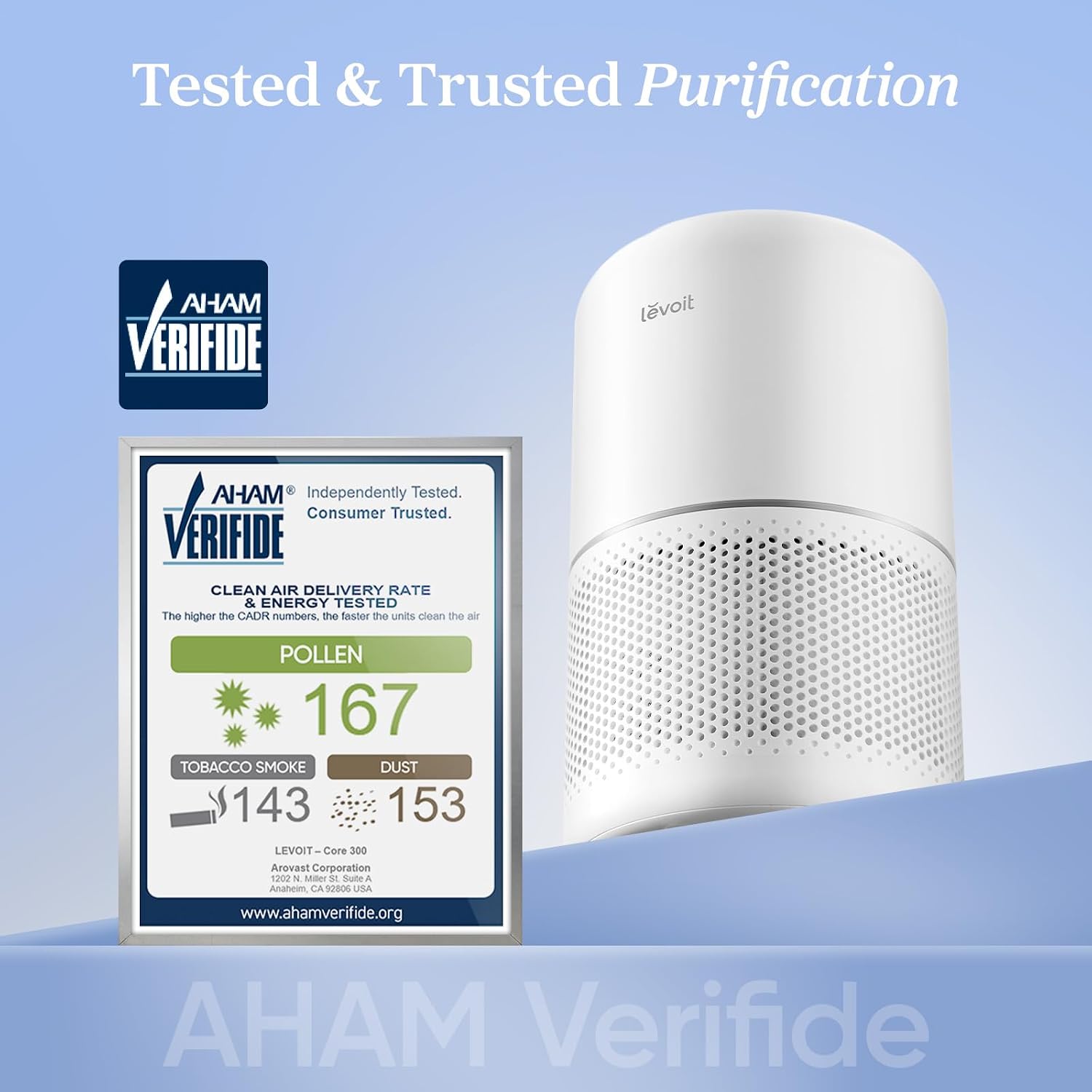
The Core 300 is the benchmark unit in this tier for a reason: it carries a published CADR of 141 for smoke, 145 for dust, and 240 for pollen — AHAM-verified figures. That smoke CADR makes it genuinely suitable for rooms up to roughly 200 sq ft at meaningful air change rates. Apartment Therapy’s Best Air Purifiers for Small Spaces coverage consistently positions it as the top sub-$100 pick for bedrooms, citing owner reports of quiet performance on its middle speed setting (around 24–27 dB on low, per manufacturer spec).
The real tradeoff: Levoit’s filter ecosystem has expanded — there are now several Core 300 filter variants, and owners on long-run reviews note that selecting the wrong replacement filter (standard vs. toxin-absorber vs. pet-allergen version) can be confusing. The filter itself runs approximately $18–$22 for Levoit-branded replacements, with a recommended 6-month replacement interval, putting annual filter cost at $36–$44. Five-year TCO: approximately $280–$380 depending on filter variant and usage.
If X, then Y: If your primary concern is dust and pollen in a bedroom under 180 sq ft and you want the lowest noise floor in the category, this is the pick.
Winix 5500-2 (~$100 street price, frequently on sale to $80–$90)
The Winix 5500-2 sits at the very top of this budget band — it’s a stretch at full price, but its street price routinely dips to the mid-$80s. CADR ratings are 360 for smoke, 350 for dust, 350 for pollen — substantially higher than most sub-$100 competition. That’s a unit legitimately capable of handling living rooms up to 360 sq ft. Consumer Reports’ Air Purifier Buying Guide has consistently rated Winix products highly on actual performance relative to rated CADR, noting that some brands underperform their published numbers while Winix units tend to track their specs closely in independent evaluation.
It also includes a PlasmaWave feature — a plasma-based ionization system Winix markets as an additional purification layer. Honest caveat: the EPA’s indoor air quality guidance recommends caution with ionizers and ozone-generating technologies in occupied spaces. Winix’s PlasmaWave is marketed as ozone-safe (below 0.05 ppm threshold set by California Air Resources Board), and the company publishes third-party ozone test data to support that claim. But the feature can be disabled entirely — and for allergy-driven use cases in small spaces, the HEPA + activated carbon filter alone is the functional argument here.
Filter replacements: approximately $25–$35 for a replacement set (HEPA + carbon), with a 12-month replacement cycle under normal use. Annual filter cost: $25–$35. Five-year TCO: roughly $225–$310 — lower than the Core 300 per year despite a higher unit price, because the filter lasts twice as long.
If X, then Y: If you’re choosing a purifier for a living room or larger studio (200–350 sq ft) and want the best raw CADR performance under $100, the Winix 5500-2 on sale is the pick. Disable PlasmaWave if you’re operating it near sleeping family members and want to be conservative.
Coway AP-1512HH Mighty (~$85–$100 street price)
The Coway Mighty is the Wirecutter long-term top pick in this bracket — a position it has held across multiple review cycles, which is notable. CADR is 246 for smoke, 240 for dust, 240 for pollen, covering rooms up to roughly 360 sq ft. Wirecutter’s 2025 coverage cites owners consistently reporting that the unit runs effectively on its second-highest fan speed, where noise output is manageable for sleeping — a meaningful real-world advantage since rated CADR requires actual use at meaningful speeds.
The Coway also has an air quality indicator light (a simple LED that shifts color based on particle sensor readings) — not a substitute for a dedicated IAQ monitor, but useful as a rough operational cue. ASHRAE Standard 52.2’s framework for evaluating air cleaning devices is the methodological backbone behind why particle sensor feedback, even simplified, adds operational value.
Filter cost: replacement HEPA runs approximately $20–$25 with a 12-month cycle; the carbon pre-filter is washable (no replacement cost). Annual filter spend: $20–$25. Five-year TCO: approximately $185–$225 — the lowest in the shortlist.
If X, then Y: If 5-year TCO is your primary optimization and you want a unit with a multi-year track record of owner satisfaction, this is the pick.
The Decision Frame: How to Choose Between These Three
| Unit | CADR (Smoke) | Best Room Size (4 ACH) | Annual Filter Cost | 5-Year TCO |
|---|---|---|---|---|
| Levoit Core 300 | 141 | ~130–180 sq ft | $36–$44 | $280–$380 |
| Winix 5500-2 | 360 | ~300–360 sq ft | $25–$35 | $225–$310 |
| Coway AP-1512HH | 246 | ~200–260 sq ft | $20–$25 | $185–$225 |
- Small bedroom, noise-sensitive sleeper: Levoit Core 300
- Larger living area, want max CADR for the dollar at unit purchase: Winix 5500-2 (on sale)
- Best 5-year cost efficiency, proven long-term track record: Coway AP-1512HH Mighty
One rule that applies across all three: place the unit in the room you actually occupy most, not in a hallway or central location. The EPA’s home air cleaner guide is unambiguous that purifiers are most effective when operating close to the occupant’s breathing zone — a $60 purifier positioned well outperforms a $150 unit positioned poorly.
What this price tier can’t do: handle wildfire smoke events affecting a 700+ sq ft space, meaningfully reduce VOCs (volatile organic compounds — gases from paint, cleaning products, and furniture off-gassing) beyond what thin activated carbon layers can absorb, or replace ventilation in truly sealed spaces. If those are your use cases, the honest answer is that you’re shopping in the wrong tier, and a $200–$400 unit with a deeper carbon bed and higher CADR is the correct starting point.
But if your goal is cleaner air in the room where you sleep, at a price that doesn’t require financing? All three units above will not embarrass you.