Carbon monoxide — CO for short — is an odorless, colorless gas produced any time a fuel-burning appliance (furnace, gas range, car engine, boat motor) doesn’t combust completely. You cannot smell it, taste it, or see it, which is exactly why a CO detector is a life-safety device rather than a nice-to-have. At low concentrations CO causes headaches and dizziness; at higher levels it can be fatal within minutes. The U.S. Environmental Protection Agency, in its document Carbon Monoxide’s Impact on Indoor Air Quality, is unambiguous: every home with an attached garage or fuel-burning appliance needs at least one working CO detector. What product listings and safety guides don’t spell out clearly enough is that “CO detector” is not one product — it’s a category with five meaningfully different form factors, each suited to a different situation. Buy the wrong one and you have a genuine protection gap. This article breaks down plug-in, battery-only, combination smoke/CO, portable, and smart-connected units: what each type does well, where it falls short, and the decision rule for matching the right device to your specific scenario.
The Five Types and Their Real-World Tradeoffs
1. Plug-In Units: Reliable, Low-Maintenance, Outlet-Dependent
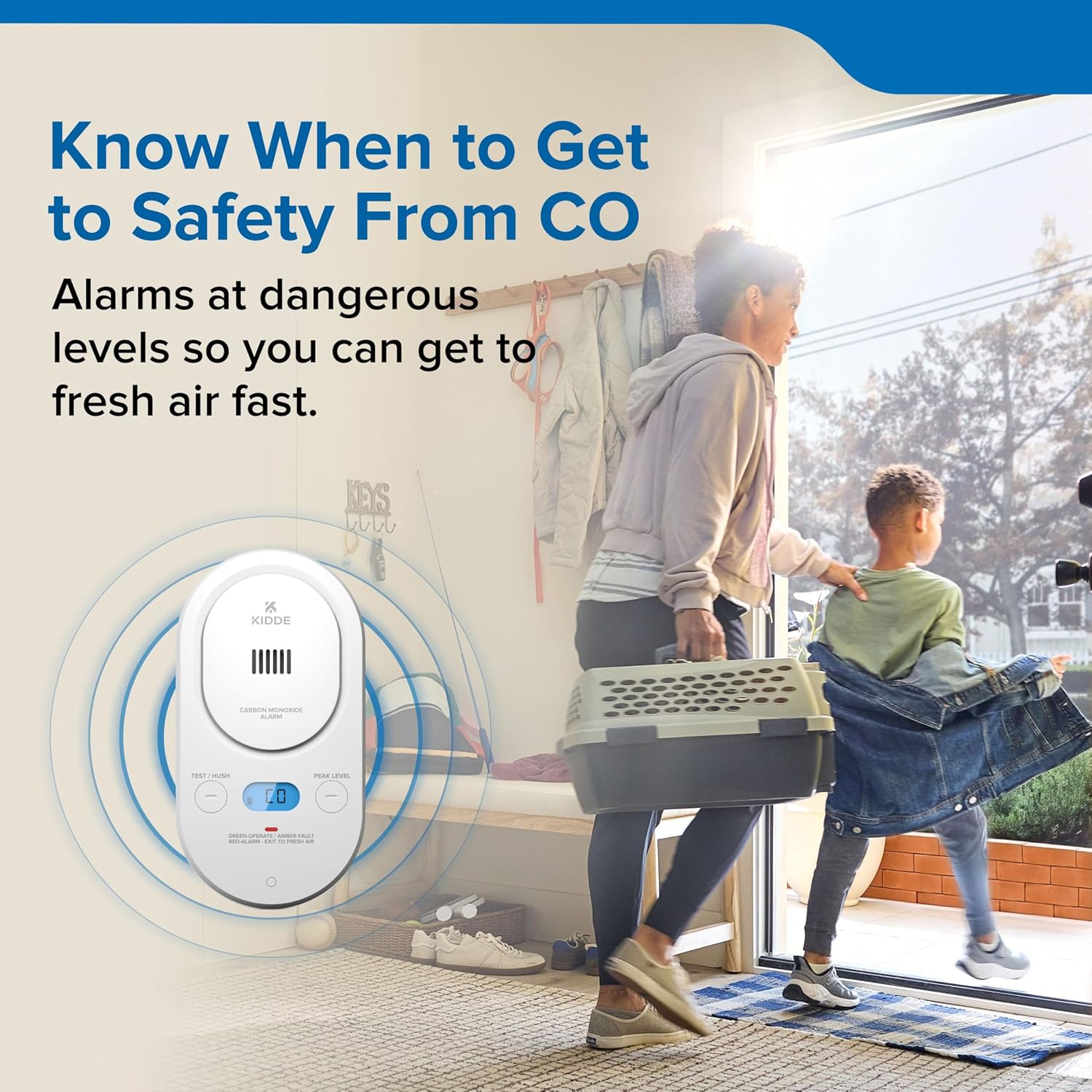
Plug-in CO detectors draw power directly from a wall outlet, which means you never chase a low-battery chirp at 3 a.m. Most include a battery backup — typically a 9V cell — that activates during power outages. The Kidde plug-in series is the most widely reviewed product in this category, and owners consistently flag one detail worth dwelling on: the END display alert. When a Kidde plug-in unit reaches the end of its sensor life — typically around seven years — the display cycles to “END” rather than simply going silent. That is not a trivial feature; it is the difference between knowing your protection has lapsed and assuming it has not.
The tradeoff: You need a correctly positioned outlet. Outlet placement in older homes does not always align with where CO detectors should go. The National Fire Protection Association’s NFPA 720: Standard for the Installation of Carbon Monoxide Detection and Warning Equipment advises against using extension cords with CO alarms, which limits placement flexibility considerably.
Decision rule: If your protection priority is a fixed bedroom hallway or near a furnace room with a nearby outlet, plug-in is the low-hassle baseline option.
TOPTES
$50.99
In stock on Amazon
Check price on Amazon2. Battery-Only Units with 10-Year Sealed Batteries: The 3 A.M. Problem Solved
The purchase story behind the X-Sense SC07 — and similar 10-year sealed-battery units — repeats itself across owner accounts with striking consistency: someone’s previous CO detector starts chirping at 3 a.m. with a dying-battery alert, they pull it off the wall in frustration, and they replace it with a sealed-battery unit specifically to never repeat that experience. The 10-year sealed battery means the detector and its power source are co-designed to expire together, eliminating the maintenance variable entirely.
By the numbers:
| Feature | Plug-In (Kidde) | 10-Yr Sealed Battery (X-Sense SC07) |
|---|---|---|
| Power source | AC outlet + 9V backup | Sealed lithium, 10-year rated |
| Sensor lifespan | ~7 years | ~10 years |
| Battery replacement | As needed | Never (replace unit at end of life) |
| Outlet required | Yes | No |
The tradeoff: Once the sealed battery is exhausted, the unit is exhausted — there is no extending its life by swapping cells. You are committing to a replacement cycle tied to the device, not the battery. For most buyers, that is a feature rather than a limitation.
Decision rule: If you want set-it-and-forget-it protection in a bedroom, hallway, or any room without a convenient outlet, a 10-year sealed unit is the lowest-friction option over its full service life.
X-Sense
$31.99
In stock on Amazon
Check price on Amazon3. Combination Smoke and CO Detectors: Convenience with One Documented Caveat
Combination units — devices that detect both smoke and CO in a single housing — appeal to homeowners who want to minimize device count and installation complexity. The Kidde 30CUD10 is the most-reviewed combo unit in this tier, and the bulk of owner feedback is positive. However, one documented early-failure report warrants acknowledgment: a unit that malfunctioned within its expected service window. That is not a pattern across the broader review set, but it is worth flagging because combination units carry a specific failure-mode risk that single-purpose units do not. If the housing fails, you lose two protection layers simultaneously.
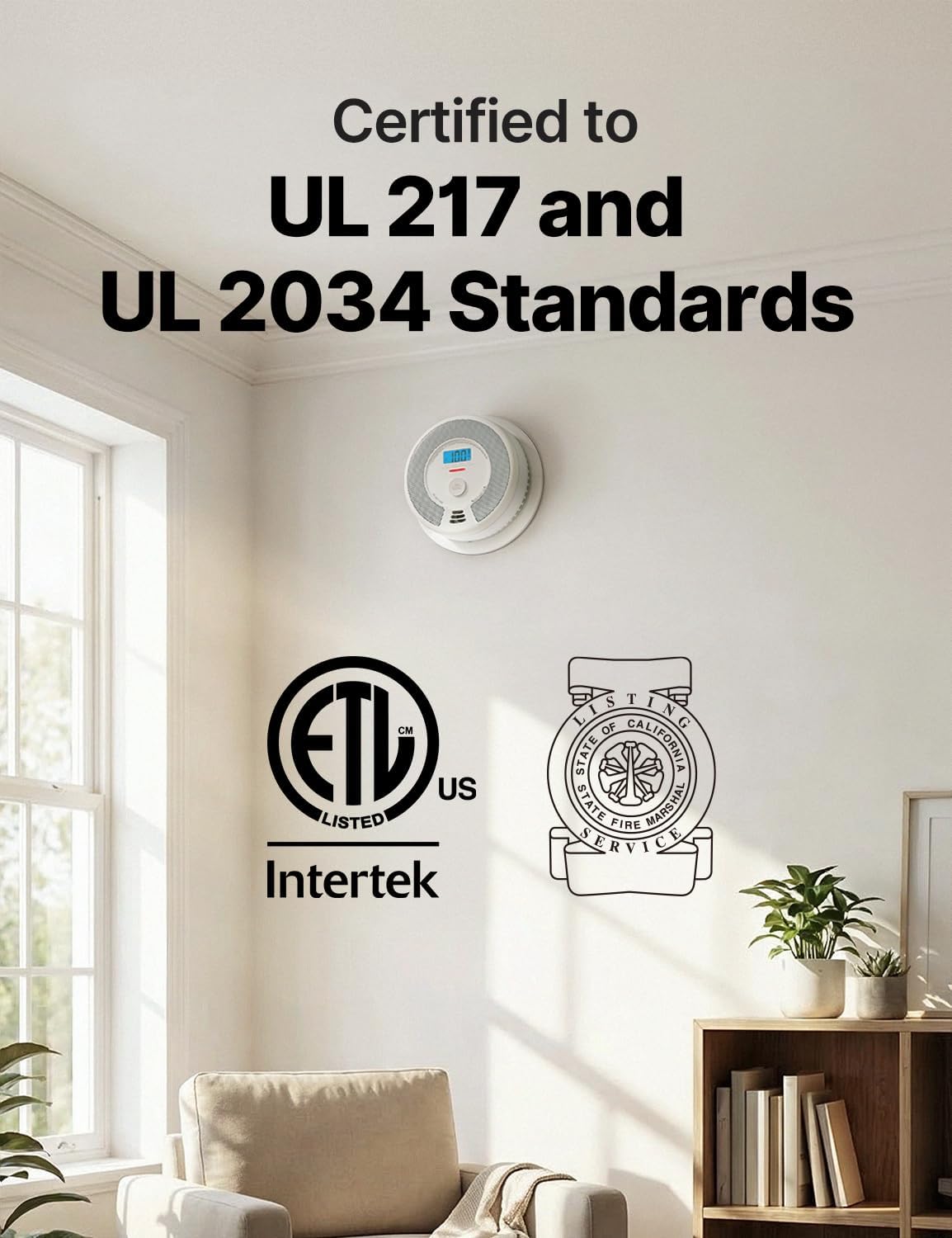
Per Underwriters Laboratories certification requirements, combination units must independently meet both UL 2034 (Single and Multiple Station Carbon Monoxide Alarms) and UL 217 (smoke alarm standards). The question is not whether a certified combo unit detects accurately — it is whether the convenience of a single device is worth the dependency.
The tradeoff: One installation point, one power source, one test button — but also one potential single point of failure. Property managers with code-compliance requirements should verify local jurisdiction acceptance of combo units before specifying them at scale.
Decision rule: If you are furnishing rental units or a vacation home where simplicity and reduced device count matter more than redundancy, combination units are defensible. If you are in a medically motivated or high-risk household — elderly residents, compromised respiratory health — consider dedicated units for each threat type.
TOPTES
$50.99
In stock on Amazon
Check price on Amazon4. Portable CO Sniffers: Situational Tools, Not Substitutes
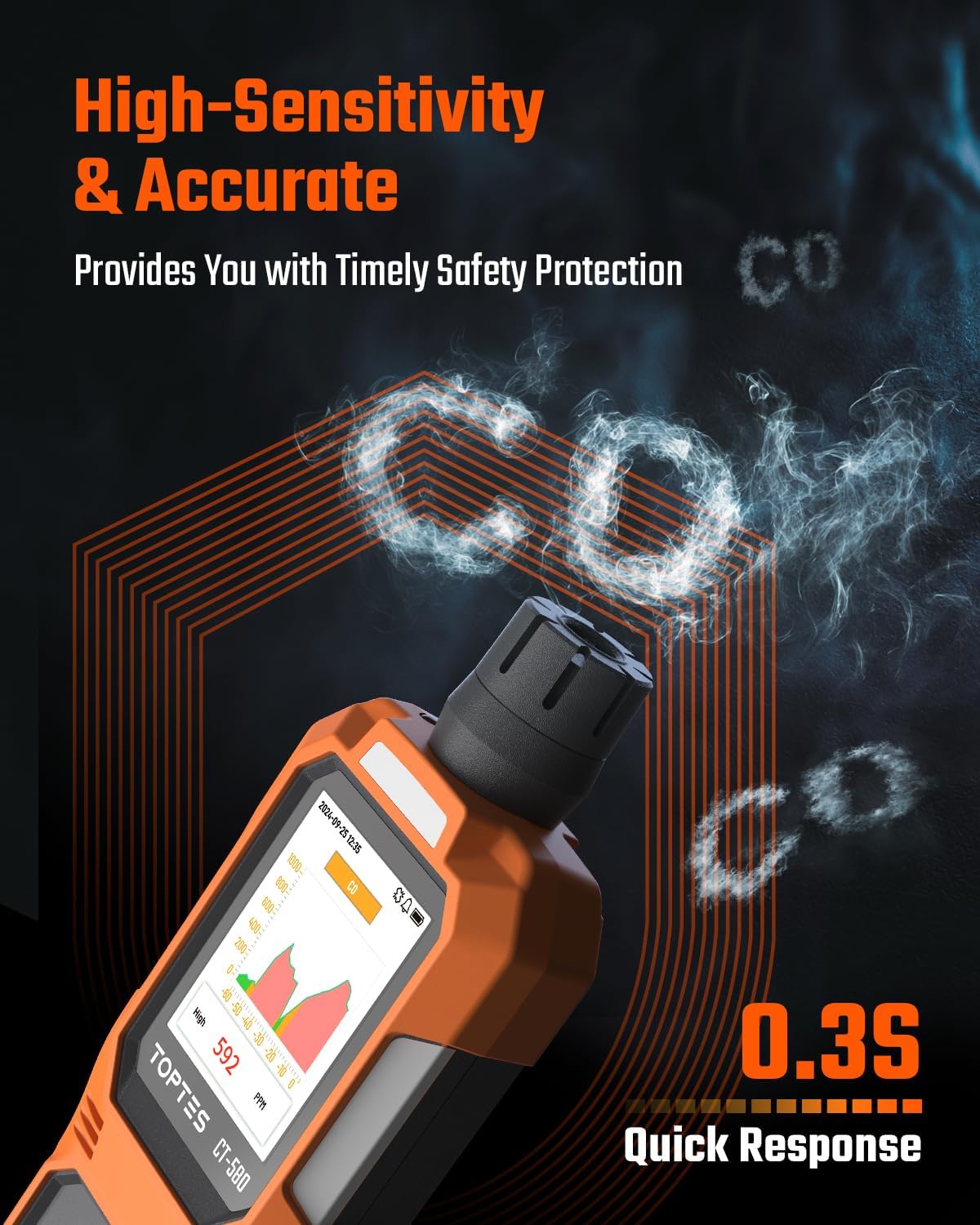
The TOPTES portable CO detector occupies a completely different use case than any wall-mounted unit. Owners who describe purchasing it are strikingly specific: a pregnant driver checking her vehicle for exhaust intrusion through the cabin, a boat owner who used the portable sniffer to identify which engine was leaking CO rather than simply that CO was present somewhere on board. These are situations where a wall-mounted unit is structurally incapable of helping — you need to move through a space with a live sensor and watch real-time PPM (parts per million — a measure of how many CO molecules exist per million air molecules) numbers change as you approach the source.
Portable sniffers typically display live numeric PPM readings, which gives them a diagnostic function that fixed detectors do not provide. The U.S. Environmental Protection Agency, in Carbon Monoxide’s Impact on Indoor Air Quality, notes that fixed detectors are designed to alarm at sustained exposure thresholds — per the Underwriters Laboratories standard UL 2034, alarms must trigger within 90 minutes at 70 PPM, within 35 minutes at 150 PPM, and within 15 minutes at 400 PPM — not to locate leak sources. A portable unit can detect 1–9 PPM variations that would never trigger a fixed alarm but matter enormously if you are trying to locate a slow exhaust leak.
The tradeoff: Portable CO sniffers require active use — someone must carry them through the space. They also typically lack the battery life and weatherproofing for permanent installation. They complement fixed protection; they do not replace it.
Decision rule: If you own a boat, RV, or vehicle with a suspected exhaust intrusion issue, or if you are a property manager investigating a CO complaint before bringing in a technician, a portable sniffer is the right specialized tool.
X-Sense
$31.99
In stock on Amazon
Check price on Amazon5. Smart CO Detectors with App Integration: Closing the Unoccupied-Home Gap
The most underappreciated use case in CO detection is the unoccupied home. A traditional CO detector — even a well-functioning one — alarms into an empty house. Nobody hears it. The Kidde Smart detector with Ring integration addresses this directly: it pushes alerts to your smartphone when CO is detected, regardless of whether you are physically present. Owners who flag this feature consistently identify the same scenario — a vacation home, a rental property, a house where the owners are traveling — where remote notification transforms a local alarm into an actionable alert.
Ring integration means the alert can also trigger connected devices in the Ring ecosystem, and the notification appears in the Ring app alongside other security alerts. For property managers or homeowners with HVAC-integrated systems, this represents a meaningful upgrade in protection posture at a fraction of the cost of a monitored security service.
The tradeoff: Smart units create app dependency. If the Wi-Fi connection is interrupted or app-tier permissions lapse, remote alerting may be degraded. The local alarm continues to function — but the unoccupied-home use case specifically requires reliable connectivity to deliver its core benefit.
Decision rule: If you manage a property you do not occupy continuously, or if you are integrating CO detection into a broader smart home or indoor air quality monitoring stack, smart CO detection closes a real gap that no other product type addresses.
Kidde
$51.00
In stock on Amazon
Check price on AmazonFrequently Asked Questions
Where exactly in a home should CO detectors be placed — near the floor or ceiling?
Unlike smoke, which rises, CO is roughly the same density as air and distributes relatively evenly throughout a space. The U.S. Consumer Product Safety Commission, in its guidance document Carbon Monoxide Detectors: Proper Placement and Use, recommends placing CO detectors at sleeping levels — typically on a wall or ceiling near each bedroom area — so occupants are alerted before concentrations reach dangerous levels during sleep. The National Fire Protection Association’s NFPA 720 specifies detectors on every level of the home and within ten feet of each sleeping area. Floor-level placement is not necessary or recommended.
How do I know when a CO detector has expired and needs replacement?
Most CO detectors use an electrochemical sensor with a rated lifespan of five to ten years depending on the unit. Better units display an “END” or “REPLACE” alert, as documented in Kidde plug-in owner reviews. If your unit lacks this feature, write the installation date on the back at setup. The U.S. Consumer Product Safety Commission recommends replacing CO detectors every five to seven years regardless of apparent function, because sensor degradation may not trigger an obvious failure mode — the unit may simply stop detecting accurately without alarming.
Can a portable CO detector be used to find a leak source in an RV or boat?
Yes — and this is specifically the use case owners describe for portable sniffers such as the TOPTES. Because portable units show live PPM readings, you can walk through a space and watch concentrations rise as you approach the source. Boat and RV owners report using portable sniffers to isolate which engine or appliance is contributing CO — a diagnostic step a fixed wall alarm cannot perform. The EPA’s Carbon Monoxide’s Impact on Indoor Air Quality endorses point-source testing as a diagnostic complement to fixed alarm systems.
Do combination smoke and CO detectors perform as well as dedicated single-purpose units?
Per Underwriters Laboratories certification requirements, combination units must independently meet both UL 2034 (CO alarm) and UL 217 (smoke alarm) standards — so a certified combo unit is not compromised in either detection capability. The practical concern raised in owner reviews is redundancy rather than sensitivity: a single-device failure eliminates both protections simultaneously. For high-risk households or commercial applications where code-compliance documentation matters, dedicated units provide cleaner audit trails and eliminate single-point-of-failure risk.
What does a numeric PPM reading on a digital CO detector actually mean for safety?
PPM stands for parts per million — a measure of how many CO molecules exist per million air molecules. For reference: the Occupational Safety and Health Administration, in its Carbon Monoxide Poisoning guidance, sets the permissible workplace exposure limit at 50 PPM over an eight-hour shift. Per the Underwriters Laboratories standard UL 2034, fixed CO alarms must trigger within 90 minutes at 70 PPM, within 35 minutes at 150 PPM, and within 15 minutes at 400 PPM. Below 35 PPM, most healthy adults experience no symptoms — but sustained low-level exposure between 35 and 70 PPM can cause headaches and fatigue, particularly in children, elderly individuals, and people with cardiovascular conditions. A digital display showing live PPM provides context a binary alarm does not: 10 PPM during furnace startup may be transient and normal; 10 PPM sustained for hours warrants investigation.
The Decision Rule
Match the product to the scenario, not the price point:
- Fixed outlet available, bedroom hallway or furnace room: Plug-in unit (Kidde plug-in series).
- No outlet, set-and-forget priority: 10-year sealed battery (X-Sense SC07).
- Rental unit, vacation home, device-count minimization: Combination smoke/CO (Kidde 30CUD10), with the single-point-of-failure caveat acknowledged.
- Boat, RV, vehicle, or leak investigation: Portable sniffer (TOPTES) as a supplement — not a substitute — for fixed protection.
- Unoccupied property, smart home stack, remote alerting: Smart CO detector with Ring integration.
The wrong detector for the situation is not just a suboptimal purchase — it is a protection gap. None of these categories require significant budget: the most expensive unit here costs less than a single HVAC service call. The only genuinely costly mistake is leaving any of these scenarios unaddressed.