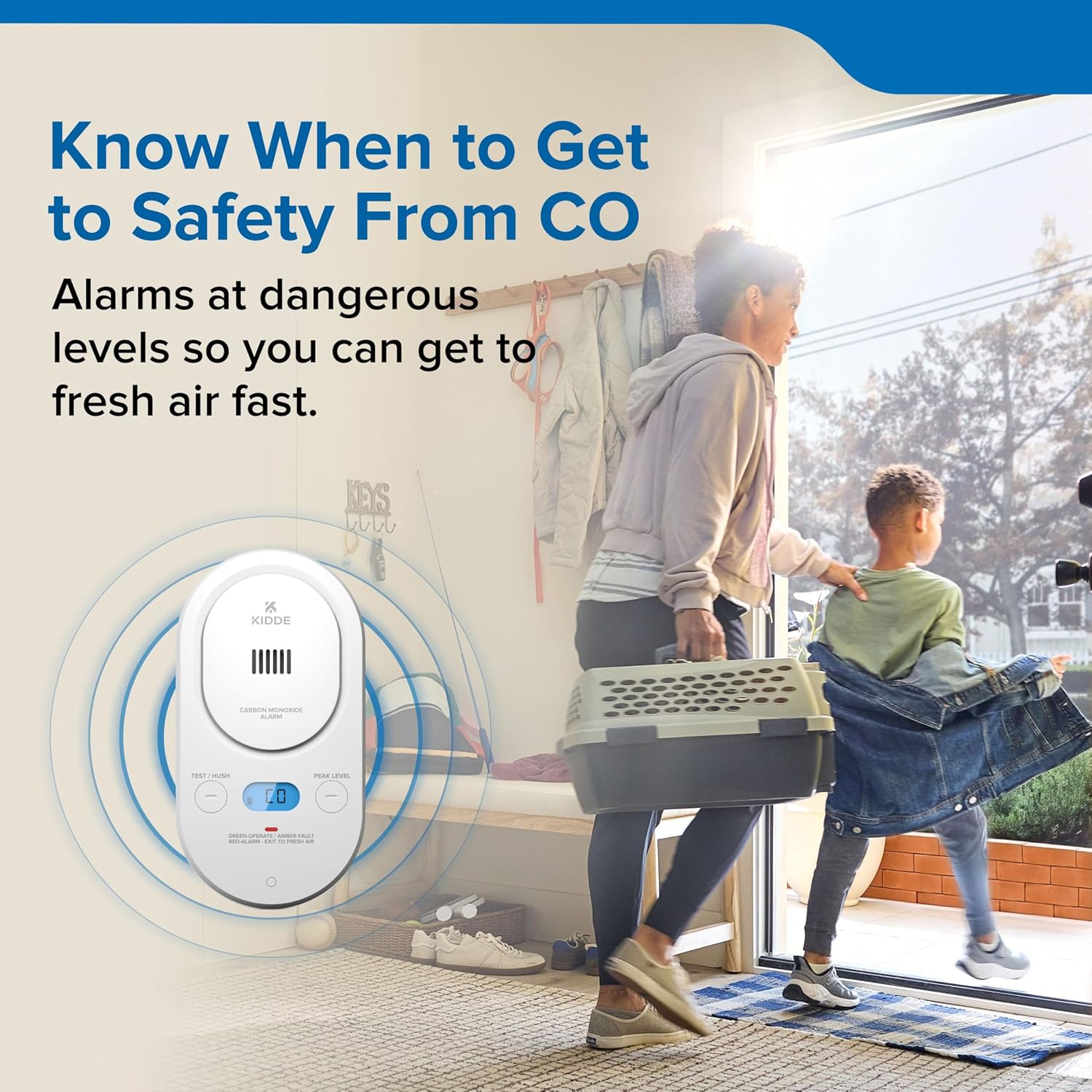
Carbon monoxide — CO for short — is sometimes called the “invisible killer” because you genuinely cannot see, smell, or taste it. It’s a gas produced whenever something burns: your gas furnace, a fireplace, an attached garage with a running car, even a gas range. At low concentrations it causes headaches and dizziness that most people chalk up to the flu. At high concentrations it can be fatal within minutes. A carbon monoxide detector is a small, plug-in or battery-powered device that monitors the air in your home and sounds an alarm before CO reaches dangerous levels. If you have any fuel-burning appliance or an attached garage, you need at least one — and probably several. This guide explains what the spec labels actually mean, which sensor technology is worth paying for, and exactly where to mount every unit so you’re covered, not just compliant.
| EDITOR'S PICK[First Alert CO606](https://www.amazon.com/dp/B07B4CGQLT?tag=greenflower20-20) | Mid-tier[Kidde Smoke and Carbon Monoxide…](https://www.amazon.com/dp/B0DDWS7Z3S?tag=greenflower20-20) | Budget pick[X-Sense Smoke Detector Carbon M…](https://www.amazon.com/dp/B0GGHFD2B8?tag=greenflower20-20) | |
|---|---|---|---|
| Power source | Hardwired & battery | Battery | Battery |
| Battery backup | ✓ | — | — |
| Battery life | — | 10-Year | 10-Year |
| Detection type | CO only | Smoke & CO | Smoke & CO |
| Display | — | — | LCD |
| Alarm loudness | — | 85 dB | — |
| Price | $64.49 | $51.00 | $31.99 |
| See on Amazon → | See on Amazon → | See on Amazon → |
Why “UL Listed” Is the First Thing to Check — and What It Actually Means
Before placement or features, start with certification. The Underwriters Laboratories UL 2034 standard is the baseline safety certification for residential CO alarms sold in the United States. Per UL’s published documentation on UL 2034, a listed alarm must activate at specific CO concentration thresholds held over specific time windows — it cannot simply trip at any momentary spike. That design intent matters: CO alarms are engineered to not false-alarm from brief, minor exposure (like a car idling momentarily in a nearby street) while still catching sustained dangerous buildup.
What UL 2034 requires, in plain terms:
- The alarm must not sound at 70 parts per million (ppm) held for less than 60 minutes
- The alarm must sound at 70 ppm held for 60–240 minutes
- The alarm must sound at 150 ppm within 10–50 minutes
- The alarm must sound at 400 ppm within 4–15 minutes
This tiered response is intentional. The longer CO sits at lower levels, the more biological damage it does — so the standard scales urgency with concentration and duration. If you’re buying a detector and it doesn’t say “UL 2034” or “UL Listed” on the box, put it back.
The National Fire Protection Association’s NFPA 720 standard (Standard for the Installation of Carbon Monoxide Detection and Warning Equipment) builds on UL 2034 by specifying where detectors must be installed, not just what the devices must do. Many state and local codes have adopted NFPA 720 language directly, so it’s the reference document contractors and inspectors cite.
Sensor Types: Electrochemical vs. Biomimetic vs. Metal Oxide Semiconductor
Most buyers don’t realize CO detectors use three distinct sensing technologies, each with different performance profiles and price implications. Understanding the tradeoff is especially useful if you’re outfitting a multi-zone home or comparing a $25 unit to a $70 one.
Electrochemical sensors are the dominant technology in mid-to-high-grade residential detectors. A small chemical cell generates electrical current proportional to CO concentration. Electrochemical sensors are accurate across a wide concentration range, respond relatively quickly, and have low false-alarm rates. Manufacturers typically rate them for 5–7 years. The CDC’s FAQ on carbon monoxide poisoning implicitly endorses this technology by recommending detectors from established brands — virtually all of which use electrochemical cells at the $40+ price point.
Biomimetic sensors use a gel that changes color when it absorbs CO, triggering an optical or electrical alarm. They’re accurate but slower to respond at very low concentrations, and they can be sensitive to humidity. They appear in some first-generation combo devices but are less common now.
Metal oxide semiconductor (MOS) sensors use a tin-dioxide surface that changes electrical resistance when CO is present. They’re cheap to manufacture, which is why you find them in the lowest-cost units. The tradeoff: MOS sensors can trip on other gases (hydrogen from batteries, alcohol vapor), produce more false alarms, and are generally less precise at the low-concentration, long-duration exposure window that UL 2034’s lower thresholds are designed to catch. For a primary detector in a bedroom hallway, electrochemical is worth the extra $20.
By the numbers — sensor technology at a glance:
| Sensor Type | Typical Price Range | Rated Lifespan | False-Alarm Tendency |
|---|---|---|---|
| Electrochemical | $35–$120 | 5–7 years | Low |
| Biomimetic | $30–$60 | 2–3 years | Low-moderate |
| Metal Oxide (MOS) | $15–$40 | 2–5 years | Moderate-high |
Placement: The NFPA 720 Logic and Where Most Homes Fall Short
This is where most homeowners — even conscientious ones — have gaps. CO doesn’t behave like smoke: it’s slightly lighter than air but mixes quickly throughout a room, so ceiling vs. knee-height placement matters less than which rooms you cover.
Required by NFPA 720 and most state codes:
- On every level of the home, including the basement
- Outside every separate sleeping area (meaning the hallway, not inside the bedroom — though inside each bedroom adds meaningful protection, especially if doors are closed at night)
- In any room with a fuel-burning appliance if that room is a sleeping area
High-priority locations most guides underemphasize:
The basement, especially near the furnace. Your gas furnace is the single most common CO source in a well-maintained home, and a cracked heat exchanger — an internal component that separates combustion gases from circulated air — can leak CO directly into your ductwork. A detector within 10 feet of the furnace gives you the earliest warning. Per the EPA’s indoor air quality guidance on carbon monoxide, malfunctioning heating equipment is responsible for the majority of non-fire CO incidents in residential settings.
The attached garage or the rooms directly above it. A car left running for even 2–3 minutes in an attached garage — even with the garage door open — can push CO concentrations into dangerous territory in the space above. Place a detector in the garage itself (rated for the temperature swings garages experience) and in the room directly above if one exists.
Near any sleeping areas. CO poisoning during sleep is particularly dangerous because you don’t wake up from the headache that would otherwise alert you. Inside every bedroom, in addition to the hallway unit, is a conservative but defensible choice for households with children, elderly members, or anyone with cardiovascular conditions.
Where detectors are less useful:
- Kitchens: the CPSC advises keeping CO detectors at least 15 feet from fuel-burning cooking appliances to reduce false alarms from normal cooking activity
- Directly adjacent to bathrooms with gas water heaters: fine to have one nearby, but the humidity can stress some sensor types
The interconnect question: Modern hardwired CO detectors can be interconnected so that when one trips, every unit in the house sounds. For homes with complex layouts or multiple floors, interconnected systems — either hardwired or via Z-Wave/Zigbee wireless links — are worth the installation cost. If your alarm sounds at 2 AM and the source is the basement furnace, you want the bedroom unit screaming, not just the basement unit.
Smart Features, Combo Units, and Total Cost of Ownership
The market in 2026 has converged significantly on combination smoke/CO detectors, and for most households that’s a reasonable choice — with caveats.
Combo units simplify installation and ensure CO coverage wherever you have a smoke detector. The tradeoff: smoke detectors typically need replacing every 10 years, while electrochemical CO sensors age out at 5–7 years. A combo unit on the 7-year sensor schedule means you’re replacing the whole device more often than a smoke-only unit would require. Check the manufacturer’s end-of-life date printed on the back of the unit — most electrochemical detectors include a date-coded sticker, and per CPSC guidance, you should replace the entire unit when that date passes, regardless of whether the alarm still sounds during the self-test.
Smart/connected detectors from brands like Kidde and First Alert now offer Wi-Fi or Z-Wave integration, push notifications to your phone when an alarm triggers, and — in higher-end versions — ppm readout on an app so you can see whether a 35 ppm reading is trending up or has plateaued. For a household with a vacation property, a rental unit, or an elderly relative living alone, remote notification is legitimately valuable. Owners consistently report that the peace-of-mind factor of a phone alert when you’re away is the feature they use most.
5-year total cost of ownership math for a 3-level home (basement, main floor, upper floor, plus 3 bedrooms):
Assume 8 units: 3 hallway units + 3 bedroom units + 1 basement + 1 garage.
- Budget MOS-sensor units at ~$25 each: $200 upfront, likely replaced at year 3–4 due to false alarms or sensor degradation → ~$400 over 5 years
- Mid-grade electrochemical at ~$45 each: $360 upfront, 5–7 year lifespan → $360–$400 over 5 years
- Smart electrochemical at ~$80 each: $640 upfront, 5–7 year lifespan → $640 over 5 years, with remote monitoring included
The mid-grade electrochemical option wins on 5-year TCO while delivering superior sensor accuracy. Smart units are worth the premium specifically when remote monitoring has household utility — otherwise you’re paying for an app you’ll open twice.
The Decision Framework: If X, Then Y
If your home has any fuel-burning appliance (gas furnace, boiler, gas range, fireplace, wood stove) or an attached garage: you need CO detectors. Full stop. Start with one per floor plus one per sleeping area hallway, all UL 2034 listed with electrochemical sensors.
If you’re in a fully electric home with no attached garage: CO risk is low but not zero (neighboring units in apartments, emergency generator use during outages). One detector per floor is a low-cost insurance policy.
If you have an older home with a gas furnace over 15 years old: prioritize a basement unit near the furnace and schedule an HVAC inspection. The CPSC recommends annual professional service of fuel-burning appliances — a cracked heat exchanger is the scenario that makes CO detectors earn their keep.
If you’re managing a rental property or short-term rental: check your state’s specific CO detector statutes. As of 2026, the majority of U.S. states mandate CO detectors in rental housing, many following NFPA 720 placement requirements. Non-compliance creates both safety liability and legal exposure.
If interconnect and remote alerting matter (large home, elderly household member, rental property): step up to smart units with Wi-Fi notification or invest in a hardwired interconnected system during your next HVAC or electrical project.
The spec labels on CO detectors look intimidating — ppm thresholds, sensor chemistries, UL numbers — but they translate to a simple principle: buy UL 2034 certified, choose electrochemical, place one on every level and outside every sleeping area, and replace on the manufacturer’s schedule. That’s the whole job. Everything else is optimization.