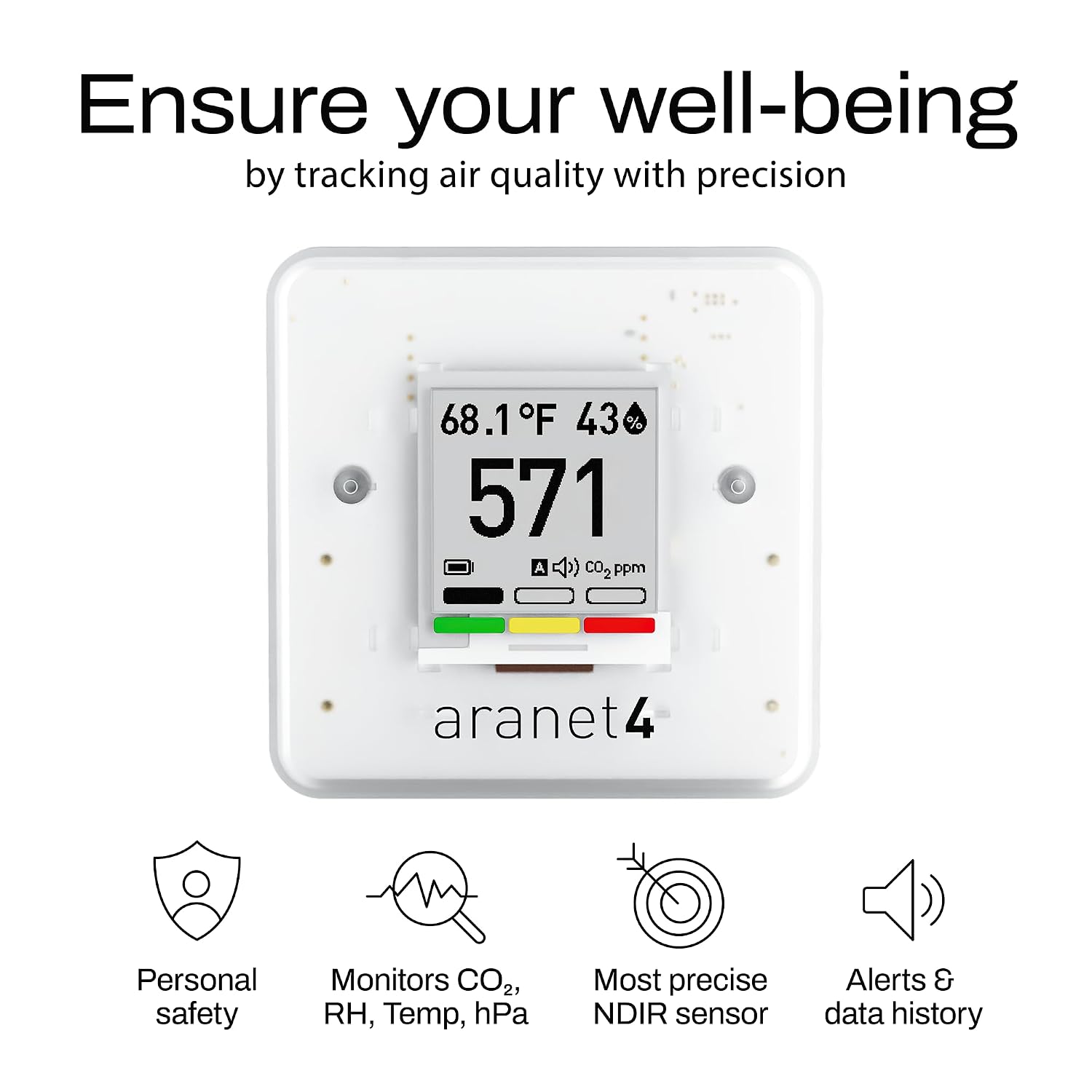
Carbon dioxide — the gas you exhale with every breath — is invisible, odorless, and quietly accumulating in every room you spend time in. At normal outdoor concentrations (roughly 420 parts per million, or ppm, in 2026), CO2 is harmless. But in a sealed bedroom overnight or a poorly ventilated home office, occupant breathing can push levels above 1,500, 2,000, even 4,000 ppm before anyone notices. At those concentrations, peer-reviewed research links elevated CO2 directly to impaired decision-making, reduced alertness, and disrupted sleep quality — not because CO2 is acutely toxic at those levels, but because rising CO2 is both a direct physiological stressor and a reliable indicator that fresh air (and oxygen) aren’t circulating adequately. A CO2 monitor is simply a device that measures that concentration in real time and shows it on a display or app so you can act on it. This guide explains what those readings actually mean, which monitors are worth buying for home office and bedroom use, and how to turn that data into better air — and better days.
| EDITOR'S PICK[Aranet4 Home](https://www.amazon.com/dp/B07YY7BH2W?tag=greenflower20-20): Wireless Indoor A… | Mid-tier[BREATHE Airmonitor Plus Indoor](https://www.amazon.com/dp/B0CLYRBRSB?tag=greenflower20-20)… | Budget pick[Amazon Smart Air Quality Monito](https://www.amazon.com/dp/B08W8KS8D3?tag=greenflower20-20)… | |
|---|---|---|---|
| CO2 sensor | ✓ | ✓ | — |
| PM2.5 sensor | ✗ | ✓ | — |
| VOC sensor | ✗ | ✓ | — |
| Formaldehyde | ✗ | ✓ | — |
| Display type | E-Ink | — | — |
| Battery powered | ✓ | — | — |
| Price | $159.00 | $95.99 | $44.99 |
| See on Amazon → | See on Amazon → | See on Amazon → |
Why CO2 Levels Spike Faster Than You Think
Most people imagine their bedroom as a large, airy space. In practice, a sealed 12×12-foot room with an 8-foot ceiling holds roughly 1,150 cubic feet of air — about 32.5 cubic meters. Two adults sleeping in that room exhale approximately 200 liters of CO2 per hour combined. Do the arithmetic and you’ll find CO2 concentrations climbing above 1,500 ppm within two to three hours of closing the door, reaching 2,000–2,500 ppm by morning if ventilation is minimal. The same dynamic plays out faster in smaller home offices, where one person sitting at a desk for a focused four-hour work block can push a 100-square-foot room above 1,200 ppm without any dramatic air quality event occurring.
By the numbers:
| CO2 Level (ppm) | What Research Associates With It |
|---|---|
| 400–700 | Outdoor baseline to well-ventilated indoor — cognitive performance unimpaired |
| 800–1,000 | ASHRAE 62.1’s informal “comfort threshold” for occupied spaces |
| 1,000–1,500 | Harvard BREATHE Study links to measurable declines in decision-making scores |
| 1,500–2,500 | Drowsiness, difficulty concentrating — common in sealed bedrooms overnight |
| 2,500–5,000 | Significant cognitive impairment; one reviewer reported 4,500 ppm in their own small office |
| >5,000 | OSHA workplace ceiling for 8-hour exposure; rare in residential settings but achievable in very small sealed spaces |
The Harvard T.H. Chan School of Public Health’s BREATHE Study — one of the most cited pieces of research in this space — found that doubling CO2 concentrations from 550 ppm to 1,000 ppm produced a 15% decline in cognitive function scores across nine decision-making domains. At 2,500 ppm, scores dropped by roughly 50%. That’s not a minor rounding error in your productivity — that’s the difference between a sharp afternoon and one where you re-read the same paragraph four times.
ASHRAE Standard 62.1-2022, the ventilation engineering industry’s primary reference, uses 1,000 ppm as a practical benchmark for adequate ventilation in occupied spaces, not because it’s a safety threshold but because it reliably indicates that fresh-air delivery is sufficient for typical occupancy. Per the EPA’s indoor air quality guidance, CO2 itself at these levels isn’t the direct harm — it’s the canary in the coal mine for overall ventilation adequacy, which determines whether other pollutants, humidity, and airborne particles are also accumulating.
Which CO2 Monitors Are Actually Worth Buying
Not all CO2 sensors use the same underlying technology. The meaningful distinction is between NDIR sensors (Non-Dispersive Infrared — the gold-standard detection method that directly measures CO2 molecules using light absorption) and cheaper electrochemical or “estimated CO2” sensors that infer CO2 from other gases like VOCs. Consumer monitors worth considering for home offices and bedrooms all use NDIR technology. Anything marketed as “eCO2” is making an educated guess, not a measurement.
Aranet4 Home is the device that technically literate reviewers keep returning to. One published reviewer explicitly compared the Aranet4 against a professional-grade TIM10 CO2 analyzer and reported readings within acceptable tolerances — a level of user-reported accuracy validation that’s rare in this category. The Aranet4 uses a Swedish-made NDIR sensor, updates every two minutes by default (configurable down to one minute), displays readings on a clean E-ink screen visible in direct sunlight, and syncs via Bluetooth to a companion app. Battery life is measured in years, not weeks. The tradeoff is that the Aranet4 is a single-purpose device — it doesn’t measure particulate matter, humidity, or VOCs — and it requires periodic outdoor calibration (more on that in the FAQ). For buyers who want the most trustworthy CO2 number possible and are willing to pay for that confidence, the Aranet4 is the reference standard at the consumer price point.
Airthings View Plus takes the opposite approach: it’s a comprehensive sensor platform measuring CO2, PM2.5, VOCs, humidity, pressure, radon, and light. An Airthings owner writing in-depth reviews specifically cited buying the View Plus for a finished basement where teenagers spend significant time studying — framing CO2 monitoring as a genuine health and safety concern rather than a comfort nicety. The cloud-connected dashboard and multi-sensor coverage make the View Plus well-suited to buyers who want a single device that answers multiple air quality questions. The tradeoff that must be acknowledged plainly: at least one documented owner report describes the device becoming permanently non-functional after a firmware update, with Airthings support unable to resolve it. This is a real risk with any cloud-dependent device where functionality is tied to software the manufacturer controls. It doesn’t disqualify the View Plus — it means buyers should treat it as a connected appliance with software dependencies, not a standalone instrument.
Amazon Smart Air Quality Monitor earns a specific mention not primarily for CO2 accuracy but for ecosystem integration. Multiple reviewers specifically call out its ability to trigger Alexa routines based on live air quality readings — without requiring IFTTT workarounds — as a genuinely practical feature. If your ventilation fan, smart window opener, or air purifier is on Alexa, this monitor can automate the response to rising CO2 without any manual intervention. That use case is meaningfully different from a standalone display monitor and worth the tradeoff in sensor sophistication.
BREATHE AirMonitor Plus represents the “wake-up call” device category. One published reviewer reported discovering 4,500 ppm CO2 in their own small home office — a reading they described as an immediate and dramatic revelation about a problem they hadn’t suspected. For buyers who are still in the “do I even have a problem?” phase, an accessible monitor that delivers real-time alerts performs a different and legitimate function than a lab-grade instrument.
Turning Readings Into Action: Ventilation, Not Purification
Here’s the decision-frame that matters most: CO2 is not removed by air purifiers. A HEPA filter captures particles. A carbon-activated filter adsorbs certain gases. Neither does anything meaningful to CO2 concentrations because CO2 is a simple, stable gas that only leaves a space through ventilation — moving air out and fresh air in. If your CO2 monitor reads 1,800 ppm, opening a window for 15 minutes will drop it faster than any purifier running on high.
The practical protocol most IAQ practitioners recommend:
- Establish your baseline. Run your monitor for a week without changing behavior. Note when and where readings peak — typically early morning in the bedroom, or mid-afternoon in a closed home office.
- Identify the intervention. A bedroom that hits 2,000 ppm overnight needs ventilation during sleep: a cracked window, a heat-recovery ventilator (HRV), or a ERV unit that exchanges air without dumping conditioned air. A home office that spikes during a four-hour focus block needs either a window-opening habit or mechanical ventilation.
- Automate the response. If your CO2 monitor has smart home integration — Airthings via its API, the Amazon Smart AQM via Alexa, or the Aranet4 via third-party integrations — you can trigger a ventilation fan or smart window to activate automatically when CO2 crosses a threshold. The IAQA’s residential CO2 monitoring guidance frames this feedback loop as the primary value proposition of continuous monitoring over spot-checks.
The virus transmission angle is real and worth naming directly: multiple buyers across multiple CO2 monitor product categories have explicitly framed CO2 monitoring as a proxy for airborne disease transmission risk. The logic is sound — elevated CO2 indicates reduced fresh-air dilution, which is the same condition that allows airborne pathogens to accumulate. CO2 monitoring doesn’t replace other protective measures, but it provides real-time feedback on the ventilation adequacy that underlies them.
Frequently Asked Questions
What CO2 level is actually dangerous vs. just uncomfortable or impairing focus? Genuinely dangerous CO2 concentrations — those that cause acute physiological harm — begin above 5,000 ppm for sustained exposure (OSHA’s 8-hour ceiling) and become acutely dangerous above 40,000 ppm. Levels common in homes (1,000–3,000 ppm) are not dangerous in that acute sense. But “not dangerous” isn’t the same as “no effect.” The Harvard BREATHE Study documents measurable cognitive performance declines starting around 1,000 ppm. Most practitioners use 800–1,000 ppm as an action threshold for occupied spaces, per ASHRAE 62.1-2022 guidance.
Do air purifiers reduce CO2 levels, or do I need to open windows? Air purifiers do not reduce CO2. No HEPA, UV-C, ionizer, or carbon filter removes meaningful quantities of CO2. Ventilation — moving outdoor air in and indoor air out — is the only residential solution. Opening windows is the fastest intervention. Mechanical options include ERV/HRV units, exhaust fans, or whole-home ventilation systems.
How accurate are consumer CO2 monitors compared to professional equipment? NDIR-based consumer monitors — Aranet4, Airthings, and similar — are generally accurate to ±50–75 ppm or ±3–5% of reading, which is adequate for the action decisions homeowners need to make. One Aranet4 reviewer who compared readings directly against a professional TIM10 analyzer reported good agreement. Electrochemical “eCO2” sensors found in cheaper monitors can be off by hundreds of ppm. The gap matters less at extreme values (clearly high) and most at the critical 800–1,200 ppm threshold where decisions about ventilation hang.
Does the Aranet4 really need to be calibrated outdoors and how often? Yes. The Aranet4 uses a self-calibration process that requires exposure to outdoor air (approximately 420 ppm in 2026) to reset its baseline. Technically literate reviewers describe this as a genuine requirement — not a marketing note — and recommend calibrating every few weeks if the device is used continuously in high-CO2 environments. The process involves placing the device outdoors in a shaded, open location for 15–20 minutes and initiating a calibration sequence in the app. Skipping it can result in baseline drift that makes readings read artificially low.
Can I use a CO2 monitor to trigger my smart air purifier or fan automatically? Yes, with the right monitor and ecosystem. The Amazon Smart AQM can trigger Alexa routines directly — multiple reviewers specifically praise this capability for running without IFTTT dependency. Airthings devices can trigger automations via their API and IFTTT. Note that triggering a purifier won’t lower CO2 (see above), but triggering a ventilation fan, smart window, or ERV unit will. The most useful automation is CO2 threshold → ventilation device on, not CO2 threshold → air purifier on.
What caused my CO2 readings to suddenly spike — and is my Airthings monitor malfunctioning? Sudden spikes are almost always real events: a guest in the room, cooking nearby (combustion produces CO2), a window that closed, or a change in HVAC mode that reduced fresh-air intake. If readings spike with no occupancy and no changed conditions, check whether the sensor has drifted and needs outdoor calibration recalibration. The firmware-related bricking issue documented in Airthings reviews is a distinct problem — a device that stops functioning entirely after an update is not a sensor calibration issue. If your Airthings device is non-responsive after a firmware update, that’s a warranty/support matter, not an air quality event. Back up your historical data periodically if you rely on Airthings for long-term trend analysis.