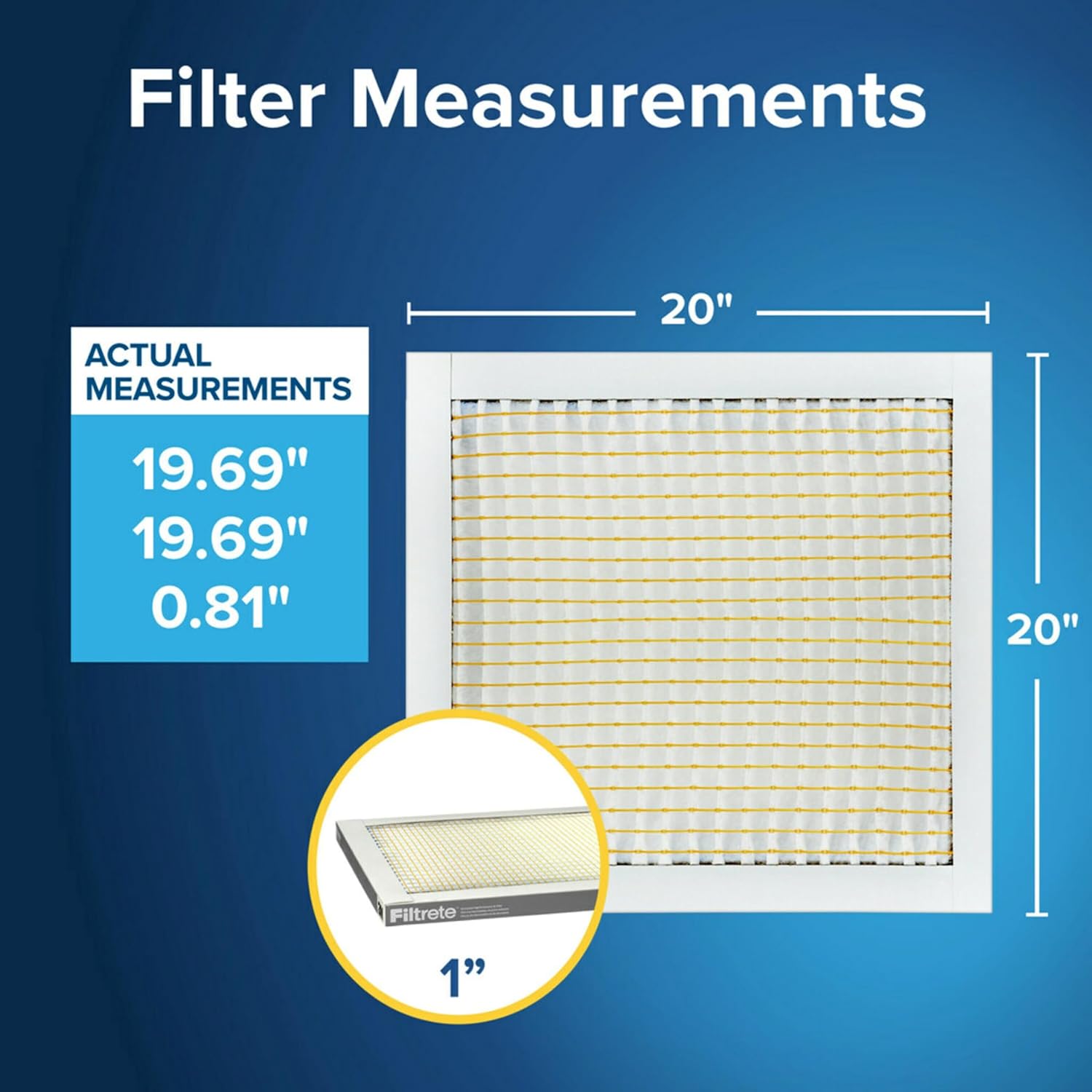
Your furnace filter — that flat panel sitting inside your air handler — does more than keep dust off the blower fan. Every cubic foot of air in your home cycles through it multiple times a day, so whatever that filter captures (or misses) directly shapes what you and your family breathe. The number printed on the filter’s edge is its MERV rating (Minimum Efficiency Reporting Value), a standardized score developed by ASHRAE — the American Society of Heating, Refrigerating and Air-Conditioning Engineers — that tells you how well the filter traps particles of different sizes. A MERV 4 fiberglass panel barely catches visible lint. A MERV 16 hospital-grade filter stops bacteria and fine smoke. What you need sits somewhere in between, and choosing wrong costs you either air quality or airflow — sometimes both. This guide walks through how to read those ratings, what they mean for your specific system, and when the math justifies stepping up to a whole-home integrated filtration solution.
| EDITOR'S PICK[Genuine AprilAire 213 Replaceme…](https://www.amazon.com/dp/B00UOXMCBI?tag=greenflower20-20) | Mid-tier[Genuine AprilAire 413 Replaceme…](https://www.amazon.com/dp/B00UOXM6W8?tag=greenflower20-20) | Budget pick[Filtrete 16x20x1 Air Filter](https://www.amazon.com/dp/B07FP5X2S3?tag=greenflower20-20) | |
|---|---|---|---|
| MERV rating | 13 | 13 | 11 |
| Size | 20x25x4 | 16x25x4 | 16x20x1 |
| Pack size | 2 | 1 | 2 |
| MPR rating | — | — | 1000 |
| Use period | — | — | 3-Month |
| Price | $106.99 | $57.88 | $21.99 |
| See on Amazon → | See on Amazon → | See on Amazon → |
What the MERV Scale Actually Measures
MERV runs from 1 to 20. The test protocol, defined in ASHRAE Standard 52.2, fires calibrated particles at a filter in three size ranges — roughly 0.3–1 µm, 1–3 µm, and 3–10 µm — and measures what percentage gets stopped at each size. The minimum efficiency across those ranges is the rating. That “minimum” detail matters: a filter doesn’t get credit for its best-case performance; it’s rated on its worst.
Here’s a condensed breakdown of where common filter classes land:
| MERV Range | What It Stops | Typical Use Case |
|---|---|---|
| 1–4 | Large dust, lint, pollen >10 µm | Basic equipment protection only |
| 5–8 | Mold spores, pet dander, dust mites | Residential entry point, most builder-grade installs |
| 9–12 | Fine dust, Legionella, vehicle exhaust particles | Allergy-conscious homeowners, good residential standard |
| 13–16 | Bacteria, tobacco smoke, fine PM2.5 | High-performance residential, light commercial |
| 17–20 | Virus carriers, sub-0.3 µm particles | Cleanrooms, surgical suites |
For residential HVAC purposes, the working range is MERV 8 through MERV 13. Per the U.S. EPA’s Guide to Air Cleaners in the Home, MERV 13 is the threshold at which a filter begins to address fine particulate matter (PM2.5) — the category most strongly linked to respiratory and cardiovascular health outcomes. That’s a useful decision anchor: if PM2.5 is your concern (wildfire smoke, urban pollution, gas cooking), MERV 13 is your floor.
The Airflow Tradeoff: Why You Can’t Just Max Out the Rating
Here’s the tradeoff most guides skim past. Higher MERV = denser media = more resistance to airflow. That resistance is measured as static pressure drop, and your HVAC system’s blower fan was engineered to work within a specific static pressure range. Push it too high and you get:
- Reduced airflow — the system moves less air per minute, lowering heating and cooling effectiveness
- Coil freeze-up — in cooling mode, restricted airflow causes the evaporator coil to drop below freezing, icing over and stopping cooling entirely
- Blower motor strain — the motor works harder against resistance, raising energy consumption and shortening equipment life
Per IAQA technical guidance, most residential systems installed before 2018 were designed around MERV 8 filters. If you slot in a MERV 16 without checking your equipment specs, you are almost certainly starving the system of airflow. The filter may be cleaner on paper; your air quality and your utility bill may both get worse.
The practical rule: Check your HVAC manufacturer’s documentation for maximum rated static pressure drop (usually 0.08–0.15 inches of water column at rated airflow). Cross-reference that against the filter manufacturer’s pressure-drop curve at your system’s nominal CFM. If you can’t find those specs, MERV 11 in a properly sized 4-inch media filter is the safe residential ceiling for most systems built since 2010. Thicker filters (4-inch vs. 1-inch) dramatically reduce pressure drop at the same MERV rating — a 4-inch MERV 11 often causes less restriction than a 1-inch MERV 8.
The Case for Whole-Home Integrated Filtration
A standalone 1-inch slot filter is a compromise by design. Its surface area is limited, it loads up fast (typically every 30–90 days), and it sits downstream of the blower in most systems — meaning particles circulate through your living space before getting a filtration pass. Whole-home integrated systems address these constraints at the architecture level.
HVAC-Integrated Media Cabinets
Products like the Aprilaire 5000 (electronic air cleaner) and Aprilaire 4400 (media filter cabinet) install directly into the return-air duct before the air handler, giving the filter a larger cross-sectional area — often 16×25 inches or larger versus a standard 16×20 slot. That larger face area drops velocity across the media, cuts pressure drop, and extends filter life to 6–12 months between changes. The American Lung Association’s Health House guidelines cite expanded media cabinets as a recommended upgrade for households with allergy or asthma concerns precisely because they maintain effective filtration without compromising airflow.
Lennox PureAir S takes a different approach: it combines a MERV 16 media stage with a photocatalytic oxidation (PCO) stage targeting VOCs and odors. Installer-coordinated pricing typically lands between $1,200 and $2,500 installed depending on system compatibility — a meaningful jump from a $30 filter, but the five-year total cost of ownership (TCO) comparison is less dramatic than the sticker shock suggests.
Five-Year TCO: A Quick Comparison
Let’s run the math on three realistic configurations for a 2,000 sq ft home:
Configuration A — 1-inch MERV 8, replaced every 60 days
- Filter cost: ~$8/each × 30 replacements = $240 in filters
- No install cost
- 5-year filter TCO: ~$240
Configuration B — 4-inch MERV 11 media cabinet (e.g., Aprilaire 4400 format)
- Cabinet install: ~$350–$500 (one-time, HVAC contractor)
- Filter: ~$30–$45/each × 5 replacements (annual) = ~$175
- 5-year TCO: ~$525–$675
Configuration C — Whole-home electronic air cleaner (e.g., Lennox PureAir S range)
- Unit + install: $1,500–$2,500
- Annual maintenance (cartridge + PCO element): ~$120–$180/year
- 5-year TCO: ~$2,100–$3,400
Configuration B’s TCO premium over A is roughly $300–$435 across five years. Annualized, that’s $60–$87/year for a meaningfully better filtration outcome — quieter system operation and PM2.5 capture that a MERV 8 simply can’t match. The case for Configuration C rests on whether VOC and odor control justify the premium, which it does in households with gas ranges, attached garages, or members with chemical sensitivities.
Matching Filter Tier to Real-World Conditions
The MERV rating is necessary but not sufficient. Here’s a decision framework based on household conditions:
Healthy adults, no pets, temperate climate, minimal outdoor pollution: A well-maintained MERV 8–10 in a properly sized filter slot is defensible. Change it on schedule (every 60–90 days for 1-inch; every 6–12 months for 4-inch). The EPA’s indoor air quality guidance notes that filter loading — how dirty the filter gets — affects efficiency: an under-loaded electrostatic filter actually improves efficiency over time as the media charges up, while a clogged mechanical filter restricts airflow and stops working entirely.
Pets, mild allergies, suburban environment: MERV 11 minimum, 4-inch media cabinet if your system can accommodate the install. Owners who have made this switch consistently report fewer visible dust accumulations on surfaces, which is a reasonable proxy for reduced airborne loading.
Asthma, significant allergy history, urban or wildfire-smoke exposure: MERV 13 is the floor per EPA and American Lung Association guidance. Confirm your system can handle the static pressure or specify a high-flow cabinet housing. This is also the tier where an HVAC professional’s site visit is worth the diagnostic fee — pressure-drop calculations on your specific equipment are more reliable than general rules.
Commercial or high-occupancy spaces (yoga studio, clinic, boutique hotel): MERV 13–16 in commercial air handlers, supplemented by continuous IAQ monitoring (PM2.5 sensors with logging) to document filter loading rates and trigger replacements on condition rather than on calendar. The RGF Environmental REME HALO is frequently specified in these settings for its in-duct bipolar ionization stage, targeting airborne pathogens and VOCs on top of mechanical filtration — though installers should review IAQA technical bulletins on ionization byproduct documentation before specifying.
Filter Change Intervals: The One Number People Get Wrong
Manufacturer-recommended intervals are calculated under average conditions — roughly one to two occupants, no pets, light particulate loading. Real-world intervals are shorter. The IAQA recommends visual inspection monthly regardless of stated interval; if a filter is more than 50% visually loaded, change it regardless of schedule. A loaded filter is worse than a missing filter in terms of airflow restriction — and at very high loading, particles can begin shedding off the upstream face back into the airstream.
For households tracking air quality with a PM2.5 monitor, a useful field heuristic: if your indoor PM2.5 rises to within 20–30% of outdoor levels during a high-pollen or high-pollution day, the filter is either loaded, undersized for MERV, or bypassing at the frame seal. Check the seal first — a good filter in a leaky slot delivers worse real-world performance than a mediocre filter with a tight seal.
The Decision Rule
If you’re sorting out where to invest right now, here’s the simplified if/then:
- If your current filter is 1-inch MERV 6 or below: Upgrade to 1-inch MERV 11 immediately — same slot, immediate improvement, under $15/filter. It’s the single highest-return move in residential IAQ per dollar.
- If you’ve already done that and still have allergy or PM2.5 concerns: Commission a 4-inch media cabinet install with MERV 11–13 media. Budget $400–$700 installed and reset expectations on filter change frequency to annually.
- If you have a medically driven need, a commercial space, or an existing smart HVAC platform: Specify a whole-home integrated system. Get a licensed HVAC contractor to pull static pressure measurements before specifying equipment. The Aprilaire 5000, Lennox PureAir, and RGF REME HALO are all credible in this tier — but compatibility with your specific air handler matters more than brand preference.
- If budget is constrained to under $100 and whole-home changes aren’t feasible now: A MERV 13 1-inch filter in a well-sealed slot plus a standalone HEPA room purifier in the bedroom addresses the rooms where you spend the most time sleeping. It’s not a whole-home solution, but the air quality math in your highest-exposure room is competitive.
The filtration tier you choose doesn’t need to be permanent. Starting with a properly rated, properly sealed, regularly changed filter is the unglamorous foundation that every integrated system sits on top of — and it’s where most of the real-world gains live.