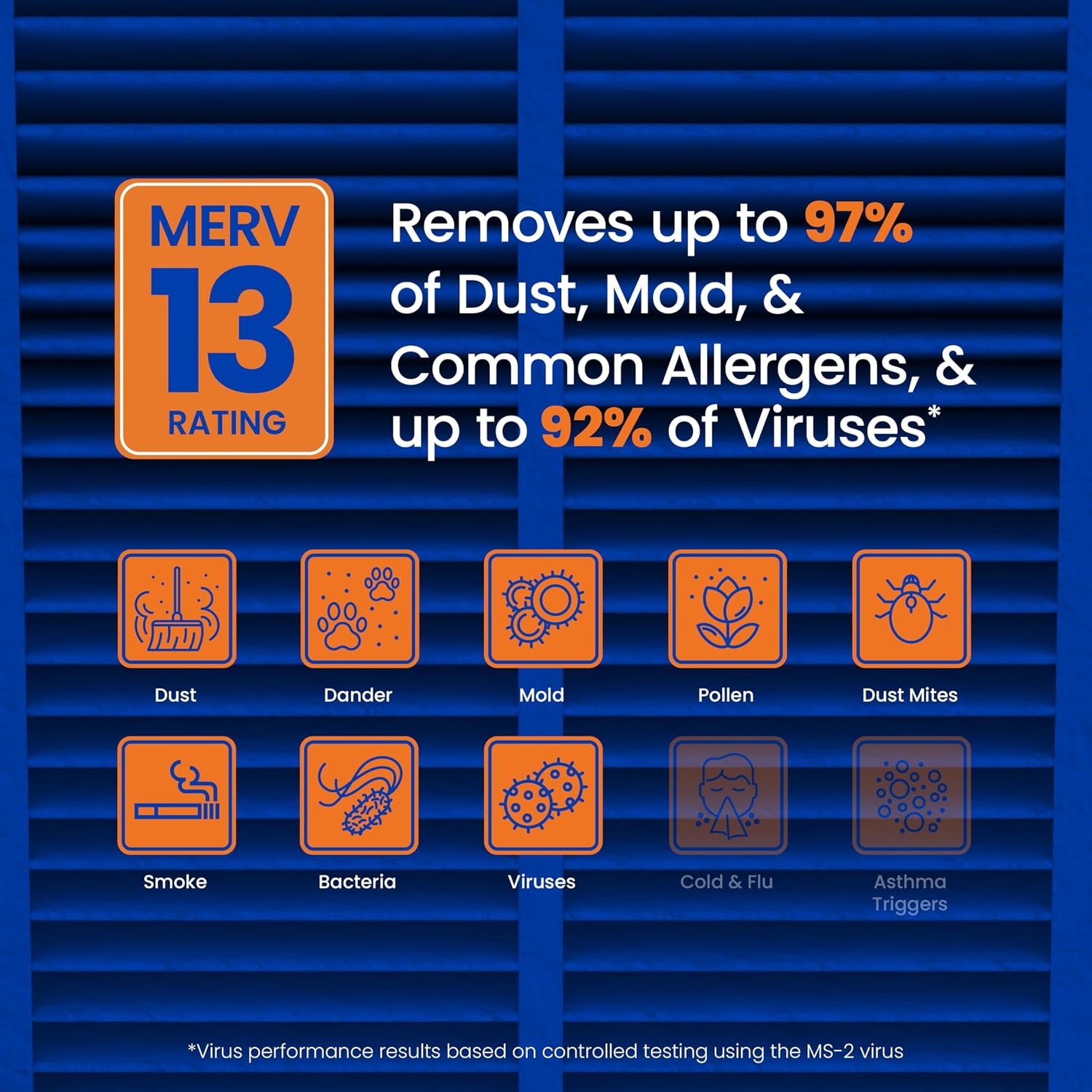
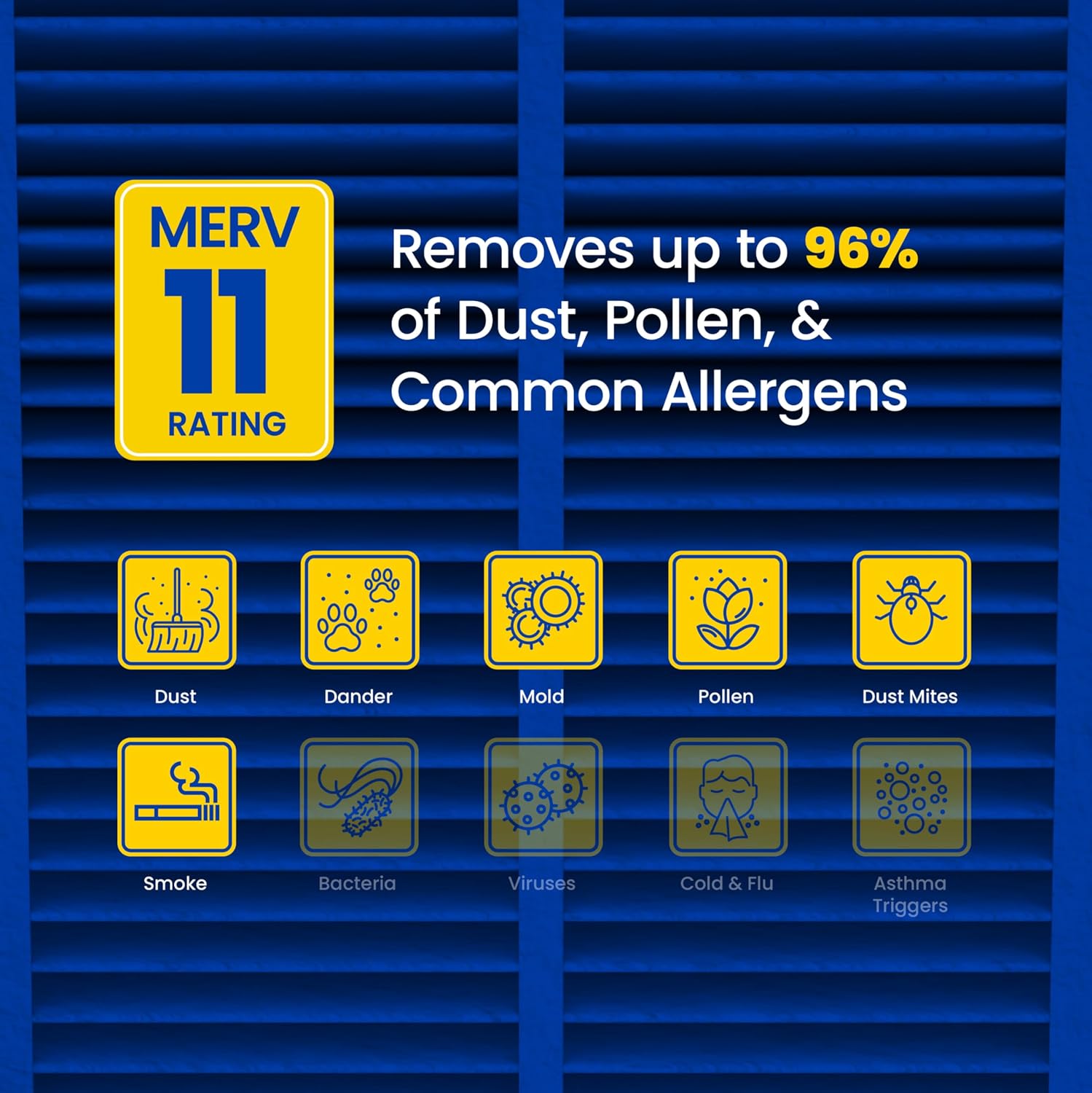
If you’ve ever stood in a hardware store staring at a wall of furnace filters — and then driven home wondering whether you should’ve bought a portable air purifier instead — this article is for you. Here’s the quick orientation: your home’s HVAC system (the heating and cooling unit that pushes air through ducts in your walls and floors) uses a filter to catch airborne particles before recirculating air through every room. MERV 13 is a filter efficiency rating — MERV stands for Minimum Efficiency Reporting Value, and a 13 rating means the filter can capture at least 50–75% of particles in the 0.3–1.0 micron range, including fine dust, pollen, mold spores, and many virus-carrying droplets, according to ASHRAE Standard 52.2: Method of Testing General Ventilation Air-Cleaning Devices for Removal Efficiency by Particle Size. A room air purifier, by contrast, is a standalone plug-in unit that cleans air only in the space where it sits. Both strategies target the same problem — airborne allergens — but they work at very different scales, carry different costs, and have real-world limitations that most product listings bury in the fine print. This guide maps both strategies against each other so you can make the call that matches your home and your health situation.
| EDITOR'S PICK[Genuine AprilAire 213 Replaceme…](https://www.amazon.com/dp/B00UOXMCBI?tag=greenflower20-20) | Mid-tier[Genuine AprilAire 210 Replaceme…](https://www.amazon.com/dp/B00UOXM6PU?tag=greenflower20-20) | Budget pick[Genuine AprilAire 413 Replaceme…](https://www.amazon.com/dp/B00UOXM6W8?tag=greenflower20-20) | |
|---|---|---|---|
| MERV rating | 13 | 11 | 13 |
| Size (W×H×D) | 20x25x4 | 20x25x4 | 16x25x4 |
| Pack quantity | 2 | 1 | 1 |
| Allergy focus | ✓ | — | ✓ |
| Dust focus | — | ✓ | — |
| Price | $106.99 | $60.98 | $57.88 |
| See on Amazon → | See on Amazon → | See on Amazon → |
The Core Tradeoff: Whole-Home Coverage vs. Targeted Performance
The central tension here is breadth vs. depth. A whole-house MERV 13 filter, installed in your HVAC return air slot, treats every cubic foot of air that moves through your system. It covers your living room, bedroom, kitchen, and hallways simultaneously — without you managing multiple separate units. That’s the compelling pitch.
The limitation is physics: your HVAC system only filters air when the fan is running. If your system cycles off overnight, air in your bedroom sits unfiltered for hours. According to the U.S. Environmental Protection Agency’s publication Residential Air Cleaners: A Technical Summary, Third Edition, particle levels rebound faster than most people expect after everyday activity — cooking, walking, pets moving. The whole-house filter is a high-volume, moderate-frequency solution. It is excellent at reducing baseline particle load across the whole home. It is not a precision instrument for a bedroom where someone sleeps eight hours and wakes up congested.
A room air purifier inverts this profile. A well-sized unit with a true HEPA filter — which captures 99.97% of particles at 0.3 microns, a more aggressive standard than MERV 13 — runs continuously in one room, cycling the room’s air volume multiple times per hour. The tradeoff is that the purifier does nothing for the hallway, the living room, or anywhere else.
The practical answer for most allergy households isn’t either/or. It’s knowing which layer to prioritize first.
Comparing the Three Main Approaches
### Budget-Tier: 1-Inch Flat-Panel MERV 13 Whole-House Filter
The lowest-cost entry into MERV 13 filtration is the standard 1-inch flat-panel filter available at most hardware stores. These filters carry the correct efficiency rating but have substantially less filtration media surface area than their thicker counterparts. ASHRAE Standard 52.2 measures filter efficiency under sealed lab conditions — real-world installed performance depends on frame integrity and cabinet fit, and thin cardboard-edge filters can warp or collapse under sustained static pressure from a running air handler, creating bypass gaps that render the MERV rating effectively meaningless for that bypassed air.
Replacement frequency is the hidden cost: a 1-inch flat panel typically needs replacement every one to three months, meaning 20–30 replacements over five years. For households with pets, renovation dust, or multiple occupants, that interval shortens further.
This option is appropriate when your HVAC cabinet cannot physically accommodate a deeper filter and you need the broadest possible MERV coverage at the lowest upfront cost. Supplement with a bedroom air purifier if symptoms persist.
Genuine
$57.88
In stock on Amazon
Check price on Amazon### Mid-Tier: 4-Inch Deep-Media MERV 13 Whole-House Filter
A 4-inch deep-media MERV 13 filter — from manufacturers such as AprilAire (models 213 and 413) or compatible alternatives such as TruFilter — is the most commonly recommended whole-house upgrade for allergy households. The deeper media has roughly four to six times the surface area of a 1-inch flat panel, which means it loads far more slowly and typically lasts nine to twelve months.
The sealed metal-edge frame design found on the AprilAire 213 and 413 is specifically noted by owners as a key feature preventing air bypass — the failure mode described above. ASHRAE guidance supports the use of deep-media filters at MERV 13 ratings as generally compatible with residential HVAC systems, while cautioning that 1-inch MERV 13 flat panels can cause airflow restriction in systems not rated for higher static pressure.
Third-party compatible filters such as TruFilter receive generally positive reviews for construction quality, and the cost difference over a five-year horizon is real. The reasonable approach: verify that any compatible filter’s frame holds its seal over the full replacement interval before committing to it as your long-term choice.
5-year approximate cost (2026 pricing):
- AprilAire 413 OEM filter: ~$30–$45 per filter × 1 per year = ~$150–$225 over five years, plus a one-time compatibility check if a filter rack isn’t already installed.
- TruFilter compatible MERV 13 (4-inch): ~$18–$28 per filter × 1 per year = ~$90–$140 over five years.
Genuine
$60.98
In stock on Amazon
Check price on Amazon### Premium-Tier: Layered Strategy — 4-Inch MERV 13 Whole-House Filter Plus Dedicated Bedroom HEPA Purifier
For households where a family member has significant respiratory conditions — COPD, severe asthma, or documented sensitivity to fine particulates — the highest-performing approach combines a properly sealed 4-inch MERV 13 whole-house filter with a dedicated room air purifier in the primary bedroom.
The American College of Allergy, Asthma, and Immunology, in its patient guidance on air filters and indoor air quality, specifically identifies the bedroom as the highest-impact single room for allergen-sensitive individuals, given the number of hours spent there during sleep. A room air purifier with a true HEPA filter (99.97% efficiency at 0.3 microns) running continuously overnight addresses exactly the gap the whole-house filter cannot: the hours when the HVAC fan is off and particle levels rebuild from bedding, pets, and normal respiration.
Consumer Reports’ Air Purifiers Buying Guide supports the layered approach for households with documented allergy diagnoses, noting that no single-point solution covers all exposure scenarios. Units sized appropriately for the bedroom — typically rated for 300–400 square feet — provide multiple air changes per hour when run on auto or medium settings overnight.
5-year approximate cost for the layered strategy (2026 pricing):
- 4-inch MERV 13 whole-house filter (mid-tier): ~$90–$225 over five years depending on brand choice.
- Room air purifier (bedroom): ~$120–$160 unit cost + ~$30–$50 per year in HEPA and pre-filter replacements = ~$270–$410 over five years for one room.
- Total layered strategy: ~$360–$635 over five years for whole-home baseline coverage plus bedroom precision filtration.
This is the only approach that addresses both diffuse whole-home particle load and the concentrated overnight bedroom exposure window simultaneously.
Genuine
$106.99
In stock on Amazon
Check price on AmazonThe Air Bypass Problem and Why Filter Frame Quality Matters
Air bypass deserves its own section because it’s the most common real-world failure mode for whole-house filtration — and it’s almost entirely invisible to the homeowner.
When a filter doesn’t seal tightly against the HVAC cabinet walls, a meaningful fraction of airflow routes around the filter entirely, unfiltered. This makes your MERV rating irrelevant for that portion of air. ASHRAE Standard 52.2 tests filter efficiency under sealed lab conditions. It cannot account for gaps caused by a warped cardboard frame, a filter that’s slightly too small for the cabinet, or a flat-panel filter that collapses inward under the negative pressure of the return air plenum.
The design features that prevent bypass are: a rigid frame (metal or thick fiberboard that doesn’t compress or warp), correct dimensional fit for your specific cabinet, and media that doesn’t collapse under operating static pressure. If you upgrade to MERV 13 and don’t notice any reduction in surface dusting over 30–60 days, bypass is the first variable to investigate — pull the filter and look for light gaps or frame deformation around the edges.
When Each Strategy Actually Wins
Choose whole-house MERV 13 as your primary strategy when:
- You have forced-air HVAC that runs regularly and can accommodate a deep-media filter cabinet.
- Your allergy symptoms are diffuse — you react throughout the home, not just in one room.
- You have children, pets, or recently completed a renovation, all of which dramatically elevate whole-home particle load.
- Your budget requires covering the most square footage per dollar.
Add a room air purifier — or lead with one — when:
- You or a family member has significant respiratory conditions where bedroom air quality during sleep hours is the highest-priority intervention, as identified in the American College of Allergy, Asthma, and Immunology’s patient guidance on air filters and indoor air quality.
- Your HVAC runs infrequently — mild climates, radiant heat, window AC units — meaning whole-house coverage is intermittent at best.
- You’re renting and cannot modify the HVAC filtration system.
- You need true HEPA-level filtration (99.97% at 0.3 microns) rather than MERV 13-level filtration (approximately 50–75% at 0.3 microns) for a specific medical need.
The decision rule: If your HVAC runs at least eight hours per day and you can install a sealed 4-inch media filter, start with MERV 13 whole-house and evaluate symptoms over 30–60 days. If the primary bedroom remains a problem, layer in a room purifier sized to that space. Consumer Reports’ Air Purifiers Buying Guide consistently supports this layered approach for households with documented allergy diagnoses.
Frequently Asked Questions
Do I need to run my HVAC fan continuously for a whole-house filter to work?
You don’t need it running 24/7, but more runtime means more air cycles through the filter. Most modern thermostats have a “fan ON” setting separate from heating and cooling. The U.S. EPA’s publication Residential Air Cleaners: A Technical Summary supports fan-on operation specifically for homes prioritizing particle reduction. The tradeoffs are energy cost and slightly accelerated filter loading — plan for filter checks every nine months rather than twelve if you run fan-on year-round.
Will upgrading to MERV 13 restrict airflow and damage my HVAC system?
Potentially, if you choose a 1-inch flat-panel MERV 13. ASHRAE Standard 52.2 guidance notes that deep-media filters at MERV 13 (4–5 inch) are generally compatible with residential HVAC systems, while 1-inch MERV 13 flat panels can cause airflow restriction in systems not engineered for higher static pressure. Verify your HVAC cabinet dimensions first. If you can only fit a 1-inch filter, consider staying at MERV 11 and supplementing with a room purifier rather than forcing a high-resistance flat panel your system wasn’t designed for.
Can I use a third-party compatible filter instead of the OEM filter without voiding my warranty?
Filter choice does not void your HVAC system’s warranty — that protection covers mechanical and electrical components, not consumable filter selection. What you’re managing is performance risk, not warranty risk. The OEM filter is engineered to the manufacturer’s cabinet tolerances and tested for bypass prevention in that specific geometry. Compatible filters reviewed positively for construction quality represent a meaningful cost saving over five years. The reasonable approach: use the OEM filter for the first year to establish a baseline, then evaluate a compatible filter in year two and track dusting frequency and symptom notes.
If I already have a whole-house MERV 13 filter, do I still need a bedroom air purifier?
For most allergy households: not necessarily, but it depends on HVAC runtime and your symptom profile. If your system runs frequently and you’ve installed a properly sealed 4-inch MERV 13 filter, bedroom air quality during system operation should be meaningfully improved. The gap case is overnight: if your system cycles off for extended periods while you sleep, particle levels rebuild from bedding, pets, and respiration. If you’re still waking with congestion after 60 days of MERV 13 operation, a bedroom purifier running on auto-mode overnight is the targeted next step — a complement to the whole-house filter, not a replacement for it.
How often do 4-inch whole-house filters need replacement compared to 1-inch flat-panel filters?
A 4-inch deep-media filter typically lasts nine to twelve months versus one to three months for a 1-inch flat panel. Over five years, you might replace a 4-inch filter five times versus 20–30 times for a 1-inch filter — which substantially narrows or eliminates the per-filter cost advantage of cheaper flat panels when total filter spend is counted. Homes with multiple pets or active renovation work fall toward the nine-month end of that range.
For most allergy households in 2026, the whole-house MERV 13 filter is the highest-leverage, lowest-cost-per-room starting point — especially with a properly fitted 4-inch media filter that eliminates bypass. Layer in a room purifier for the bedroom if you have a high-symptom sleeper, a family member with COPD or severe asthma, or an HVAC system that doesn’t run enough to provide continuous coverage. Run both strategies for 60 days before drawing conclusions. The data from your own home — dusting frequency, morning symptoms, filter loading rate — will tell you more than any lab rating can.