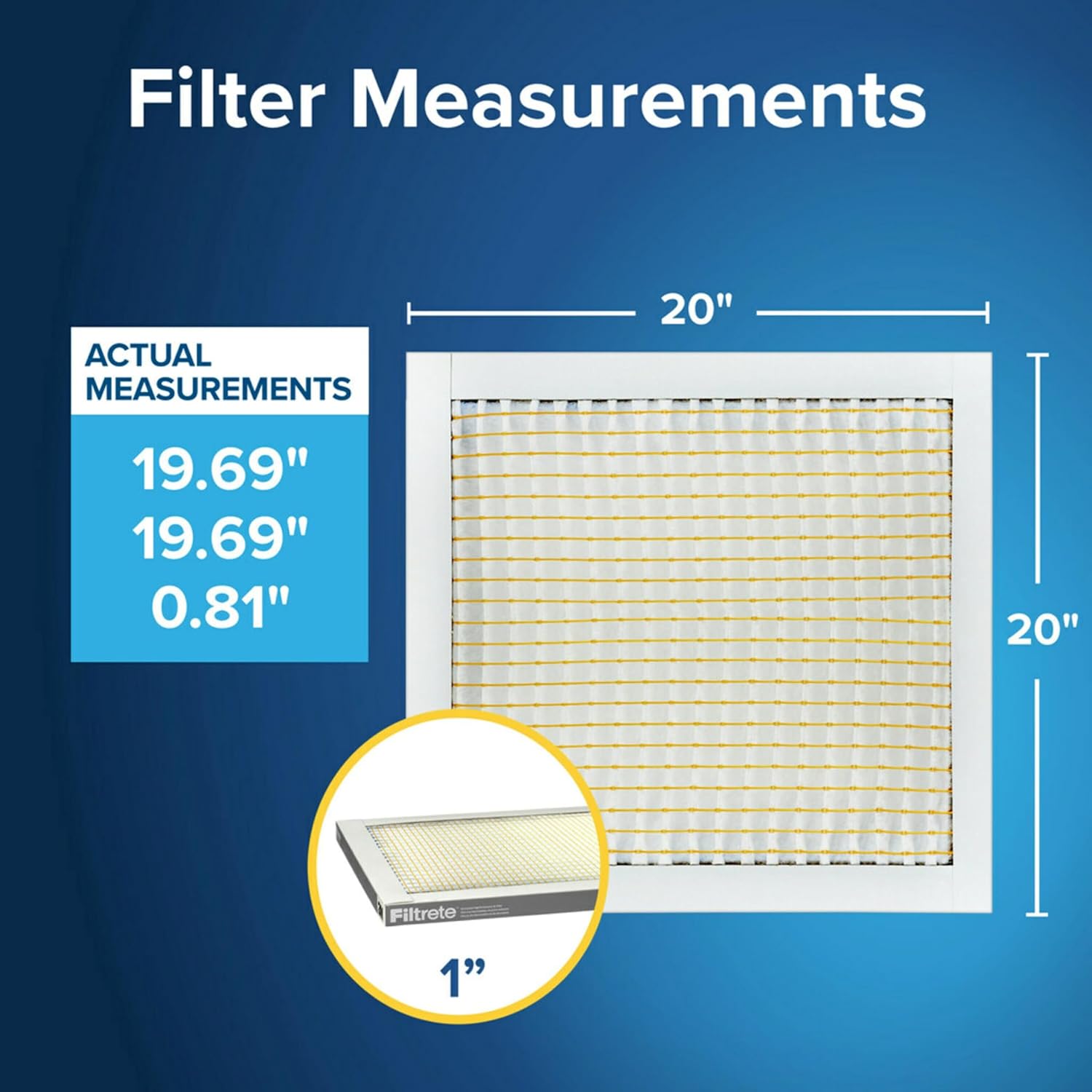
Your furnace filter is a thin wall of material — typically fiberglass, polyester, or pleated synthetic fabric — that your HVAC system (the heating, ventilation, and air conditioning equipment that moves air through your home) pulls all of your circulating air through. The number on the package, called a MERV rating (Minimum Efficiency Reporting Value), tells you how small a particle that filter can reliably catch. MERV 5 traps larger debris like dust bunnies and lint. MERV 11 adds pollen, pet dander, and mold spores. MERV 13 reaches down into fine smoke particles and some airborne pathogens. That’s the simple version. But the right choice isn’t just about the highest number you can buy — it’s about what your specific HVAC system can handle, what you’re trying to solve, and what the total five-year cost actually looks like. This guide maps all three grades against real buyer outcomes, names the tradeoffs explicitly, and ends with a clear decision rule so you can move forward with confidence.
What the MERV Numbers Actually Mean in Practice
MERV ratings are defined under ASHRAE Standard 52.2, the industry testing protocol for general ventilation air-cleaning devices. The scale runs from 1 to 16 for residential and light commercial use (HEPA filters used in medical settings operate at MERV 17–20). For most homes, the decision lives between three practical tiers:
By the Numbers
| Grade | Particle Size Target | Typical Residential Use Case | Avg. Annual Cost (1” filter) |
|---|---|---|---|
| MERV 5 | ≥ 10 microns (dust, lint, pollen clumps) | Basic equipment protection | $20–$45/yr |
| MERV 11 | 1–3 microns (pet dander, mold, fine pollen) | Allergy management, pet owners | $45–$90/yr |
| MERV 13 | 0.3–1 micron (smoke, bacteria, fine dust) | Allergy + asthma, wildfire zones | $60–$120/yr |
Costs assume quarterly replacement of a standard 1-inch filter. Four-inch media filters change the math significantly — see the FAQ.
MERV 5 (Filtrete MPR 300 and equivalents): At this grade, the filter is doing its primary job of protecting your equipment — catching large debris before it coats your blower motor and evaporator coil. Reviewers of products like the Filtrete MPR 300 are consistently clear-eyed about what they’re buying: this is a maintenance item, not an air quality upgrade. One military veteran reviewer specifically noted that Amazon pricing beats his 10% retailer discount at major big-box stores, which is exactly the value proposition here — low cost per filter, frequent change-out, mechanical protection. You’re not paying for particle capture at this grade; you’re paying for blower longevity.
MERV 11 (Filtrete MPR 1000, AprilAire 210): This is where buyers start reporting quality-of-life changes, not just equipment maintenance. Across aggregated reviews of Filtrete MPR 1000 and AprilAire 210 filters, the pattern is consistent and specific: dusting frequency drops from twice weekly to roughly twice monthly. Pet dander and fine allergens go from “a constant problem” to “under control.” One particularly credible review of the AprilAire 210 comes from a buyer who switched away from a generic filter — they used the same language, the same dusting frequency benchmark, and described the improvement as noticeable within one or two HVAC cycles. That’s not a marginal quality difference; that’s a meaningful change in how your home feels to live in.
MERV 13 (AprilAire 213, AprilAire 413): The U.S. EPA’s Guide to Air Cleaners in the Home identifies MERV 13 as the threshold at which residential filtration begins to capture fine particles associated with combustion smoke, some biological aerosols, and particles in the 0.3–1 micron range that carry the most respiratory health risk. AprilAire 213 and 413 owners are repeat purchasers — multiple reviewers mention being on their second or third filter, which is the strongest behavioral signal that the product is delivering what it promises. The language they use shifts from describing dust or dander to describing “air freshness” — a perceptual quality that maps to removing fine particulates that you don’t see but your nose and lungs register.
The Tradeoff Most Buyers Miss: Airflow Restriction
Here’s the friction point that matters before you upgrade: a denser filter catches more particles by slowing air down and forcing it through tighter fiber spacing. That’s good for your lungs and bad for an HVAC system that wasn’t engineered to push air through that resistance.
The engineering term is static pressure — the resistance your blower motor works against to move air. Every HVAC system is rated for a range of static pressure it can handle efficiently. When you install a filter with higher restriction than your system was designed for, several things happen: airflow drops across your whole home, your blower motor runs hotter and draws more electricity, your heat exchanger can overheat in a furnace, and your evaporator coil can ice over in a cooling system. None of these outcomes are hypothetical. ASHRAE’s filter performance documentation explicitly flags that media density upgrades should be matched to system design specifications.
What this means practically:
- Systems with large, well-designed ductwork (typically newer construction after 2000, or HVAC systems spec’d at 400+ CFM per ton) generally handle MERV 13 without incident when using a properly sized four-inch media filter.
- Older systems with single-return designs, undersized return ducts, or original blower motors rated at lower static pressure are the ones at risk. For these, MERV 11 is usually the right ceiling.
- The clearest signal is your contractor’s system documentation. If you’re managing a building, your install records should list designed static pressure and rated airflow. If you’re a homeowner without those records, the safest proxy is a two-finger airflow test: hold two fingers at a supply vent before and after installing a new filter. Dramatically reduced airflow is a warning sign worth calling your HVAC tech about.
Total Cost of Ownership: Running the Five-Year Math
The purchase price of a filter is almost never the right number to optimize for. What matters is the annual filter budget plus any downstream equipment or service cost implications.
Scenario A — MERV 5, quarterly 1-inch changes: Four filters per year at $8–$12 each = $32–$48/yr. Over five years: $160–$240. No meaningful air quality improvement. Adequate equipment protection if your home has low dust load and no occupants with respiratory sensitivities.
Scenario B — MERV 11, quarterly 1-inch changes: Four filters per year at $14–$20 each = $56–$80/yr. Over five years: $280–$400. Measurable reduction in surface dust and airborne allergen load per aggregated reviewer data. Right-sized for most homes with pets, children, or mild allergy sufferers.
Scenario C — MERV 13, using a 4-inch media filter (e.g., AprilAire 213 or 413): One or two filter changes per year at $30–$55 per filter = $30–$110/yr. Over five years: $150–$550. This is the counterintuitive scenario: the higher-grade filter can cost less annually because the larger media volume (four inches deep instead of one) holds far more particulate before becoming restrictive. Multiple reviewers note that Amazon pricing for AprilAire 213 and 413 filters is consistently lower than HVAC service company pricing and big-box retail — in some cases by 25–40%. If you’re managing cost-per-year, the 4-inch MERV 13 format is worth serious consideration if your system has a compatible media cabinet.
Decision Rule: If X, Then Y
You’ve read the tradeoffs. Here’s how to close the decision:
If your household has no pets, no allergy sufferers, and no recent renovation or remodel: MERV 5 or MERV 8 is sufficient. You’re protecting equipment, not chasing air quality. Buy in bulk, change quarterly, and redirect your IAQ budget elsewhere.
If you have pets, children under 12, or anyone with seasonal allergies or mild asthma: MERV 11 is the practical upgrade. The dusting-frequency reduction is real and documented. Filtrete MPR 1000 in a 1-inch format works for standard filter slots; AprilAire 210 for compatible media cabinets.
If you’re in a wildfire-adjacent region, have occupants with diagnosed asthma or COPD, or experienced a recent renovation (drywall dust, paint fumes, adhesives): MERV 13 is the right floor, not a luxury upgrade. The EPA’s indoor air quality documentation supports this threshold for fine particle capture. If your system can’t support a 1-inch MERV 13, a 4-inch media cabinet upgrade (Aprilaire, Lennox, or Honeywell whole-home media cabinet formats) is worth the one-time installation cost — typically $150–$400 installed — because it opens the door to lower annual filter costs and less airflow restriction simultaneously.
If you’re managing a multi-unit building, clinic, or commercial space: MERV 13 minimum, and you should be sourcing AprilAire or equivalent media filters through Amazon or direct distribution rather than through your HVAC service company’s parts program. The markup differential reviewers describe is consistent and significant at volume.
Frequently Asked Questions
Will upgrading to MERV 13 damage my older HVAC system? It can — and the risk is real enough to take seriously. Older systems with smaller blower motors and restrictive ductwork (common in homes built before 1990) may not generate enough static pressure to maintain adequate airflow through a dense MERV 13 filter. The result is reduced airflow, possible coil icing in cooling mode, and blower motor strain. If your system is more than 15–20 years old, consult your HVAC tech before upgrading past MERV 11. A 4-inch media cabinet filter (rather than a 1-inch MERV 13) reduces this risk significantly because the greater surface area lowers resistance even at higher MERV grades.
How often should I change a 4-inch deep furnace filter versus a 1-inch filter? A 1-inch filter typically needs replacement every 60–90 days in an average household. A 4-inch media filter — like the AprilAire 213 or 413 — is generally rated for 6–12 months, with some manufacturers citing up to 12 months in lower-dust environments. The larger media volume simply holds more particulate before pressure drop becomes a problem. Reviewers of the AprilAire 213 consistently report changing filters once or twice a year, which aligns with manufacturer documentation.
Can I use a MERV 13 filter if my system is rated for MERV 11? The system “rating” is really a static pressure rating, not a MERV ceiling. A 4-inch MERV 13 media filter may actually impose less static pressure than a 1-inch MERV 11 filter because of its larger surface area. The relevant question is: what format does your filter slot or media cabinet accept? If you’re comparing equivalent form factors (both 1-inch, for example), upgrading from MERV 11 to MERV 13 does increase restriction. Monitor airflow at your supply registers and check for any unusual blower noise in the first week.
Is a third-party MERV 13 filter as good as the genuine AprilAire 213? Published MERV ratings are third-party tested to ASHRAE 52.2, so in theory any MERV 13-certified filter performs to the same minimum standard. In practice, reviewers of AprilAire-brand filters specifically note that genuine AprilAire 213 and 413 filters fit their media cabinets precisely with no bypass gaps — and bypass (air leaking around the filter edge rather than through it) defeats filtration entirely. Third-party filters for proprietary media cabinets have mixed dimensional accuracy in aggregated reviews. For systems with AprilAire or Lennox media cabinets, OEM filters are worth the marginal cost difference. For standard 1-inch or 2-inch slots, MERV 13-rated third-party options are generally fine if the dimensions are accurate.
Does a higher MERV filter actually reduce how often I need to dust? Yes, and the reviewer evidence for this is specific and consistent. Owners who switched from MERV 5-equivalent generic filters to MERV 11 (AprilAire 210, Filtrete MPR 1000) report dusting frequency dropping from roughly twice a week to twice a month. The mechanism is straightforward: your HVAC system recirculates your home’s entire air volume multiple times per day. A filter that captures fine dust particles removes them from circulation rather than depositing them on surfaces. At MERV 13, the effect extends to finer particles — the ones you don’t see but that contribute to that “stuffy” or stale air quality perception that AprilAire 213 owners consistently describe improving.