If you share a home with a dog, a cat, or anything in between, you already know the drill: fur tumbleweeds in the corners, a faintly animal smell that you stop noticing until a guest points it out, and — if anyone in the house has allergies — eyes that itch from October through April for no obvious reason. The culprit is rarely the visible hair. It’s dander (microscopic flakes of dried skin and protein that animals shed continuously), along with airborne allergens in pet saliva and urine that hitch rides on dust particles and float at breathing height for hours. An air purifier — a device that pulls room air through one or more filters to trap particles and neutralize odors — can genuinely help with all three problems, but only if you match the right filtration technology to each problem and don’t overpay for features that don’t move the needle. This guide walks through exactly that: what the specs actually mean, which brands hold up to scrutiny, and a clean decision framework so you can stop second-guessing.
| EDITOR'S PICK[PuroAir 240 HEPA Air Purifiers](https://www.amazon.com/dp/B0B286BFZQ?tag=greenflower20-20)… | Mid-tier[LEVOIT Air Purifiers for Home L](https://www.amazon.com/dp/B0BGPF71Q6?tag=greenflower20-20)… | Budget pick[KNKA Air Purifier for Home Bedr](https://www.amazon.com/dp/B0FNDG2TNK?tag=greenflower20-20)… | |
|---|---|---|---|
| Coverage | 1,000 ft² | 1,875 ft² | 1,695 ft² |
| Washable pre-filter | — | ✓ | ✓ |
| Pet mode | — | — | ✓ |
| Auto mode | ✓ | — | — |
| Price | $149.99 | $139.98 | $119.98 |
| See on Amazon → | See on Amazon → | See on Amazon → |
The Two Jobs Your Filter Stack Has to Do (and the One Bonus Job)
Pet air quality problems break into two distinct physics categories, and confusing them is the single biggest source of buyer regret.
Particles (dander, hair, dust) are physical objects. They respond to mechanical filtration — specifically a true HEPA filter, which is a standardized designation meaning the filter captures at least 99.97% of particles at 0.3 microns in diameter (the hardest size to trap). Per the EPA’s Guide to Air Cleaners in the Home, true HEPA is the only particle-filtration designation with a universally enforced standard. “HEPA-type,” “HEPA-like,” and “HEPA-style” are marketing terms with no regulated performance floor — they can mean anything from 85% to 99% efficiency, and for pet owners with allergies, that gap matters. If a box doesn’t say “True HEPA” or cite the 99.97% at 0.3-micron standard explicitly, treat it as a lower-efficiency filter until proven otherwise.
Odors (pet smell, litter box off-gassing, wet-dog volatile organic compounds) are gas-phase molecules. HEPA does not capture gases — at all. The right tool is activated carbon (also called activated charcoal), a porous material with enormous surface area that adsorbs gas molecules through chemical attraction. The keyword here is weight: a thin carbon pre-filter pad — common in budget units — might contain 0.5 oz of carbon and saturate within weeks. Meaningful odor control generally requires at least 1–2 lbs of granular activated carbon. Wirecutter’s air purifier coverage consistently flags carbon weight as the differentiating variable between units that eliminate pet odor and units that reduce it briefly then give up.
Hair is the most benign of the three. Large pet hair doesn’t threaten your lungs and most of it never reaches the HEPA filter anyway. It does, however, clog pre-filters fast, shortening the life of the expensive downstream filter. A washable mesh pre-filter — standard on most serious units — is the right tool. Vacuum it weekly if you have a heavy shedder; this alone can double the effective life of your HEPA filter.
CADR: The Number That Actually Tells You If It’s Big Enough
CADR stands for Clean Air Delivery Rate, a cubic-feet-per-minute measurement standardized by the Association of Home Appliance Manufacturers (AHAM). It tells you how quickly the unit delivers filtered air at its rated particle removal efficiency. Higher CADR means the unit cleans a given room faster. AHAM’s general rule: multiply your room’s square footage by 1.5 to get your minimum CADR target for a normal ceiling height (8 ft).
For pet households, the practical advice from Consumer Reports’ air purifier ratings is to size up — target CADR ≥ room sq ft × 2, because pets add continuous particle load that a room-sized unit at minimum spec will struggle to keep pace with between cycles.
By the numbers — CADR sizing for common room types:
| Room size | Minimum CADR (standard) | Pet-household recommended CADR |
|---|---|---|
| 150 sq ft (bedroom) | 225 CFM | 300 CFM |
| 300 sq ft (living room) | 450 CFM | 600 CFM |
| 500 sq ft (open plan) | 750 CFM | 1,000 CFM |
The catch: CADR is measured at maximum fan speed. A unit rated at 400 CADR that sounds like a leaf blower at max is not a livable solution in a bedroom. Wirecutter’s testing methodology specifically benchmarks noise at CADR-delivering speeds, and their pet-relevant picks filter out units that require ear-splitting settings to hit their rated numbers. When you’re comparing specs, look for CADR-per-decibel alongside raw CADR — or at minimum, confirm the noise floor at medium speed (where most people actually run the unit 24/7) is below 50 dB.
How the Main Brands Stack Up for Pet Households
Here’s where the decision frame gets practical. The market for pet-owner-relevant purifiers divides into three tiers that map onto distinct tradeoff profiles.
$150–$350 range — Winix 5500-2 and Coway AP-1512HH (“Mighty”)
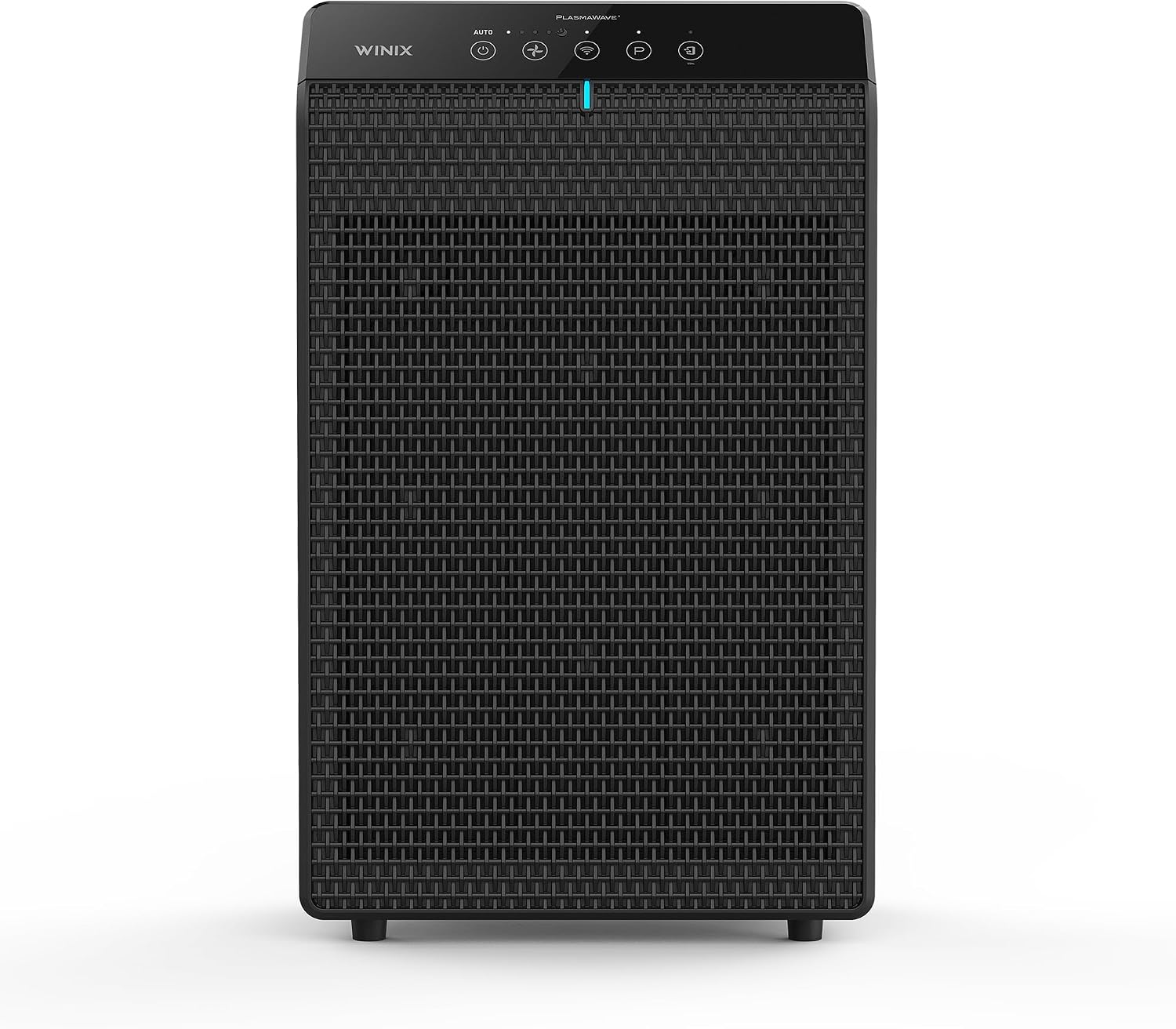
Both units are perennially cited by Consumer Reports and Wirecutter as strong value propositions for pet owners in the 350–360 sq ft range. The Winix 5500-2 carries a true HEPA filter plus a washable carbon/pre-filter combination and a plasma wave (ionizer) feature that owners can disable if they prefer to avoid ozone output. Owners in long-run reviews consistently note that the carbon layer handles moderate pet odor reasonably well but that heavy-odor households (multiple cats, indoor litter boxes adjacent to the unit) expose its limits within 4–6 months. The Coway AP-1512HH follows a similar filtration stack and earns praise for quiet mid-speed operation; its carbon filter is relatively thin, and owners with serious odor loads generally swap to Coway’s upgraded carbon filter at the first replacement cycle.
Five-year total cost of ownership matters here: both units run roughly $40–$60/year in filter costs at manufacturer-recommended replacement intervals, putting 5-year TCO in the $350–$650 range depending on replacement schedule and electricity costs.
$350–$700 range — Blueair Blue Pure 211+ and Winix AM90
The Blueair Blue Pure 211+ is rated at 350 CADR (smoke), covers up to 540 sq ft per AHAM, and its combination fabric pre-filter/particle filter design is distinctive: the outer fabric layer is washable and captures the bulk of pet hair before it reaches the main filter. Owners in aggregated reviews consistently cite this pre-filter design as genuinely useful for high-shed dogs. The weakness is carbon: Blueair’s particle filter contains a carbon layer, but it’s lighter than dedicated activated-carbon units, and reviewers at Wirecutter note this is a better particle story than an odor story. The AM90 from Winix adds Wi-Fi and a companion app — useful for auto-mode responsiveness to a pet’s activity cycles — and carries a heavier carbon payload than most units in this price band.
$700–$1,200 range — IQAir HealthPro Plus and Molekule Air Pro
The IQAir HealthPro Plus is the unit allergy specialists and immunologists most commonly reference in clinical contexts. Per published specs, it uses IQAir’s HyperHEPA filtration rated to capture particles down to 0.003 microns — an order of magnitude smaller than standard HEPA — and the V5-Cell gas/odor filter (a separate cartridge) contains 5 lbs of activated carbon and alumina, which is meaningfully heavier than anything in the sub-$500 market. Owners in long-run reviews note that odor elimination in multi-cat households is qualitatively different from budget units — the IQAir is described as genuinely resolving the problem rather than reducing it. The tradeoff is filter cost: V5-Cell cartridges run approximately $100–$120 each and are recommended every 12–18 months depending on load, putting 5-year TCO at $1,800–$2,200 all-in. That’s the honest number before the purchase decision.
The Molekule Air Pro uses a patented PECO (photoelectrochemical oxidation) technology it claims destroys — rather than traps — particles including allergens and VOCs. Consumer Reports’ independent testing of Molekule units has historically raised questions about whether real-world particle reduction matches the marketing claims, and the unit’s activated carbon load is lighter than IQAir’s. Reviewers at Wirecutter have been skeptical of PECO as a HEPA replacement for particle removal. The Air Pro is best positioned as a complement to mechanical HEPA filtration in households where VOC and chemical odor removal are priorities alongside pet odor.
The Decision Framework: If X, Then Y
You’ve read the specs. Here’s the clean rule set:
If your primary problem is dander/allergen and you have a single pet in a room under 400 sq ft: The Coway AP-1512HH or Winix 5500-2 handles this load adequately. Budget $500–$650 over five years including filters. Upgrade the carbon filter at first replacement if odor is a secondary concern.
If you have multiple pets, heavy shedders, or a litter box in the same zone: Size to at least 600 CADR, which means the Blueair Blue Pure 211+ (or two units in a large open plan) plus a serious evaluation of whether the carbon payload matches your odor load. Winix AM90’s heavier carbon layer earns it a look over the Blueair in this scenario.
If anyone in the household has diagnosed pet allergies, asthma, or immunocompromise: This is the IQAir HealthPro Plus scenario. The higher upfront cost and filter costs are justified by the filtration depth — the AAFA (Asthma and Allergy Foundation of America) consistently notes that subthreshold allergen reduction doesn’t resolve symptoms; you need near-elimination. That’s what the HyperHEPA + V5-Cell stack is engineered for.
If odor is the dominant complaint and particles are secondary: No mechanical filter alone solves this. Evaluate standalone activated-carbon air scrubbers or units with pound-scale carbon loads. The IQAir GC MultiGas (ozone- and chemical-focused, sold alongside the HealthPro) is worth adding to the research list for households with multiple indoor cats.
On “smart” features: Auto-mode that responds to a particle sensor is genuinely useful for pet households — activity bursts (playtime, grooming, litter box use) spike particle and odor load unpredictably. Winix and Blueair both offer auto-mode; IQAir’s app integration is functional but less polished than Winix’s. HomeKit compatibility as of mid-2026 remains patchy across the category — Winix AM90 works via third-party HomeKit bridges, not natively.
The honest bottom line: pet air quality is a solved problem if you match filtration technology to the actual contaminant. HEPA handles dander. Activated carbon — in sufficient quantity — handles odor. Pre-filter maintenance handles hair and protects your filter investment. Every dollar you spend beyond that buys room coverage, quieter operation at rated performance, and convenience features. Only one of those extras — coverage — affects air quality outcomes. Choose accordingly.