Carbon monoxide — CO — is an odorless, colorless gas produced any time something burns fuel: a boat engine, an RV propane heater, a hotel room’s gas furnace, a car exhaust system. You can’t smell it or see it, and at high enough concentrations it can incapacitate you before you recognize anything is wrong. A CO detector (also called a CO alarm) is a device that monitors the air in a space and sounds an alert when CO rises to a dangerous level — think of it as a smoke alarm, but for invisible combustion gases. What this article does is help you understand the specific tradeoffs that matter when you’re not in a fixed home: power sources, portability, the difference between an alarm and a sniffer, and which real-world use cases should drive your buying decision. If you’ve got an RV trip planned, a boat with a gasoline inboard, or you’re a frequent hotel traveler, the next 10 minutes of reading will save you from guessing.
| EDITOR'S PICK[Kidde Smart Smoke and Carbon Mo…](https://www.amazon.com/dp/B0F7N7WGWY?tag=greenflower20-20) | Mid-tier[X-Sense Smoke Detector Carbon M…](https://www.amazon.com/dp/B0GGHFD2B8?tag=greenflower20-20) | Budget pick[Kidde Carbon Monoxide Detector](https://www.amazon.com/dp/B0CX6RMV4B?tag=greenflower20-20) | |
|---|---|---|---|
| Power Source | Hardwired + AA backup | 10-Year sealed battery | AA battery |
| Combined CO & Smoke | Combined | Combined | CO only |
| Smart Alerts | Ring App Enabled | — | — |
| Display | — | LCD Display | LED Status Indicators |
| Alarm Volume (dB) | — | — | 85 dB |
| Certification | — | UL 217 & UL 2034 | — |
| Price | $74.97 | $31.99 | $23.97 |
| See on Amazon → | See on Amazon → | See on Amazon → |
Why “Mobile” CO Risk Is Different from Home CO Risk
In a fixed home, CO risk is relatively stable. You have hard-wired or plug-in detectors, probably on every floor, and the threat model is your gas furnace, water heater, or attached garage. The NFPA 72 code and the U.S. Consumer Product Safety Commission’s guidance both assume a permanent installation context.
Mobile environments flip nearly every assumption:
Power is variable. Your RV might be on shore power, on a generator, or running purely on battery. A hotel room has standard 120V outlets — or doesn’t, if you’re in Europe. A boat might have 12V DC throughout and no AC inverter in the cabin.
Ventilation is unpredictable. A stationary tent or a boat cabin at anchor with the engine running is a genuinely dangerous scenario. The CDC has documented CO poisoning cases specifically tied to boats with passengers near the transom while the engine idles — a configuration that concentrates exhaust gases directly at breathing level.
Source identification matters more. In a home, if your CO alarm fires, you evacuate and call the gas company. On a boat with two engines, a generator, and a propane galley stove, you need to know which source is leaking and where — because you might be 12 miles offshore. That’s a problem a standard alarm cannot solve. That’s where a handheld CO sniffer enters the picture.
The sensor lifespan problem is compounding. CO electrochemical sensors — the technology inside virtually every consumer CO detector — degrade over time regardless of whether the unit ever alarms. The CPSC and UL 2034 standard both require manufacturers to build end-of-life indicators into CO alarms, which is why the Kidde plug-in with battery backup that one long-term reviewer documented started displaying “END” after exactly 10 years of service. That reviewer’s experience is the norm, not an outlier: electrochemical cells have a finite service window, and a unit stored in a garage between camping seasons doesn’t stop aging just because it wasn’t plugged in.
The Tool Hierarchy: Alarm vs. Sniffer vs. Combination
Before you buy anything, be clear on what job you’re hiring the device to do.
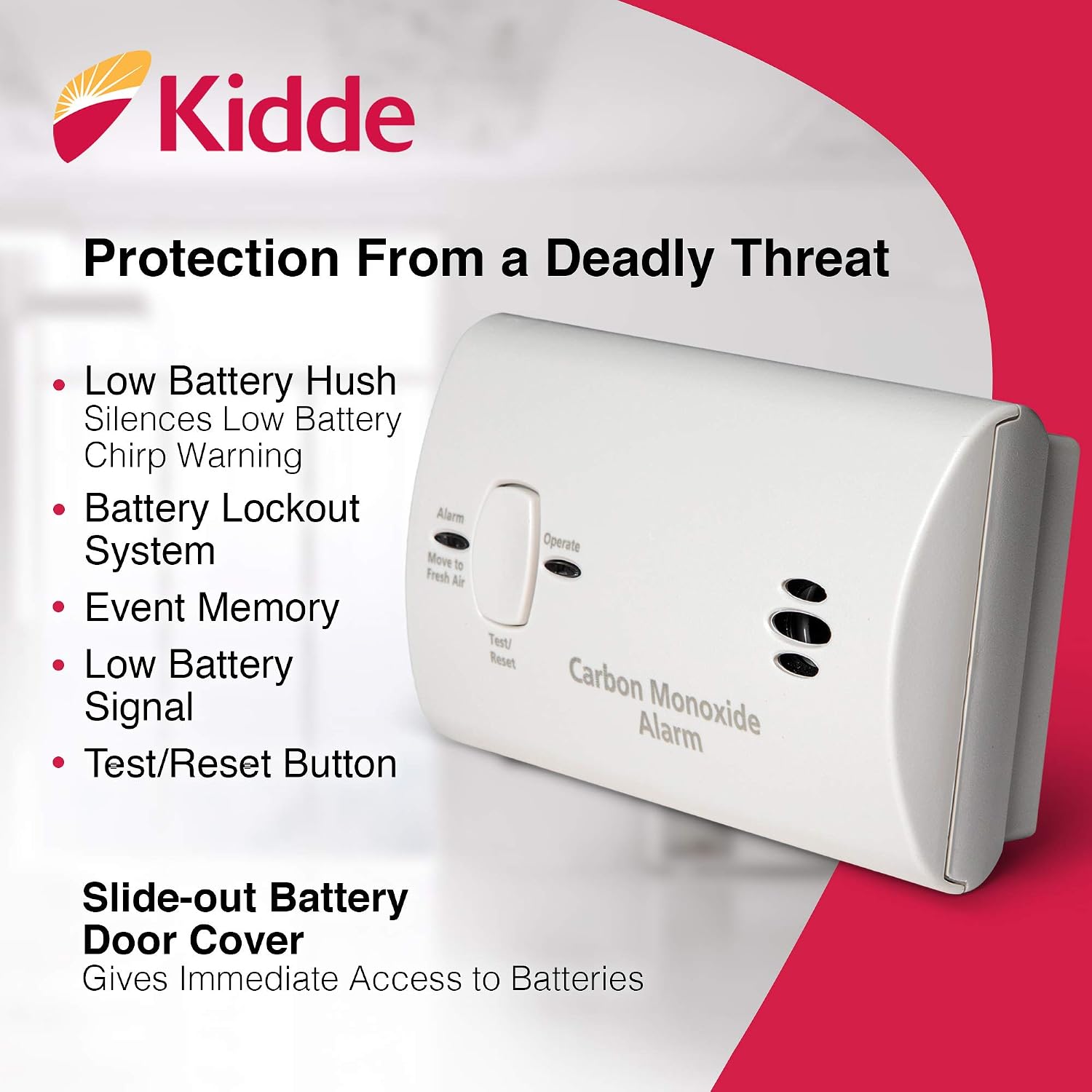
A CO alarm (like the Kidde battery-powered travel unit positioned explicitly as a “travel companion for hotel stays and road trips”) does one thing: it monitors ambient air and alerts you when CO accumulates to dangerous thresholds defined by UL 2034. It’s passive and protective. You put it somewhere, it watches the air, it screams if CO builds up. This is the minimum baseline for any sleeping space — hotel room, RV berth, boat cabin.
A handheld CO sniffer (like the TOPTES CT-580) is an active investigation tool. It draws air across a sensor and gives you a real-time readout — often a numerical PPM (parts per million) concentration — that you can use to probe specific locations. Owners who’ve used the TOPTES CT-580 describe a specific technique: they move the probe slowly along engine compartment seams, exhaust fittings, propane appliance connections, and water heater flue exits, watching for the readout to spike. One documented user identified which specific engine on a multi-engine boat was leaking CO and pinpointed the exact location of the leak — a diagnostic precision that would be impossible with an alarm-only device. Another RV owner traced a CO alarm event to a propane water heater by methodically walking the probe around the appliance’s venting until the number jumped.
The decision logic:
| If your situation is… | What you need |
|---|---|
| Hotel stays, car travel, general travel | Battery-powered CO alarm |
| RV with propane appliances | CO alarm (always on) + sniffer for troubleshooting |
| Boat with inboard gas engine | CO alarm in cabin + sniffer for source finding |
| Pregnant, immunocompromised, infant aboard | Both, no exceptions |
A pregnant traveler who proactively checked her car cabin for exhaust intrusion using a sniffer — a documented use case — is making exactly the right call. CO affects fetuses at lower thresholds than healthy adults, per CDC guidance on vulnerable populations.
Power Source Matching: The Spec That Most Buyers Miss
This is where mobile CO buying decisions most often go wrong. Match the detector’s power requirement to your environment before anything else.
Battery-powered (AA or lithium): Works everywhere, zero installation. The Kidde AA battery travel detector is purpose-built for this use case. The tradeoff is battery replacement — and the compounding problem that most people forget to check batteries before a trip. Look for units with clear low-battery indication.
10-year sealed battery: The X-Sense SC07 combo unit (smoke + CO) with a sealed lithium battery addresses a very specific pain point: owners who’ve been woken at 3 a.m. by a dying-battery chirp in a smoke alarm know exactly how viscerally annoying that experience is. A sealed 10-year unit eliminates that entirely. The tradeoff is that when the battery dies, the whole unit is replaced — which is actually what the CPSC recommends anyway, since the sensor and battery age together.
12V DC: Purpose-built for RV and marine applications. Some RV-specific CO detectors hardwire into the coach’s 12V system and don’t rely on batteries at all. If you’re in a permanent RV setup or a liveaboard boat, this is often the right answer for your primary installed alarm — and then you supplement with a battery-powered unit for travel or as a backup.
120V plug-in with battery backup: The Kidde plug-in with battery backup is well-suited for stationary RV use on shore power, with the battery backing you up when you’re off-grid. The “END” display that one 10-year owner observed is exactly how this unit is supposed to behave — the end-of-life signal is a feature, not a defect.
By the numbers:
- UL 2034 requires CO alarms to alert at 70 PPM sustained for 1-4 hours, 150 PPM for 10-50 minutes, and 400 PPM within 4-15 minutes
- Electrochemical CO sensors have a typical rated lifespan of 5-10 years
- CDC data shows approximately 400 Americans die annually from unintentional non-fire CO poisoning; boats and RVs are disproportionately represented in warm-weather incidents
Reliability Honesty: What the Review Record Actually Shows
One Kidde 10-year combo unit received a documented one-star review from an owner whose unit activated and would not reset six months after installation. That’s a real data point, and it’s worth naming directly rather than pretending the category is perfect. CO alarm failures fall into two buckets: false positives (nuisance alarms from low-level CO sources the user didn’t expect) and genuine sensor or circuit failures. Either can cause a unit that won’t reset.
The practical implication: for any mobile or critical-use application, carry a backup. A $25 battery-powered travel alarm is cheap insurance when you’re on a boat 15 miles out and your primary unit starts misbehaving. This is especially true for combo smoke/CO units — some boat and RV owners prefer to keep smoke detection and CO detection in separate dedicated devices precisely because a single-unit failure doesn’t leave you unprotected on both fronts.
Frequently Asked Questions
Can I use a regular plug-in CO detector in an RV, or do I need a 12V or battery-powered model?
It depends entirely on your power setup. If your RV is regularly connected to shore power (120V AC), a standard plug-in unit works fine. But if you’re dry camping or boondocking without shore power, you need a battery-powered or 12V DC unit — a plug-in detector with no power does nothing. Many experienced RV owners run a 12V hardwired unit as the primary alarm and keep a battery-powered travel unit as a backup. For boats, 12V DC units designed for marine use are generally the better choice because they’re rated for the humidity and vibration environment.
What is the difference between a CO alarm detector and a handheld CO sniffer, and do I need both?
A CO alarm is passive — it monitors ambient air and alerts you when concentration reaches dangerous thresholds. A CO sniffer is active — you move it around to find where a leak is coming from and get a real-time concentration reading. You need an alarm to protect you while sleeping or when you’re not actively looking for a problem. You need a sniffer when an alarm has fired (or you suspect a source) and you need to identify and locate it. For RV and boat owners with multiple potential CO sources, having both is strongly advisable.
How do I use a portable CO sniffer to actually find a propane or exhaust leak?
The technique owners describe is systematic and slow: start away from likely sources to establish a baseline reading, then move the probe tip along seams, fittings, exhaust outlets, and appliance connections at a pace of roughly 1-2 inches per second. Watch the numerical readout for any spike above baseline. For engine compartments, probe around exhaust manifold gaskets, exhaust hose connections, and any penetrations through the hull or firewall. For propane appliances, focus on the flue exit, the burner area, and any flex connections. When you find a spike, back up and approach from different angles to triangulate the exact point of highest concentration.
Do CO detectors expire, and how do I know when mine needs to be replaced?
Yes — electrochemical CO sensors degrade over time regardless of use. Most manufacturers rate their sensors for 5-10 years, and UL 2034 requires end-of-life signaling. The “END” display behavior documented by that long-term Kidde owner is the standard indicator: when it appears, the unit’s sensor is no longer reliable and the entire unit should be replaced. Check the manufacture date on the back of any unit you pull out of storage — a detector that sat in a box for three years has three fewer years of reliable service life remaining.
Is a combination smoke and CO detector appropriate for an RV or boat, or should they be separate units?
Combination units like the X-Sense SC07 are convenient and work well in many RV installations. However, some experienced marine users prefer separate dedicated units for a practical reason: smoke alarm sensitivity calibrated for a home environment may generate nuisance alarms in a cooking-heavy galley, and resetting a combined unit that’s alarming on smoke while you’re also trying to rule out CO is cognitively messy in an emergency. Separate units let you respond to each hazard clearly. That said, for travelers and RV users who want a single well-built device that covers both threats with minimal hassle, a quality 10-year sealed combo unit is a reasonable and well-supported choice.
The Decision Rule
If you’re choosing now: start with use case, then power source, then form factor.
- Traveler / hotel stays only: Battery-powered CO alarm, full stop. Pack it with your toiletries so it never gets forgotten.
- RV owner, shore power primary: Plug-in with battery backup for the coach, plus a sniffer for any season-opening appliance check.
- RV owner, frequent dry camping: 12V hardwired primary plus a battery-powered backup that doubles as your travel alarm.
- Boat owner with gasoline inboard: Marine-rated 12V alarm in the cabin, mandatory. Add a sniffer — it’s the only way to find an exhaust leak before it finds you.
- Any of the above with vulnerable passengers (infants, pregnant, elderly, immunocompromised): Both alarm and sniffer, no compromise. The cost difference between the two tools is trivial compared to the risk differential.
Whatever you buy, write the manufacture date on a piece of masking tape and stick it on the unit. Ten years goes faster than you think.