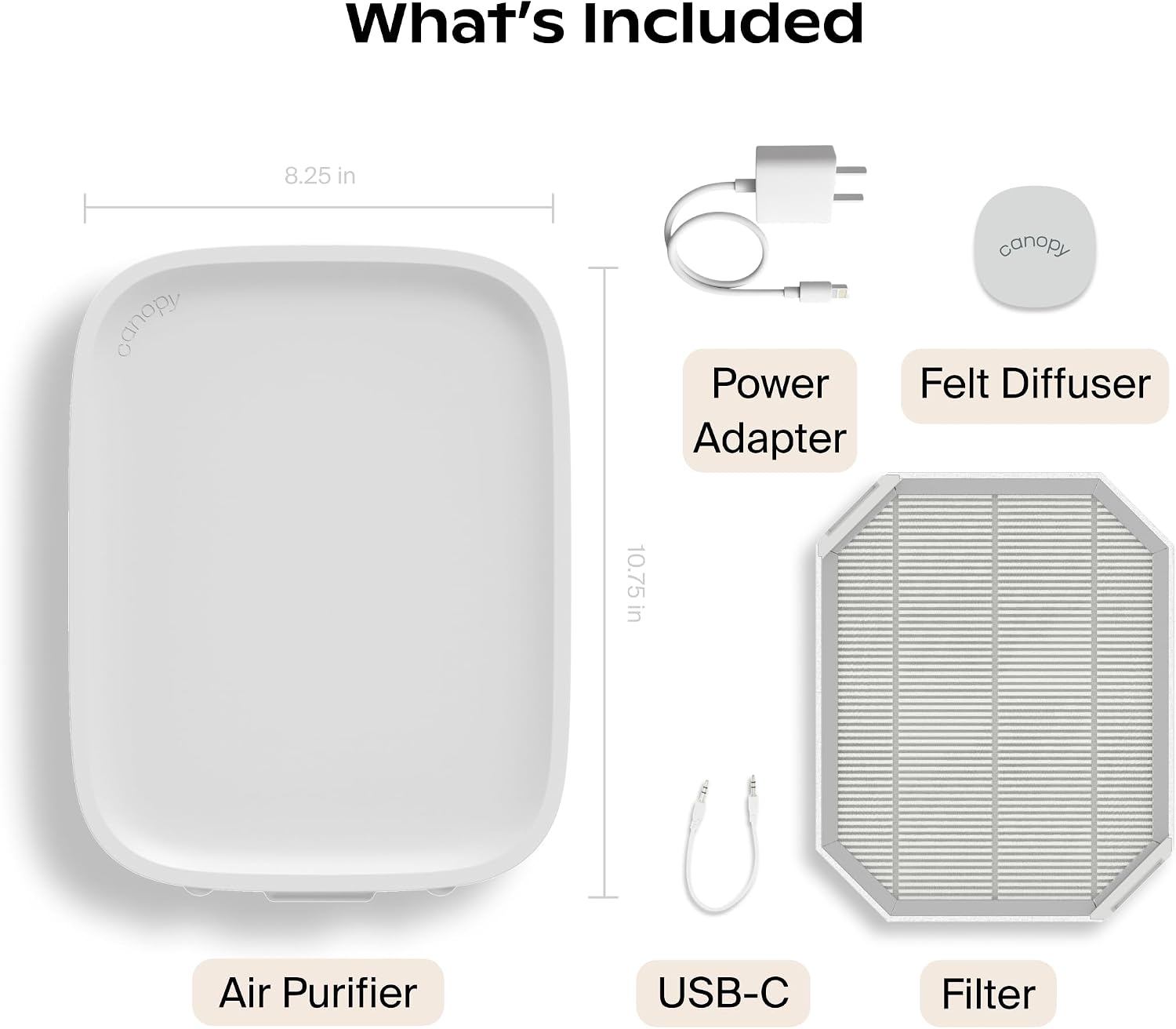
If you’ve ever set a small air purifier on your desk or tossed one in a suitcase, you already know there’s something reassuring about having one nearby — a quiet hum, a filter doing something. But “doing something” and “meaningfully cleaning the air in your space” are two different things, and for anyone making a real purchase decision right now, the gap between those two claims matters a lot. A portable or mini air purifier is a compact device — typically under 5 pounds, often USB or battery-powered — designed to filter airborne particles like dust, pollen, pet dander, and sometimes smoke or odors. The question isn’t whether they work at all. It’s whether they work enough for what you’re actually asking them to do.
This article is for buyers who’ve moved past “do I need one?” and are now wrestling with “which one, and will it actually do the job?” We’ll walk through the physics of why room coverage claims are often misleading, what the CADR number (Clean Air Delivery Rate — a standardized measure of how much filtered air a unit pushes out per minute) really tells you at small scale, and how to set realistic expectations before you spend $50 or $300.
The Core Physics Problem: Fan Size Is Not Optional
Here’s the thing no mini purifier marketing materials will tell you plainly: filtration effectiveness scales with airflow, and airflow scales with fan size. You cannot physically move enough air through a HEPA-grade filter (a filter rated to capture at least 99.97% of particles 0.3 microns in size — small enough to catch most allergens and fine smoke particles) with a USB-powered motor the size of a golf ball.
The EPA’s Guide to Air Cleaners in the Home uses the “air changes per hour” framework — ACH — to think about this. The general guidance for meaningful particle reduction is 4–5 ACH in the target room. That means the purifier needs to cycle the entire room’s air volume through its filter four to five times every hour. For a 10×10 foot room with 8-foot ceilings (800 cubic feet), you need to move roughly 3,200–4,000 cubic feet of air per hour. That’s a CADR in the neighborhood of 53–67 cubic feet per minute.
Most true mini or travel units — the hockey-puck-sized devices, USB desk units, and car-clip purifiers — have published CADRs in the range of 5 to 20 CFM, if the manufacturer publishes a CADR at all. (Many don’t, which is itself a red flag worth noting.) That’s not enough to meaningfully clean even a small hotel room. What those units can do is improve the air quality in an extremely small zone — roughly within 1–3 feet of the intake. Think of them less like room purifiers and more like a very localized shield.
Per Consumer Reports’ air purifier buying guide, the CADR-to-room-size rule of thumb is: CADR (in CFM) × 1.55 = recommended room size in square feet. A unit with a CADR of 20 covers about 31 square feet reliably. That’s a large closet, not a bedroom.
What Portable and Mini Units Actually Do Well
None of this means small purifiers are useless. It means they’re scalpels, not brooms. Used correctly, they deliver real value in specific scenarios:
Desk breathing zone protection. If you’re sitting at a desk for 8 hours a day, a unit with even a modest CADR — 15 to 30 CFM — positioned 12 to 18 inches from your face can meaningfully reduce your personal particle exposure. Wirecutter’s coverage of air purifiers consistently highlights that localized exposure reduction matters for allergy sufferers even when whole-room CADR is modest. Your lungs don’t care about the air at the other end of the room.
Car cabin air. A car interior is roughly 100 cubic feet. A unit rated at 15–20 CFM can actually achieve 4+ ACH in that space. This is one of the few environments where mini purifiers hit their legitimate use case.
Hotel rooms and short stays. A travel unit won’t clean the entire hotel room, but if you’re managing allergies triggered by dust mite particles (typically 1–10 microns — well within HEPA capture range), running a small unit on your bedside table overnight with the intake near pillow level does reduce particle counts in your immediate breathing zone. Healthline’s review of air purifiers and allergies notes that proximity to the source of allergen exposure matters significantly in determining whether filtration helps.
Supplemental coverage in high-CADR homes. If you already have a whole-room unit handling the bulk load, a desk unit near a specific irritant source (a 3D printer, a candle, a sanding project) can provide targeted supplemental filtration.
The gap cases: Portable units don’t handle gases or VOCs (volatile organic compounds — chemical off-gassing from furniture, paints, and cleaning products) unless they include an activated carbon layer, and even then, the carbon bed in a mini unit is thin enough that saturation happens quickly. They also don’t address biological contaminants distributed through HVAC systems, building-wide mold, or outdoor air infiltration. If those are your concerns, you’re in whole-home filtration territory.
By the Numbers: Portable Purifier Reality Check
| Use Case | Room/Zone Size | Minimum CADR Needed | Typical Mini Unit CADR | Verdict |
|---|---|---|---|---|
| Desk breathing zone (3 ft radius) | ~30 sq ft | ~20 CFM | 10–25 CFM | Viable |
| Car cabin | ~100 cu ft | ~7 CFM | 10–20 CFM | Strong fit |
| Small bedroom (10×10) | 800 cu ft | ~53 CFM | 10–25 CFM | Marginal to insufficient |
| Hotel room (typical king) | 400–500 sq ft | ~260 CFM | 10–25 CFM | Not meaningful for room |
Picking the Right Unit: Decision Rules by Use Case
The market for compact purifiers has matured considerably by mid-2026. Across aggregated owner reviews and published-spec comparisons, a few patterns hold consistently:
If your primary use is desk or personal zone: Look for units that publish a CADR (not just “covers up to X square feet” — that marketing language often isn’t AHAM-certified). Per AHAM’s documentation on CADR standards, the AHAM Verifide mark means the number was independently tested. Prioritize units with a true HEPA filter (not “HEPA-type” or “HEPA-style,” which are marketing terms with no regulatory definition) and at least one activated carbon layer if VOCs are a concern. Owners consistently report that USB-powered units with real HEPA filters run quieter and last longer than ionizer-based alternatives, which introduce ozone as a byproduct. The EPA explicitly flags ozone-generating devices as a concern in enclosed small spaces.
If your primary use is travel and hotel stays: Weight, noise at low speed, and filter replacement logistics matter more than peak CADR. A unit that tops out at 20 CFM but runs silently at its lowest setting is more useful on a trip than a 40-CFM unit that’s loud at idle. Owners in long-run reviews consistently flag filter availability for travel units — some compact models use proprietary filters that are only available from the manufacturer, creating supply risk. Check filter availability and cost before buying.
If you’re managing a documented allergy or respiratory condition: A portable unit as your only protection is a gap strategy, not a solution. Healthline’s overview of air purifiers and allergies is explicit that for people with moderate to severe asthma or allergic rhinitis, HEPA filtration should be combined with source control (mattress covers, HVAC filtration, humidity management) rather than relying on a single small device. If you’re in this group, the honest answer may be that your $150 travel unit budget is better spent upgrading your central HVAC filter to a MERV-13 rated option — that change alone covers the whole house.
If your budget is under $80: The realistic ceiling for useful portable filtration sits around units with a CADR of 20–30 CFM and a replaceable true HEPA filter. Below that, you’re largely buying a fan with a mesh layer. Consumer Reports’ buying guide notes that units under $50 rarely include independently verified CADR ratings — a detail worth weighing before purchase. That’s not a reason to avoid the category entirely, but it should reset expectations to “better than nothing in a small zone” rather than “this is cleaning my bedroom.”
If you’re a building manager or commercial operator looking at mini units for individual workstations or guest rooms: the honest calculus is that distributed small units rarely add up to meaningful whole-space IAQ improvement. The capital and filter-replacement costs across 20 desk units will often exceed the cost of a properly specified HVAC upgrade with MERV-13 or higher filtration. The exception is spot remediation — a conference room that generates whiteboard marker fumes, or a front desk where a single occupant is immunocompromised — where a higher-CADR compact unit (60–100 CFM range, which bridges the gap between “mini” and “full-size”) can serve a defined zone.
The Filter Cost Reality (Don’t Skip This)
Five-year total cost of ownership matters here just as much as it does for whole-home systems. A $60 unit with a $30 proprietary filter that needs replacement every 3 months costs you $180 in filters annually — $900 over five years. A $200 unit with a $40 filter on a 12-month cycle costs $200 over five years in filters. The math often reverses the sticker-price winner.
Per Wirecutter’s ongoing air purifier coverage, filter replacement cost is consistently one of the most underweighted factors in purchase decisions for compact units. Look for:
- Rated filter lifespan (hours of use, not just calendar months)
- Whether the filter is sold by multiple retailers or manufacturer-only
- Whether the unit has a real filter-life indicator vs. a fixed timer reset
A filter indicator based on actual airflow resistance is more reliable than a simple timer. Owners report that timer-based resets often prompt unnecessary replacements when air is clean, and may miss actual filter saturation in high-pollution periods.
The Decision Rule
If your concern is personal breathing zone exposure at a desk, in a car, or on a bedside table in a small space: a portable HEPA unit with a published CADR of at least 20 CFM and an independently verified filter is a legitimate, useful tool. Set it close, run it consistently, and account for filter costs.
If your concern is room-level air quality in a bedroom, living space, or any area over 150 square feet: a mini unit is a supplement at best. Your money works harder in a properly sized full-room purifier (CADR matched to your actual square footage) or an HVAC filter upgrade. Don’t let the portability convenience of a small unit talk you into undersizing your actual solution.
The physics don’t flex. But within their real limits, portable purifiers earn their place — you just have to know exactly where that place is.