You upgraded to a quality air purifier. Maybe you stacked a HEPA filter with activated carbon. You ran the numbers on CADR (Clean Air Delivery Rate — the cubic feet of clean air a purifier pushes out per minute) and picked a unit sized for your actual square footage. That’s genuinely good work. But here’s the gap no one leads with at the point of sale: three of the most consequential indoor air threats — radon gas, elevated carbon dioxide, and formaldehyde — are either invisible to HEPA filtration, generated continuously inside your space, or off-gassed from materials your purifier is sitting right next to. A purifier cleans particles from air that passes through it. It cannot reduce a radioactive gas seeping through your foundation, scrub the CO2 your own lungs are producing in a sealed room, or permanently neutralize formaldehyde baking out of new flooring. This guide is for the reader who already understands filtration basics and wants to close the monitoring gap — with real thresholds, honest product tradeoffs, and a clear decision framework.
Why Your Purifier Has a Blind Spot (And Why It Matters Now)
The filtration marketing stack — HEPA + activated carbon + UV-C — is legitimately useful for particulate matter, some VOCs (volatile organic compounds, meaning airborne chemicals that evaporate at room temperature), and biological agents. But effectiveness is conditional. Activated carbon can adsorb certain VOC molecules, including some formaldehyde, but carbon beds saturate over time and the adsorption rate for formaldehyde specifically is low relative to heavier hydrocarbons. The EPA’s “A Citizen’s Guide to Radon” is unambiguous: radon — a naturally occurring radioactive gas that rises from soil and rock decay — requires source mitigation (sub-slab depressurization systems, sealing foundation cracks) not air cleaning. And CO2 is simply a ventilation problem, not a filtration problem. You cannot filter out what your own body and your occupants are continuously producing.
The practical consequence: If you’re optimizing for health and cognitive performance — not just particle counts — you need a monitoring layer that sits alongside your purifier, not inside it. The sensors embedded in most consumer purifiers are adequate for PM2.5 triggers, but they tell you almost nothing about radon, CO2 accumulation, or formaldehyde off-gassing from a recent renovation.
By the Numbers
| Pollutant | EPA / WHO Action Threshold | What “Bad” Looks Like in Practice |
|---|---|---|
| Radon | 4 pCi/L (EPA action level) | One Airthings View Plus owner reported living at 7+ pCi/L for nearly three years while working from home — undetected |
| CO2 | 1,000 ppm (ASHRAE 62.1 ventilation benchmark); cognitive effects documented above 1,000 ppm | A BREATHE Airmonitor Plus reviewer measured 4,500 ppm in a small closed office |
| Formaldehyde | WHO guideline: 0.1 mg/m³ (30-minute average) | New flooring, cabinetry, and furniture routinely exceed this for weeks to months post-installation |
Radon: The Threat You Cannot Smell, See, or Filter
Radon is the second-leading cause of lung cancer in the United States, per the EPA’s citizen guide — responsible for an estimated 21,000 deaths annually. It’s a byproduct of uranium decay in soil and rock, and it enters buildings through foundation cracks, sumps, and gaps around utility penetrations. The dose accumulates silently over years, which is exactly what makes continuous monitoring so critical.
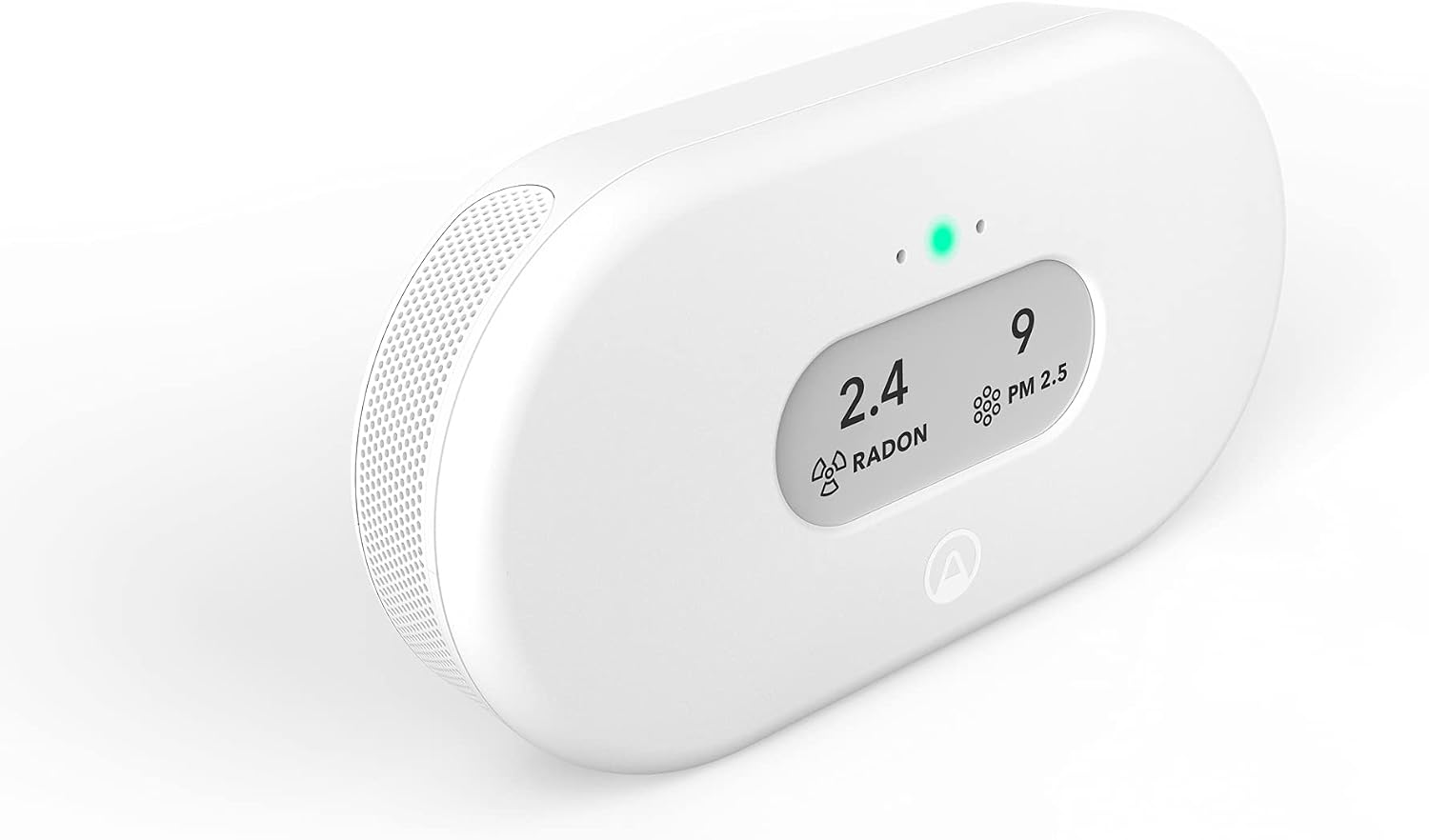
The Airthings View Plus is the monitor that comes up most consistently in serious long-run owner reviews for radon-specific coverage. Owners report that the combination of a calibrated radon sensor, CO2, PM2.5, humidity, temperature, pressure, and TVOC in a single dashboard is genuinely useful rather than gimmicky — it gives you correlated data across conditions, so you can see whether radon spikes correlate with humidity or pressure changes that drive soil gas infiltration. The unit connects to the Airthings app, and the data history is meaningful enough that homeowners have used it to document pre- and post-mitigation effectiveness.
The firmware risk is real and worth naming. At least one documented Airthings View Plus owner report describes the unit being bricked by a firmware update, with limited recourse. For a monitor you’re deploying in a health-critical role — especially radon detection in a home where someone works full-time — this is an ownership risk, not a theoretical one. If you’re specifying for a building manager or clinic context, build in a device replacement budget and confirm the brand’s firmware rollback policy before committing.
Decision frame on radon: If your building has a basement or slab-on-grade foundation and you haven’t tested, you are operating blind. A long-term passive radon test (a charcoal canister, roughly $15–$30, sent to a lab) gives you a baseline. If it comes in above 2 pCi/L, continuous monitoring with an Airthings View Plus and a quote from a certified radon mitigation contractor — typically $800–$2,500 depending on foundation type — is the correct next move. No purifier substitution applies here.
CO2: The Ventilation Signal Most Buyers Are Just Now Figuring Out
Aranet4 buyers are a notably self-aware segment. Across owner reviews, the consistent theme isn’t “air freshness” — it’s virus transmission risk and cognitive performance. That framing is scientifically grounded. Research published by Lawrence Berkeley National Laboratory’s Indoor Environment Group found that CO2 concentrations above 1,000 ppm in occupied spaces correlate with measurable decrements in decision-making performance. At 2,500 ppm, effects on complex tasks become significant. At 4,500 ppm — the level a BREATHE Airmonitor Plus user actually measured in a small closed office — you are working in conditions that would prompt OSHA to investigate an industrial site.
The Aranet4 is a purpose-built CO2 monitor using NDIR (non-dispersive infrared) sensor technology, which is the measurement method that produces reliable, drift-resistant readings. Owners consistently cite its accuracy relative to laboratory-grade equipment. The tradeoff is intentional narrow focus: the Aranet4 measures CO2, temperature, humidity, and atmospheric pressure. It does not measure particles, TVOC, or formaldehyde. If you want CO2-only data with best-in-class sensor quality and Bluetooth logging to your phone, that focus is its strength. If you want multi-pollutant correlation, the BREATHE Airmonitor Plus or a comparable multi-sensor unit is the more appropriate tool.
What CO2 level should trigger action? Per ASHRAE Standard 62.1-2022, the ventilation benchmark is roughly 700 ppm above outdoor ambient (which averages around 420 ppm globally as of 2026, per NOAA tracking data). In practical terms: if your indoor reading exceeds 1,000 ppm in an occupied room, open a window or increase mechanical ventilation. If you’re consistently above 1,200 ppm with the space occupied normally, your ventilation system is undersized for the occupancy load or the space is too airtight without mechanical fresh-air intake. CO2 is not fixed by recirculating air through a purifier — it requires genuine air exchange with the outside.
For smart-home-integrated buyers, the Amazon Smart Air Quality Monitor reads CO2 (alongside PM2.5, TVOC, humidity, and temperature) and hooks into Alexa routines — owners appreciate being able to trigger a fan or receive voice alerts when CO2 climbs. The documented limitation, per reviewer consensus, is that it works well as a trigger device within an Alexa ecosystem but doesn’t replace a dedicated sensor like the Aranet4 when precision CO2 tracking is the actual goal.
Formaldehyde and VOCs: The Off-Gassing Window You Need to Know
Multi-sensor monitor buyers — people picking up the BREATHE Airmonitor Plus, GoveeLife smart monitors, or similar units with TVOC and formaldehyde channels — consistently cite the same trigger: new construction, new furniture, or a recent remodel. That’s the right instinct. Formaldehyde (HCHO) is off-gassed from urea-formaldehyde resins in engineered wood products, adhesives, carpet backing, and many paints and finishes. The WHO indoor air quality guidelines set a 30-minute average guideline of 0.1 mg/m³ — a level that new flooring and cabinetry can exceed for weeks or months post-installation, depending on temperature, humidity, and ventilation.
Does TVOC cover formaldehyde adequately? No — and this is a critical distinction. TVOC (Total Volatile Organic Compounds) sensors use electrochemical or photoionization detection methods calibrated to a reference gas (often isobutylene). Formaldehyde, being a small aldehyde molecule, may be underweighted or missed depending on the sensor type. If formaldehyde exposure is the specific concern — post-renovation, new flooring, suspected pressed-wood off-gassing — a monitor with a dedicated HCHO channel (the BREATHE Airmonitor Plus includes one) is worth the additional cost over a TVOC-only device. A TVOC reading of “elevated” tells you something is off-gassing. A formaldehyde-specific reading tells you whether it’s the compound with the most documented human health concern in that category.
How long does off-gassing last? The honest answer depends on the product, temperature, and ventilation, but the Lawrence Berkeley National Laboratory’s indoor environment research and WHO documentation consistently point to a primary off-gassing window of 2–4 weeks for peak emissions, with a long tail of 6–12 months for engineered wood products in normal temperature ranges. Running dedicated monitoring for at least 90 days after a significant renovation — and using the data to drive ventilation decisions, not just to watch the number — is the practitioner-level approach.
Frequently Asked Questions
Can an air purifier with a carbon filter actually reduce radon levels? No, not in any meaningful or safe way. Activated carbon can capture radon decay products (the radioactive particles that form after radon decays), but it does nothing to reduce the radon gas concentration itself — and a saturated carbon filter that has captured radioactive decay products is itself a hazard. The EPA is explicit: radon mitigation requires source control, not air cleaning. If your radon levels are above 4 pCi/L, contact a certified radon mitigation contractor.
What CO2 level should trigger me to open a window or increase ventilation? Use 1,000 ppm as your action threshold in any occupied room. At that level, crack a window or run an HRV (heat recovery ventilator) if you have one. If you’re consistently hitting 1,200–1,500 ppm with normal occupancy, the ventilation design of the space needs a structural fix, not just a reactive response.
Is a separate formaldehyde sensor worth it, or does TVOC cover it adequately? In a post-renovation or new-furniture context, a dedicated HCHO sensor channel is worth it. TVOC sensors frequently undercount formaldehyde due to sensor chemistry differences. If your concern is specifically engineered wood, new flooring, or cabinets, pay for the dedicated channel.
How long after a remodel or new furniture purchase should I expect elevated VOC readings? Budget for monitoring through at least 90 days. Peak off-gassing occurs in the first 2–4 weeks, but residual emissions from engineered wood and adhesives can persist for 6–12 months at lower levels, particularly in warm or humid conditions that accelerate chemical release.
Does the Aranet4 only measure CO2, or can it measure particles and VOCs too? The Aranet4 measures CO2, temperature, humidity, and atmospheric pressure — that’s its full sensor suite. It does not measure particulate matter or VOCs. This is a deliberate design choice that prioritizes CO2 sensor accuracy over breadth. If you need CO2 alongside PM2.5 and TVOC in a single device, a multi-sensor unit like the BREATHE Airmonitor Plus or the Amazon Smart Air Quality Monitor better fits that use case, with the tradeoff that CO2 precision may vary by sensor technology.
The Decision Rule
If your concern is radon, start with a passive test, then add continuous monitoring with a dedicated radon sensor unit. Mitigation is a contractor job, not a purifier upgrade.
If your concern is CO2 and cognitive performance — home office, meeting room, yoga studio — the Aranet4 gives you the most reliable single-pollutant CO2 data; a multi-sensor unit gives you broader context with some precision tradeoff.
If your concern is post-renovation off-gassing, buy a monitor with a dedicated formaldehyde channel and plan to run it for 90+ days. Ventilate aggressively in the first month. Your purifier’s carbon filter is a supporting player, not the solution.
And in all three cases: your purifier is still doing real, valuable work on particles and some VOCs. It just can’t see the threats this guide covers. The monitoring layer doesn’t replace it — it tells you what the purifier can’t tell you about the air you’re actually breathing.