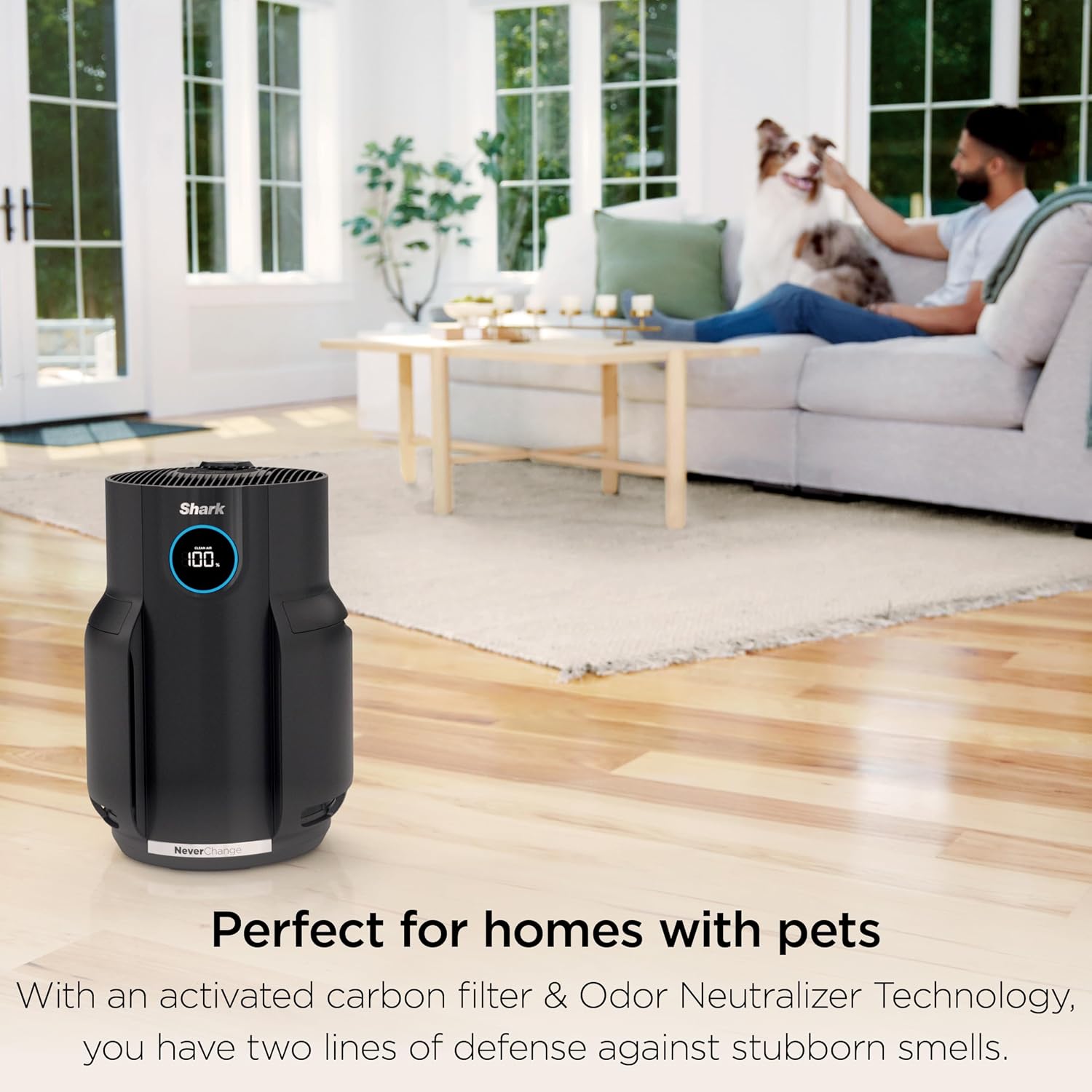
If you’ve ever stood in front of an air purifier display and felt mild dread at the $50–$80 filter replacement price tags, you already understand the appeal of Shark’s NeverChange pitch. Air purifiers work by pulling room air through a filter — most commonly a HEPA filter (High-Efficiency Particulate Air filter, a standardized media that captures 99.97% of particles 0.3 microns or larger) — which physically traps dust, pollen, pet dander, and fine particulate matter before pushing clean air back into the room. The problem with traditional HEPA filters is that they clog over time and must be thrown out and replaced, typically every 6–12 months. Shark’s NeverChange line flips that model: the filter is designed to be rinsed under water, dried, and reinstalled — indefinitely, the company says. That’s a genuinely different value proposition, and it deserves a careful look before you commit $300 to it.
This article breaks down what the NeverChange design actually does well, where it leaves real gaps, and how it stacks up against the Coway AP-1512HH and Winix 5500-2 — the two units most buyers at this price point seriously compare. We’ll show the five-year cost math, call out the smart-home limitations honestly, and end with a clean decision rule.
| EDITOR'S PICK[Shark Air Purifier for Home wit…](https://www.amazon.com/dp/B0CBQRTQ6D?tag=greenflower20-20) | Budget pick[Shark Air Purifier for Home](https://www.amazon.com/dp/B0CM6VDKSQ?tag=greenflower20-20) | |
|---|---|---|
| Coverage | 1400 sq. ft. | Large Room |
| Filter type | HEPA | HEPA-Exceeding |
| Filter life | 5-Year | NeverChange |
| Features | Multi-Room Purification | Odor Neutralizer |
| Captures | Smoke, 99.98% Particles | Pollutants, Pet Dander, Dust, Odor, Smoke |
| Model | HP302 | HP152 |
| Price | $299.00 | $169.99 |
| See on Amazon → | See on Amazon → |
What “NeverChange” Actually Means (And What It Doesn’t)
The Shark NeverChange filter system is built around a washable HEPA-type filtration layer combined with an outer pre-filter that captures larger particles first. The core claim is that you wash the filter rather than replace it — Shark’s guidance calls for cleaning roughly every 30 days under light use, more frequently in high-dust or pet-heavy homes.
Here’s what the claim does not mean, and this distinction matters for your evaluation:
The filter is not rated to last forever. Shark’s own documentation indicates the filter should be inspected regularly for physical damage or visible degradation and replaced if compromised. Most independent reviewers and appliance tracking at Consumer Reports note that washable HEPA-type filters — a category distinct from true HEPA media — can see gradual efficiency reduction over repeated wash cycles, particularly if the filter media is stretched, torn, or dried improperly. The company does not publish a specific wash-cycle lifespan figure, which is a transparency gap worth noting.
“HEPA-type” is not always the same as “True HEPA.” The U.S. Environmental Protection Agency’s Guide to Air Cleaners in the Home distinguishes between certified HEPA filters (tested to 99.97% capture at 0.3 microns) and “HEPA-type” or “HEPA-style” designations, which may fall short of that standard. Shark’s marketing materials vary by model in how precisely they characterize filtration efficiency — buyers should confirm the specific unit’s certified rating before purchase.
What owners do report consistently, and this is the signal worth weighting most: dust-on-furniture reduction is dramatically noticeable within two weeks of use. Multiple owner accounts across aggregated review data describe the change as the cleanest air their home has ever felt, with zero buyer’s remorse at the $300 price point. That’s a meaningful real-world outcome, even if the mechanism deserves scrutiny.
The Five-Year TCO Math: Where Shark Has a Real Argument
This is where the NeverChange case is genuinely strong — on paper — and where you need to run the numbers rather than take the marketing at face value.
By the numbers (5-year total cost of ownership, estimated):
| Unit | Purchase Price | Annual Filter Cost | 5-Year TCO |
|---|---|---|---|
| Shark NeverChange (~300 sq ft model) | ~$300 | ~$0–$20 (cleaning supplies, occasional pre-filter) | ~$300–$400 |
| Coway AP-1512HH | ~$150 | ~$50–$70/yr (HEPA + carbon combo) | ~$400–$500 |
| Winix 5500-2 | ~$200 | ~$60–$80/yr (HEPA + carbon combo) | ~$500–$600 |
Filter cost estimates based on published replacement pricing as of mid-2026; Coway and Winix figures sourced from manufacturer retail and third-party retail listings. Shark annual cost assumes no filter replacement but includes wash cycle frequency and modest pre-filter costs.
The math is favorable for Shark, but it rests on an assumption that hasn’t been stress-tested at scale: that the washable filter maintains its rated efficiency across 60 monthly wash cycles (five years) without measurable degradation. The NeverChange product line currently carries approximately 5,400 ratings — compared to Coway AP-1512HH’s 28,700+ and Levoit’s 100,000+ — which means the long-run durability data simply doesn’t exist yet at the volume needed to confirm or refute the cost case. Buyers absorbing this tradeoff should price in a potential filter replacement at year 3–4 as a downside scenario.
At Wirecutter’s long-run air purifier coverage, the consistent editorial theme is that filter replacement transparency is the single biggest TCO variable in this category — and Shark’s washable design sidesteps that variable in a way that’s genuinely differentiated, even if unproven at scale.
CADR, Room Coverage, and the Noise Reality Check
CADR — Clean Air Delivery Rate, a standardized metric from the Association of Home Appliance Manufacturers (AHAM) measuring how quickly a unit cleans a specific room size of dust, pollen, and smoke — is the number you use to compare units honestly across price tiers.
Shark does not prominently publish CADR figures for the NeverChange line in the same way Coway and Winix do, which is itself a transparency flag. Published spec sheets and AHAM directory listings put the NeverChange units in a competitive but not class-leading range for their coverage claims. For direct comparison:
- Coway AP-1512HH: CADR dust ~246, pollen ~240, smoke ~233 — rated for ~360 sq ft
- Winix 5500-2: CADR dust ~243, pollen ~246, smoke ~232 — rated for ~360 sq ft
- Shark NeverChange (primary model): AHAM-listed CADR figures are lower in third-party comparisons; rated coverage of roughly 300 sq ft suggests CADR dust in the 180–220 range, though Shark does not make this a front-page specification
This matters for how you size the unit. If you’re evaluating for a 300–350 sq ft bedroom or living room, the NeverChange is appropriately sized. For larger open-plan spaces, the Coway and Winix units deliver more raw throughput per dollar on the initial purchase.
On noise: owners describe the NeverChange as “big and silent” at low-to-medium fan speeds, which is consistent with the physical design — larger fan diameter at lower RPM is generally quieter than smaller fans pushed harder. This is a real advantage if bedroom use is the primary scenario. Consumer Reports’ air purifier testing methodology consistently flags noise at rated CADR speed as the variable most buyers underweight at purchase, and Shark’s design profile suggests it performs relatively well on this axis.
The Smart-Home Gap: A Real Limitation, Not a Minor Footnote
Here’s the tradeoff you need to name explicitly before committing: the Shark NeverChange has no Wi-Fi connectivity, no companion app, no HomeKit integration, no Alexa or Google Home compatibility, and no automatic mode driven by an onboard air quality sensor.
For a $300 unit in 2026, this is a genuine category gap. Winix 5500-2 includes a PlasmaWave air quality sensor with auto mode. Levoit Core 300S and Core 400S — both under $200 — offer app control and auto-adjust based on particulate readings. Even Coway’s base AP-1512HH includes an air quality indicator LED and auto mode.
None of the owner reviews in the NeverChange aggregated data mention app control as a feature they wanted and found — which likely reflects self-selection: buyers who chose the NeverChange knew they were buying a manual-control unit. But if your decision framework includes set-and-forget auto mode, real-time AQI display, or integration into a broader smart-home ecosystem, the NeverChange is the wrong tool. This isn’t a close call.
If auto mode and app control are requirements, the Winix 5500-2 or a Levoit Core 400S delivers those features at comparable or lower cost, with a much deeper installed base and longer-run performance data.
Frequently Asked Questions
How often do you actually need to clean or wash a NeverChange filter? Shark’s guidance recommends cleaning approximately every 30 days under normal use. In high-dust environments, homes with pets, or during high-pollen seasons, that interval should shorten to every 2–3 weeks. The pre-filter layer — which catches larger particles before the HEPA media — can be cleaned more frequently without impacting the main filter.
Does washing a HEPA filter degrade its filtration efficiency over time? The honest answer is: probably, and the rate depends on handling. Stretched, torn, or improperly dried filter media can develop gaps that reduce particle capture efficiency below rated levels. The EPA’s Guide to Air Cleaners notes that washable HEPA-type filters require careful maintenance to sustain performance. Shark does not publish independent third-party wash-cycle efficiency testing, so buyers are relying on manufacturer claims rather than verified long-run data.
What is the CADR rating of the Shark NeverChange and how does it compare to Winix or Coway? Shark does not prominently publish CADR figures, which limits direct comparison. Based on AHAM directory and third-party spec aggregation, the primary NeverChange model appears to deliver CADR dust performance in the 180–220 range for its 300 sq ft coverage claim — competitive but below the Coway AP-1512HH and Winix 5500-2, both of which deliver CADR dust ratings above 240 for similar room-size ratings.
Is the NeverChange filter truly never replaced, or does it eventually need replacement? Eventually, it needs replacement. Shark’s design goal is to dramatically extend filter life through washing rather than eliminate replacement entirely. Physical damage — tears, permanent discoloration that doesn’t clear with washing, or visible media degradation — triggers a replacement need. Shark does sell replacement filters for the NeverChange line, which confirms this. “Never replace” is marketing shorthand for “replace far less often than traditional HEPA,” not a literal lifetime guarantee.
Does the Shark NeverChange have an air quality sensor or auto mode? No. The NeverChange units reviewed here are manual fan-speed controls only — no onboard air quality sensor, no auto mode, no app connectivity. Fan speed is set by the user and stays where you put it. For buyers who want automatic adjustment based on real-time particulate readings, this is a disqualifying limitation.
The Decision Rule
Run this decision frame against your actual situation:
If your primary concern is long-run filter cost and you’re comfortable manually managing a monthly wash routine — and you don’t need smart-home integration or auto mode — the Shark NeverChange presents a genuinely compelling TCO case for a 250–350 sq ft room. The real-world dust reduction feedback from owners is among the more enthusiastic in the category. Our pick for this profile.
If you want set-and-forget auto mode, app control, or smart-home integration — or if you’re covering a room above 350 sq ft — the Winix 5500-2 or Levoit Core 400S outperform the NeverChange on features at comparable or lower price points, with substantially deeper review bases confirming long-run reliability.
If you’re on the fence specifically because of filter cost — run the five-year math above against your current purifier’s filter replacement schedule. If you’re already spending $60–$80/year on filters, the NeverChange’s breakeven is roughly year 2–3 versus a Winix, assuming the washable filter holds efficiency. That’s a reasonable bet, not a guaranteed one.
The NeverChange is a legitimately different product, not just a marketing repositioning. It’s the right answer for a specific buyer. The job is making sure that buyer is you.