A smart air purifier is exactly what it sounds like: an air purifier (a device that pulls room air through a filter to remove particles like dust, pollen, smoke, and pet dander) with a WiFi radio built in, so you can control it from your phone and — ideally — have it react automatically to changing air quality. The “smart” part sounds like a bonus feature, but if you’re running multiple units across a home or managing air quality in a commercial space, the app ecosystem is actually the product you’re buying. A purifier with a bad app is just an expensive fan you can turn on remotely. A purifier with a great app becomes a system that learns your space, surfaces real data, and integrates with everything else you’ve invested in. This guide cuts through the marketing to show you which app platforms are genuinely useful, which ones lock you into recurring costs or proprietary sensors, and how to make the right call based on what you actually need.
| EDITOR'S PICK[Levoit Air Purifiers for Home L…](https://www.amazon.com/dp/B0BGPF71Q6?tag=greenflower20-20) | Mid-tier[LEVOIT Air Purifier for Home La…](https://www.amazon.com/dp/B0CGV8FLNX?tag=greenflower20-20) | Budget pick[GoveeLife Smart Air Purifier fo…](https://www.amazon.com/dp/B0CYHBHRHW?tag=greenflower20-20) | |
|---|---|---|---|
| Coverage | 2933 ft² | 1073 ft² | 1046 ft² |
| Filter Type | HEPA 3-in-1 | HEPA | 3-in-1 |
| Washable Pre-Filter | — | ✓ | — |
| Price | $237.49 | $109.99 | $64.99 |
| See on Amazon → | See on Amazon → | See on Amazon → |
What “Smart” Actually Means — and Where the Tradeoffs Live
The word “smart” on a purifier box covers a wide range of actual capability. At minimum, it means a companion app lets you change fan speed remotely. At the useful end of the spectrum, it means the unit reads its own onboard air quality sensor (measuring PM2.5 — fine particulate matter at 2.5 microns or smaller — plus sometimes VOCs, CO₂, or humidity), adjusts fan speed automatically in response, logs historical data, and pushes that data to your existing smart home platform.
The tradeoffs cluster around three axes:
1. Sensor quality vs. sensor theater. Many purifiers include an onboard sensor whose readings look authoritative in the app but aren’t calibrated to any external standard. Per IAQA technical guidance on sensor-grade IAQ monitoring, consumer-grade laser particle counters (the type used in most purifiers) have meaningful drift over time and can read differently depending on humidity. A unit that shows “Air Quality: Good” while a calibrated reference monitor disagrees isn’t smart — it’s reassuring. The better brands publish their sensor methodology; most don’t.
2. Auto-mode reliability. Auto mode — where the fan ramps up when the sensor detects a spike in particles — is the feature that justifies buying a smart unit over a dumb one. But across aggregated owner reviews compiled by Wirecutter’s air purifier coverage and Consumer Reports’ annual purifier rankings, the pattern is consistent: auto mode varies enormously in latency and sensitivity. Some units respond to a cooking spike in under two minutes; others take eight to ten minutes or never leave low speed during short-duration events. That lag matters if you’re trying to protect a clinically sensitive occupant.
3. Ecosystem lock-in vs. platform openness. This is the one most buyers underestimate. Once you’ve placed three units in your home and trained yourself on the app’s dashboard, switching brands requires replacing hardware. Some manufacturers compound this with filter subscription models or cloud-dependent features — if the company shuts down its servers or paywalls an API, core functionality degrades or disappears entirely.
The App Ecosystem Landscape in 2026: A Practitioner’s Map
Here’s how the major platforms break down for buyers who are past the first-unit, single-room phase:
IQAir — Best Data, Closed Platform
IQAir’s companion app (used with the HealthPro Plus and AirVisual Pro sensor line) is the most data-dense consumer IAQ platform available. It integrates with IQAir’s global outdoor AQI network, overlays indoor readings against outdoor baselines, and provides detailed filter life tracking down by filter layer. Operators in long-run facility reviews note the AirVisual dashboard is genuinely useful for multi-zone monitoring in clinics and boutique hotel rooms.
The ceiling: IQAir uses a proprietary sensor ecosystem. You can’t pull its data into Home Assistant, Apple HomeKit, or Google Home natively without third-party workarounds that break with firmware updates. For buyers who want one platform for everything, this matters. For buyers who want the best IAQ intelligence and are willing to run a parallel dashboard, it’s defensible.
Filter cost reality check: IQAir HealthPro Plus filters run approximately $200–$280 per full replacement cycle (pre-filter, HyperHEPA, V5-Cell gas filter combined). At the manufacturer-recommended replacement interval of 12–18 months under moderate use, five-year TCO on filters alone lands at $800–$1,200 above the unit purchase price. That’s not a hidden cost — IQAir is unusually transparent about it — but it’s a material line item for anyone building a multi-unit deployment.
Blueair — HomeKit Integration Done Right
Blueair’s app (covering the Blue Pure and Blueair Pro series) earns consistent marks from reviewers at Wirecutter for its clean UI and reliable Apple HomeKit and Amazon Alexa integration. The auto-mode implementation is one of the faster-responding in its class based on published spec comparisons — Blueair rates the Pro series’ particle detection response at under 60 seconds for significant PM2.5 spikes.
The practical advantage for smart-home-integrated buyers: because Blueair supports HomeKit natively, you can build automations that tie air quality to other room conditions — run the purifier when the window sensor closes, or trigger it from a CO₂ threshold set by a separate sensor on the same HomeKit hub. That cross-device logic is where “smart” starts earning its name.
Lock-in risk is moderate. Blueair’s filter subscription program (SQA — regular auto-ship) creates convenience but also makes it easy to default into higher spend. The filters themselves are competitively priced at roughly $50–$90 per year for mid-range Blue Pure units, making 5-year TCO more manageable than the premium tier.
Molekule — The App That Outpaced the Hardware
Molekule’s story is instructive. The brand built a genuinely sophisticated app experience — detailed VOC and particulate trending, well-designed historical graphs, and solid Alexa integration — around filtration technology (PECO) whose efficacy claims generated significant independent scrutiny. Per Consumer Reports’ testing methodology reviews and Wirecutter’s long-form evaluation of the Air Pro, the unit’s measured CADR (Clean Air Delivery Rate — the cubic feet per minute of clean air a purifier delivers, rated by AHAM, the Association of Home Appliance Manufacturers) underperformed its price tier in independent evaluations.
The lesson for practitioners: don’t let a polished app ecosystem substitute for CADR-verified performance. Molekule’s app is good. The underlying clean air delivery math didn’t match the marketing at the time of its most scrutinized reviews. That’s the exact mistake an intermediate buyer makes — confusing a great UX with a great product.
Coway and Winix — Value-Tier Apps With Honest Tradeoffs
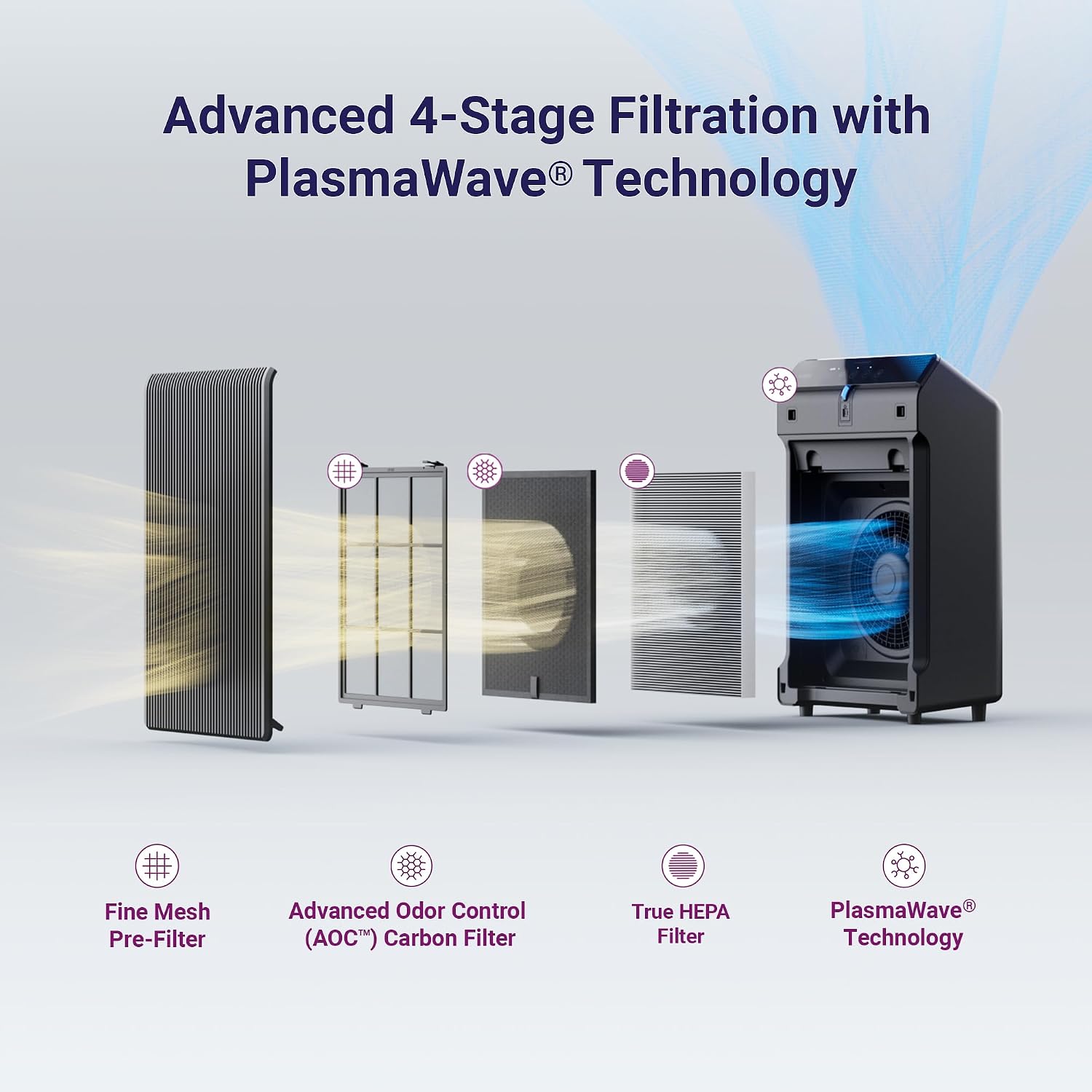
Coway’s Airmega line and Winix’s PlasmaWave series sit in the $200–$600 tier and their apps reflect the price point. Coway’s app covers scheduling, filter life, and basic air quality trends. Owners consistently report it’s functional without being exceptional — no Google Home integration natively, Alexa support available. Winix’s app experience draws more mixed reviews; owners note connectivity drops on 5GHz networks (most Winix units require 2.4GHz only, per their published setup documentation), which is an annoying but solvable configuration issue.
For buyers deploying multiple units in a cost-sensitive commercial setting (yoga studio, small clinic), the Coway Airmega 400S or Winix 5500-2 provide credible CADR-per-dollar ratios, and the app limitations are manageable if you’re not trying to pipe data into a larger building management system.
By the Numbers: App Ecosystem Comparison
| Brand | HomeKit | Google Home | Alexa | Open API / HA | 5-Yr Filter TCO (est.) |
|---|---|---|---|---|---|
| IQAir (HealthPro Plus) | No | No | No | No (workarounds only) | $800–$1,200 |
| Blueair Pro | Yes | No | Yes | Limited | $350–$600 |
| Coway Airmega 400S | No | No | Yes | No | $250–$400 |
| Winix 5500-2 | No | No | Yes | No | $150–$250 |
| Molekule Air Pro | No | No | Yes | No | $500–$900 |
TCO estimates based on manufacturer-published filter pricing and recommended replacement intervals as of Q1 2026.
The Lock-In Question: What to Actually Evaluate Before You Buy
Lock-in in the smart purifier space takes three forms, and they’re not equally risky:
Hardware lock-in (proprietary filters, non-standard form factors) is the most expensive. IQAir and Molekule filters are brand-exclusive and priced accordingly. This isn’t inherently disqualifying — IQAir’s multi-stage filtration justifies premium filter costs for medical-grade applications — but it means your ongoing cost is entirely at the manufacturer’s discretion.
Cloud lock-in (features that depend on an active server connection) is the most fragile. Per EPA guidance on smart building technology and IAQ monitoring, any system that requires cloud validation for local operation creates a single point of failure. In 2025, at least two consumer IAQ brands reduced app functionality after restructuring — a pattern Consumer Reports’ smart home coverage has flagged as an industry-wide risk. Ask: does auto-mode still work if the app is down? For most major brands, yes. For some newer entrants, no.
Data lock-in (no export, no API access) matters most for commercial operators and medically motivated buyers who want to document air quality over time for liability or clinical purposes. IQAir’s AirVisual platform offers CSV export and API access at the business tier. Most consumer-grade brands do not.
Decision Framework: If X, Then Y
Work through these in order before committing:
If you’re running 3+ units and want a unified dashboard: IQAir AirVisual ecosystem is the most capable, but accept the closed-platform tradeoff and model the filter TCO before you scale.
If deep Apple HomeKit or whole-home automation integration matters most: Blueair Pro series is the defensible choice — native HomeKit, solid CADR, reasonable 5-year filter costs.
If you’re budget-constrained but need basic remote control and scheduling: Coway Airmega 400S delivers on CADR (rated 246 CFM for smoke per AHAM) and the app covers core needs without overreach.
If a vendor’s app polish is the deciding factor: pause and pull the AHAM CADR certificate first. A great dashboard on an underperforming unit is the Molekule lesson — one the industry learned publicly and expensively.
If you’re specifying for a commercial or clinical setting where air quality documentation matters: prioritize API access and data export over consumer UX. IQAir at the premium tier or a standalone IAQ sensor network (Awair, Airthings, or similar) feeding a purifier on separate control logic is a more defensible architecture than any single consumer-brand smart purifier.
The app is infrastructure. Evaluate it the way you’d evaluate any infrastructure decision: by what it costs when something goes wrong, not just how it looks when everything works.