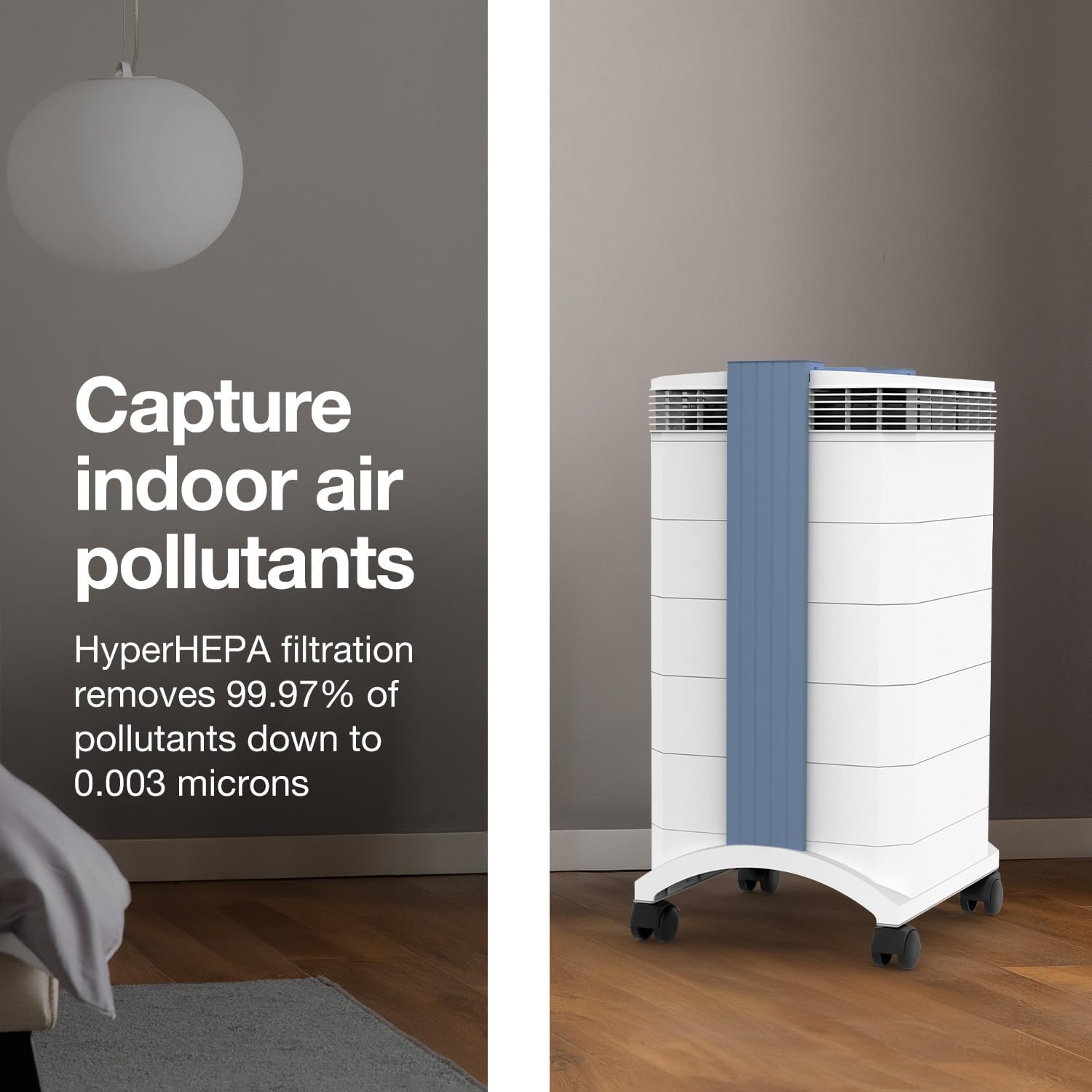
If you’ve been shopping for an air purifier after a wildfire season or noticed that your home smells like paint, cleaning products, or something you can’t quite name, you’ve probably focused on HEPA filters — the dense, paper-like filters that trap tiny particles. HEPA is genuinely great at what it does: catching smoke particles, dust, pollen, and even some bacteria. But wildfire smoke and household chemicals are a two-part problem. The visible haze and fine particles are only half of it. The other half is a class of invisible airborne chemicals called volatile organic compounds — VOCs for short — which are gases released by smoke, building materials, cleaning products, and dozens of other everyday sources. HEPA filters don’t touch gases. For VOC removal, the spec that actually separates a useful purifier from a useless one is carbon filter depth: how much activated carbon (a porous material that chemically traps gas molecules) the unit contains, and how it’s structured. This article walks you through what depth means, why it matters more than any other carbon-related spec, and how to use it as your primary filter when you have a real purchase decision in front of you.
| EDITOR'S PICK[IQAir GC Multigas XE Air Purifi…](https://www.amazon.com/dp/B0D7M5XX6C?tag=greenflower20-20) | Mid-tier[PuroAir 400 HEPA Air Purifier L…](https://www.amazon.com/dp/B0C3FXZLZ5?tag=greenflower20-20) | Budget pick[Levoit Air Purifiers for Home L…](https://www.amazon.com/dp/B0BGPF71Q6?tag=greenflower20-20) | |
|---|---|---|---|
| Coverage | 1125 sq ft | 2000 ft² | 2933 ft² |
| Filter type | Activated Carbon | HEPA CarbonTech | 3-in-1 HEPA |
| Smart features | WiFi | Sensor & Auto | WiFi, PM2.5 |
| Made in | Swiss Made | — | — |
| Claimed strength | — | 500X stronger | — |
| Price | $1,599.99 | $259.99 | $237.49 |
| See on Amazon → | See on Amazon → | See on Amazon → |
Why HEPA Alone Fails in Wildfire and Chemical Scenarios
If you’re evaluating purifiers under time pressure — a smoke event, a renovation, a tenant complaint — it’s worth being precise about what you’re actually solving for.
Wildfire smoke is a genuine dual threat. The particle side (PM2.5 — particles smaller than 2.5 microns, small enough to penetrate deep into lungs) is well-documented in EPA guidance, and any true HEPA filter handles it effectively at rated airflow. But smoke also carries a dense VOC payload: benzene, formaldehyde, acrolein, polycyclic aromatic hydrocarbons. Per the California Air Resources Board’s portable air cleaner effectiveness research, wildfire smoke VOC concentrations inside homes can spike to levels that exceed outdoor air quality standards even when windows are closed, because gases infiltrate through building envelopes more easily than particles do.
Indoor VOC sources compound the problem. Lawrence Berkeley National Laboratory research on indoor air chemistry (Weschler, C.J.) documents how common renovation materials — paints, adhesives, flooring — off-gas significantly for weeks to months after installation. A home under renovation or recently finished is a chronic, low-grade VOC environment even without wildfire season adding to the load.
HEPA filters physically intercept particles. They do this through a combination of diffusion, interception, and impaction — mechanisms that work on mass. Gas molecules are orders of magnitude smaller and pass through HEPA media as easily as they pass through a window screen. When a manufacturer bundles a thin carbon “pre-filter” with a HEPA unit and markets it as VOC-capable, they’re not lying about the mechanism — carbon does adsorb gases — but the amount of carbon determines how long and how effectively it works. A 30-gram carbon pad saturates in days under real smoke load. A 5-pound carbon bed lasts months.
What Carbon Filter Depth Actually Means (and How to Read It)
“Carbon filter depth” refers to two related things: physical thickness of the carbon bed and total carbon mass (weight). Both matter because they determine adsorption capacity — the total volume of gas molecules the filter can capture before it becomes saturated and must be replaced.
Activated carbon works through adsorption (not absorption — the gas molecules bond to the surface of carbon granules rather than being absorbed into a liquid). The surface area of activated carbon is enormous — one gram can have the surface area of several tennis courts — but that capacity is finite. Once all the binding sites are occupied, the filter stops working and can even begin releasing previously captured compounds (called off-gassing or breakthrough), which is worse than no carbon at all.
By the numbers:
| Carbon mass (approx.) | Realistic VOC scenario | Expected useful life |
|---|---|---|
| < 100g (thin pad/mesh) | Light odor, low-load office | Days to weeks under smoke |
| 300g – 1 lb | Moderate VOC, seasonal smoke | 2–4 months at moderate load |
| 2–5 lbs | Wildfire season, renovation off-gas | 6–12 months with replacement |
| 10+ lbs (HVAC-grade) | Commercial, clinical, whole-home | 12–24 months, source-dependent |
These are directional ranges drawn from published manufacturer specs and CARB evaluation methodology — real-world life varies with pollutant concentration, airflow rate, and humidity (high humidity reduces adsorption efficiency).
Granule size and carbon type also affect performance. Pelletized carbon with a consistent granule size creates more uniform airflow through the bed, reducing channeling (where air takes the path of least resistance and bypasses carbon). Impregnated carbon — carbon treated with potassium permanganate or other compounds — is specifically formulated for aldehydes and acid gases that plain activated carbon handles poorly. For wildfire scenarios, an impregnated or blended carbon bed is meaningfully better than plain activated carbon at comparable weights.
The U.S. EPA’s Guide to Air Cleaners in the Home notes that effectiveness of carbon filters varies significantly by VOC type and that manufacturers rarely publish standardized VOC removal data the way they publish CADR numbers for particles. This is the core problem: CADR (Clean Air Delivery Rate) is a standardized, third-party-tested metric for particles. There is no equivalent universal standard for VOC removal. You’re reading spec sheets and manufacturer claims without the same verification backstop. This makes carbon weight and bed depth your best available proxy.
How to Apply This to Real Purchasing Decisions
Here’s where this becomes actionable if you have a unit or shortlist in front of you right now.
Step one: Find the carbon weight, not the filter description. Marketing copy that says “activated carbon filter” tells you almost nothing. Look for a spec that states carbon weight in grams or pounds, or bed depth in inches. If it’s not published, assume it’s a thin pad. Manufacturers proud of their carbon stages publish the numbers.
Units in the $300–$600 range from brands like IQAir, Austin Air, and Blueair Pro series diverge sharply on this spec. Austin Air’s HealthMate, for example, publishes a 15-pound carbon and zeolite blend — a genuinely deep bed designed for ongoing chemical load. IQAir’s HealthPro Plus uses a separate chemisorption filter stage with HyperHEPA. These units cost more partly because the carbon stage costs more to manufacture and more to replace. Across aggregated reviewer patterns, owners dealing with chronic VOC environments — near traffic corridors, in wildfire-prone regions, post-renovation — consistently rate these high-carbon units as the ones that actually eliminated odor rather than masking it. Budget units with thin carbon pads receive consistent complaints that chemical smells return within weeks.
Step two: Calculate carbon replacement cost over 5 years. This is where the TCO (total cost of ownership) math changes the decision frame. A unit with a $50 carbon filter that needs replacement every two months costs $300/year in carbon alone. A unit with a $180 filter that lasts 12 months on the same load costs $180/year and likely removes more VOCs across that cycle. Per ASHRAE Standard 62.1 guidance on maintaining filtration performance, filter-change intervals based on time alone (rather than saturation monitoring) tend to result in underperforming filters toward the end of their cycle. Smart units with VOC sensors that trigger filter alerts close this gap — but only if the sensor is calibrated for the specific VOC classes you’re targeting, not just a generic air quality index.
Step three: Match carbon type to your specific VOC profile. This is the nuance most buyers skip.
- Wildfire smoke: Benzene, formaldehyde, acrolein. Plain activated carbon handles benzene reasonably well. Formaldehyde requires impregnated carbon or a dedicated oxidation stage (some units use UV-C or photocatalytic oxidation alongside carbon — with caveats about ozone byproducts, per EPA warnings on some PCO technologies).
- Renovation off-gassing: VOC cocktail dominated by xylene, toluene, and acetaldehyde — standard activated carbon performs adequately here at sufficient volume.
- General household chemicals: Cleaning products, personal care aerosols, cooking combustion — a broad-spectrum carbon bed handles this well as a chronic background load.
- If you’re managing a commercial space (boutique hotel, yoga studio, clinic) where VOC sources are diverse and ongoing, an HVAC-integrated carbon media bank — Lennox PureAir systems or Aprilaire’s filtration platform — allows much larger carbon mass and professional replacement scheduling, which portable units can’t replicate.
Step four: Don’t let noise performance become the reason you run the unit at too-low a speed. This is a real-world failure mode. A unit with excellent carbon depth but an intolerable fan at the airflow needed to turn the room’s air over 4–6 times per hour becomes a unit people run on low, which reduces both CADR and effective VOC contact time with the carbon bed. Noise ratings at high speed should be part of your comparison. Reviewers consistently flag this as the practical differentiator between units with comparable specs on paper.
HVAC-Integrated Carbon: When Portables Stop Being Enough
If the square footage, source load, or operational context exceeds what a portable can handle, the decision frame shifts. Whole-home systems like the Aprilaire 5000 (a media air cleaner with a thick filtration bed) or RGF Environmental’s REME HALO (a photohydroionization system with different chemistry) represent a different architecture — centralized treatment of all air cycling through the HVAC system rather than spot treatment of a single room.
For these systems, carbon depth is specified in terms of media bed thickness across the duct cross-section. The installation context means carbon replacement is a scheduled service event, not a consumer behavior. Building managers and clinic operators should request documentation of the carbon media type (granulated vs. bonded vs. impregnated), verified replacement intervals at their specific CFM and expected pollutant load, and any ozone or byproduct validation for oxidation-based stages — ASHRAE Standard 62.1 and EPA guidance both flag reactive air-cleaning technologies that generate ozone as a byproduct as a separate risk to manage.
The Decision Rule
If the VOC load is real — wildfire season, renovation, traffic-adjacent location, clinical or hospitality context — apply this filter:
If the carbon weight isn’t published, or is under 300g, don’t buy it for VOC removal. It’s a particle purifier with a marketing checkbox.
If the carbon weight is 1–5 lbs and the filter cost per year is under $200, it’s your best portable option — confirm granule type and whether impregnated carbon is included for your specific VOC class.
If the room exceeds 600 sq ft, the VOC source is ongoing, or you’re specifying for a commercial space, move the evaluation to HVAC-integrated systems. The carbon mass available in a portable unit isn’t sized for that scenario, and the replacement burden on building staff or tenants becomes a compliance problem, not just a performance one.
The HEPA in your purifier is doing good work. But in wildfire and VOC scenarios, the carbon is the filter that actually earns its price. Read that spec first.