Most air purifiers work by pulling room air through a physical filter — usually a HEPA filter (High-Efficiency Particulate Air, meaning it captures 99.97% of particles 0.3 microns or larger) — and then you replace that filter every 6–12 months at a cost of $30–$80 per cycle. Washable-filter and “NeverChange” purifiers take a different approach: instead of disposable media, they use materials you rinse off, wipe down, or run under the faucet, with manufacturers claiming they can last 5 years or indefinitely. That promise is genuinely compelling — but it raises a fair question: do real owners who have actually run these units for multiple years back it up? This article pulls together long-run owner reports (1–6 years of use) across the main washable-filter platforms on the market, names the tradeoffs honestly, and ends with a decision framework so you can match the right approach to your actual situation.
| EDITOR'S PICKAirdog X5 Air Purifiers for Lar… | Mid-tierShark Air Purifier for Home wit… | Budget pickWINIX 5520 Air Purifier for Hom… | |
|---|---|---|---|
| Rated Coverage | 1614 ft² | 1400 ft² | 1882 ft² |
| Filter Type | Washable | HEPA | True HEPA |
| Filter Reuse | ✓ | ✓ | — |
| Filter Life | — | 5 years | — |
| Air Quality Sensor | — | — | ✓ |
| Auto Mode | — | — | ✓ |
| Price | $505.00 | $299.00 | $129.99 |
| See on Amazon → | See on Amazon → | See on Amazon → |
What “Washable Filter” Actually Means Across These Platforms
The term covers at least three meaningfully different technologies, and conflating them leads to bad buying decisions.
Washable mechanical pre-filters are the most common. Almost every purifier has a fabric or mesh pre-filter you vacuum or rinse to capture large particles (hair, pet dander, dust bunnies). This is not the same as a washable main HEPA filter — it just protects the HEPA from clogging prematurely. The Blueair 211+ exemplifies a nuanced version of this: the outer fabric sleeve that wraps the main filter can be machine washed without disturbing the compressed inner filter. One long-run owner report notes the key mechanical detail — the inner filter retains its accumulated fine-particle load even when the sleeve is cleaned, which means you’re maintaining airflow without resetting the inner filter’s capture efficiency. Blueair’s design is worth understanding before you assume you can wash the whole unit.
Electrostatic precipitator (ESP) plates are a genuinely different mechanism. Units like the Airdog X5 use electrically charged collection plates to attract particles the same way a magnet attracts iron filings. You remove the plates every few weeks, wash them with dish soap and warm water, and reinstall. There is no filter media to replace. The EPA’s Guide to Air Cleaners notes that ESP units can produce trace ozone as a byproduct of the ionization process — something worth monitoring if you have asthma or chemical sensitivities, and worth cross-referencing against California Air Resources Board (CARB) certification before purchasing.
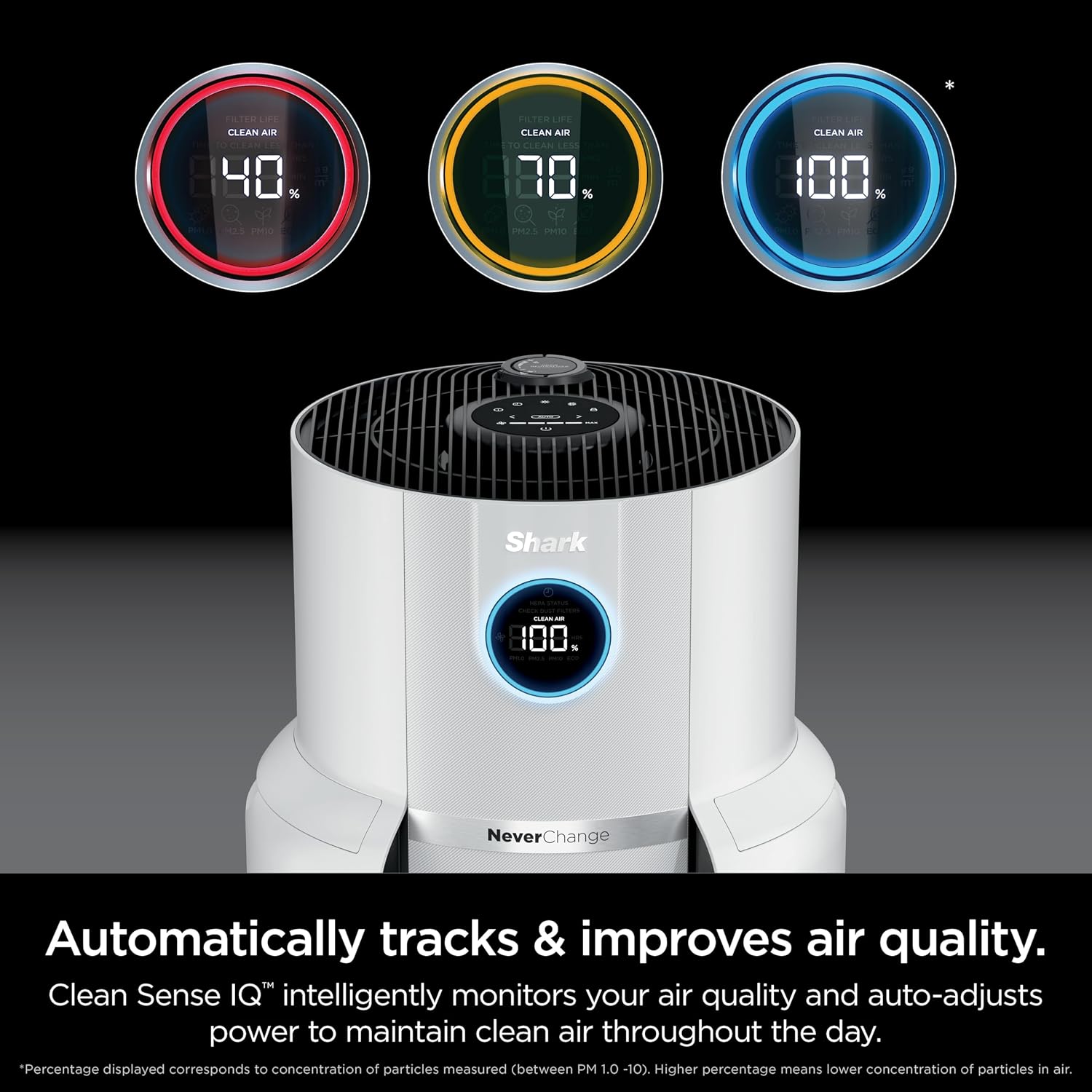
Long-life composite filters — the Shark NeverChange line is the flagship example here — use a multi-layer structure claimed to last the life of the unit, typically rated at 5 years. Unlike washable plate systems, these don’t get rinsed; the outer surface can be vacuumed, but the internal media is sealed. The “NeverChange” name markets the absence of replacement cost, not the presence of a wash cycle.
Understanding which type you’re evaluating changes every downstream question, including how to assess owner reports.
What Long-Run Owners Actually Report (1–6 Years of Real-World Data)
The Six-Year Benchmark: Nuwave OxyPure
The most durable data point in the current owner record comes from a Nuwave OxyPure owner who reports running the unit 24 hours a day, every day, for six consecutive years. The filters, which include a washable pre-filter and a stainless-steel bio-guard, are described as easy to clean and still functional. Six years of continuous operation is a genuinely unusual longevity claim in this category — most long-run reviews cap out at two to three years. The important caveat: this single owner report, while credible, is exactly that — one data point. Cleaning discipline, local air quality (urban vs. rural, wildfire proximity, pet load), and HVAC system quality all affect how aggressively filters accumulate particulates. Per IAQA best practices for residential filtration, filter maintenance intervals should always be calibrated to local conditions, not just manufacturer schedules. Attribute this result to one owner’s disciplined maintenance under their specific conditions.
Shark NeverChange: Strong at 1–2 Years, Unknown at Year 5
Shark NeverChange owners at the 1–2 year mark are notably enthusiastic. Across aggregated owner reports, the patterns that emerge most consistently are strong wildfire smoke performance and heavy-duty household use durability. Owners in high-smoke-event regions specifically credit the unit with handling seasonal air quality emergencies without the filter-replacement scramble that catches HEPA owners off guard during wildfire season.
Here is the honest evidence gap you need to know before committing: no owner report yet documents the Shark NeverChange filter condition at or beyond the claimed 5-year mark. The units weren’t widely available long enough for that data to exist. You are being asked to trust a manufacturer’s longevity claim that has not yet been validated by independent owner experience at full rated lifespan. That’s a real risk if you’re making a 5-year total-cost-of-ownership calculation. It doesn’t make the product wrong — it makes it unverified at the most important horizon. If that uncertainty bothers you (and it should, if you’re a practitioner making a recommendation for a client or building), the Nuwave or Airdog platforms offer more mature data.
Airdog X5: The Strongest Financial Case in the Category
The most financially compelling long-run owner data in this article comes from an Airdog X5 owner running the unit under an exceptionally high pet load — 20 dogs — and specifically citing filter cost savings as the primary motivator for choosing ESP technology. At that particle load, a conventional HEPA setup would require filter replacement every 2–3 months, generating roughly $120–$400 per year in filter costs depending on the unit. The Airdog’s washable plates eliminate that cycle entirely. The same owner credits the unit with eliminating personal congestion symptoms, which speaks to actual particle capture performance rather than just convenience.
The tradeoff worth naming explicitly: washable ESP plates do require consistent cleaning. The Airdog’s collection plates need to be washed every 2–4 weeks under heavy use — more often than typical HEPA filter replacement schedules. If your client or household will not actually maintain that rhythm, efficiency degrades, and ozone byproduct risk increases. The EPA’s air cleaner guide explicitly flags this behavioral dependency as a limitation of ESP systems.
The Math: 5-Year Total Cost of Ownership
Here’s a simplified comparison across the main washable platforms versus a conventional HEPA unit.
| Platform | Filter Cost (Year 1) | Ongoing Annual Filter Cost | 5-Year Filter Spend |
|---|---|---|---|
| Mid-range HEPA (e.g., Winix C545) | $30–50 | $30–50/yr | $150–250 |
| Blueair 211+ (sleeve only washable) | $30–50 sleeve | $30–50/yr inner filter | $150–250 |
| Shark NeverChange | $0 (included) | $0 (claimed) | $0 (unverified at yr 5) |
| Airdog X5 (ESP plates) | $0 | $0 (plates only) | $0 |
| Nuwave OxyPure (washable bio-guard) | $0 | Minimal ($20–40 for bio-guard refresh) | $80–160 |
Electricity costs excluded — vary by wattage and run hours. All filter costs based on manufacturer replacement pricing as of May 2026.
The cost-per-year math clearly favors washable platforms — but only if the unit’s actual particle capture efficiency holds over time. Consumer Reports’ air purifier testing methodology notes that filter performance typically declines as media loads with fine particles, which is why HEPA filters are designed to be replaced rather than cleaned. Washable plate systems sidestep this by washing away the accumulated load. Whether long-life composite filters like the Shark NeverChange maintain consistent MERV or HEPA-equivalent performance across 5 years without any maintenance of the internal media is the unresolved engineering question in that category.
Are Washable Plate Purifiers as Effective as True HEPA?
This is the question that practitioners get asked most, and the honest answer is: it depends on particle size and ozone tolerance. Per ASHRAE Standard 52.2, which governs particle removal efficiency testing methodology, ESP systems are highly effective at capturing large and mid-size particles but show variable performance on ultrafine particles below 0.1 microns compared to HEPA-rated mechanical filters. Wirecutter’s air purifier coverage consistently notes that HEPA mechanical filtration has the most robust and consistent independent performance data. That doesn’t mean ESP is inadequate for most residential and commercial applications — it means the evidence base is stronger for HEPA.
For a medically sensitive occupant (asthma, post-surgery recovery, allergy-driven purchase), the more conservative recommendation is HEPA-mechanical filtration with documented CADR ratings, not ESP. For a high-volume-use setting with a cost-conscious operator, the Airdog’s real-world owner data is more persuasive than the theoretical comparison.
Frequently Asked Questions
Does the Shark NeverChange filter really last 5 years? The manufacturer rates it for 5 years, and 1–2 year owner reports are genuinely positive. But no independent owner report has yet documented filter condition at or beyond the 5-year mark. Treat this as a reasonable promise with an unverified long tail. If the filter does need replacement at year 3–4, the cost economics shift significantly.
What do you actually have to clean or replace on a washable-filter purifier? It depends on the platform. ESP units like the Airdog require plate washing every 2–4 weeks under moderate use. Nuwave’s washable pre-filter and bio-guard get rinsed periodically. Shark NeverChange outer surfaces can be vacuumed but the internal media is sealed. Blueair 211+ owners can wash the outer sleeve without touching the inner filter. Nothing is truly zero-maintenance — the honest framing is lower-cost maintenance, not no maintenance.
Are washable plate purifiers like the Airdog as effective as true HEPA at capturing fine particles? For large and mid-range particles, ESP performance is comparable or competitive. For ultrafine particles below 0.1 microns, mechanical HEPA filtration has more consistent independent performance data per ASHRAE 52.2 methodology. For medically sensitive occupants, HEPA-mechanical is the lower-risk choice. For high-pet, high-dust environments where cost is the primary driver, ESP owner data is persuasive.
How do I know when a washable filter needs cleaning? On ESP systems, visible gray or brown discoloration on the collection plates is the signal. On pre-filter mesh, visible particle buildup is the cue. Some units include air quality sensors that show degraded performance — if your CADR-equivalent output drops measurably (higher PM2.5 readings in the room despite the unit running), that’s the functional signal regardless of visible condition. Per IAQA guidance, don’t rely solely on visual inspection in high-load environments.
Do washable-filter purifiers save money compared to replacing HEPA filters annually? Yes, over a 3–5 year horizon, if the unit’s capture efficiency holds. The 5-year cost-of-ownership gap between a conventional HEPA unit ($150–250 in filters) and an ESP or long-life platform ($0–160) is real. The uncertainty is performance degradation over time, which is better documented for HEPA-replacement cycles than for long-life washable systems.
The Decision Rule
If your primary driver is proven particle capture with documented CADR data, choose HEPA-mechanical and budget for annual filters. The performance evidence base is deeper, and the economics are manageable.
If you have a high-load environment (heavy pets, commercial-volume use) and cleaning discipline is realistic, the Airdog X5’s washable plate system has the strongest real-world financial case in the category — backed by genuine multi-year owner data, not just manufacturer claims.
If you want the lowest-friction long-term ownership and can accept an unverified 5-year filter claim, the Shark NeverChange is the right platform to evaluate — with the explicit understanding that year-5 performance data doesn’t yet exist.
If you want the longest independently documented washable-platform data point in the market right now, the Nuwave OxyPure’s six-year continuous-use owner report is currently the benchmark — with cleaning discipline as the non-negotiable operating requirement.
The category is maturing, but not all of its promises have aged enough to be verified. Match the platform to the evidence you’re comfortable betting on, and build your TCO calculation around what owners have actually reported — not the best-case scenario on the product page.