You’ve probably seen the $800 air purifier sitting in a friend’s living room and thought: is that actually doing anything, or is it an expensive nightlight? Fair question. An air purifier is a device that pulls room air through a series of filters — most importantly a HEPA filter (High Efficiency Particulate Air, a lab-defined standard that captures at least 99.97% of particles 0.3 microns in diameter) — and returns cleaner air to the room. The number that tells you how fast it does this is called CADR, or Clean Air Delivery Rate, measured in cubic feet per minute. Higher CADR = faster cleaning of a given room. Below $200, you get solid HEPA filtration for a bedroom or home office. Above $500, the question changes: you’re paying for larger coverage, quieter operation at high CADR, smarter sensors, or filtration that goes beyond particles into gases, VOCs (volatile organic compounds — chemical off-gassing from paint, furniture, and cleaning products), and ultrafine pollution. This guide is for people who are close to pulling the trigger on that higher tier and want to make sure the math actually works.
What You’re Actually Buying Above $500
Let’s be direct: the jump from a $150 Levoit to a $600 Winix or $1,200 IQAir isn’t just about marketing. There are four legitimate reasons the premium tier earns its price — and a few where it doesn’t.
1. CADR-to-noise ratio. This is the metric that separates real premium from premium-priced. Any purifier can hit a high CADR if you run it at maximum fan speed. The test is whether it can deliver meaningful air changes per hour (ACH — how many times per hour the entire room’s air volume passes through the filter) at a sleep-able noise level, typically below 45 dB. Budget units get loud fast. Reviewers at Wirecutter (The New York Times) consistently flag that mid-range and premium units justify much of their cost here: the Coway Airmega 400, for instance, is rated for spaces up to 1,560 sq ft, and owners report it holds reasonable noise levels at its medium setting where CADR remains genuinely useful.
2. True coverage area, not advertised coverage. AHAM (the Association of Home Appliance Manufacturers) publishes CADR ratings through standardized testing — their guidance document “CADR: What It Is and How to Use It” recommends sizing a purifier to deliver at least 2 ACH in your target room. Most budget units top out at 300–400 sq ft when you apply this 2-ACH rule. Premium units are often the only realistic choice for open-plan living areas, large primary bedrooms, or combined kitchen-dining spaces above 700 sq ft.
3. Multi-stage filtration for gas-phase pollutants. HEPA catches particles. It does not meaningfully capture formaldehyde, benzene, nitrogen dioxide, or cooking-generated VOCs. The EPA’s Indoor Air Quality resources are explicit that particle filtration and gas-phase filtration are distinct problems requiring distinct media. Units like the AirDoctor 3500 and IQAir HealthPro Plus layer activated carbon or proprietary gas-phase media over their HEPA stages. If your concern is a newly renovated space, a home with gas appliances, or wildfire smoke (which contains both fine particles and toxic gases), this matters.
4. App ecosystem and auto-mode reliability. Smart sensors that adjust fan speed automatically based on real-time PM2.5 readings sound like a minor feature — but owners across long-run reviews consistently report that well-implemented auto-mode is the actual use pattern for 90% of purifier life. You set it, forget it, and the unit ramps up when you’re cooking or when outdoor air quality degrades. Units with poor sensor calibration or unstable app connections defeat this entirely. More on this below.
The Shortlist: Four Units Worth the Price Premium
IQAir HealthPro Plus (~$899–$1,050 street price, 2026)
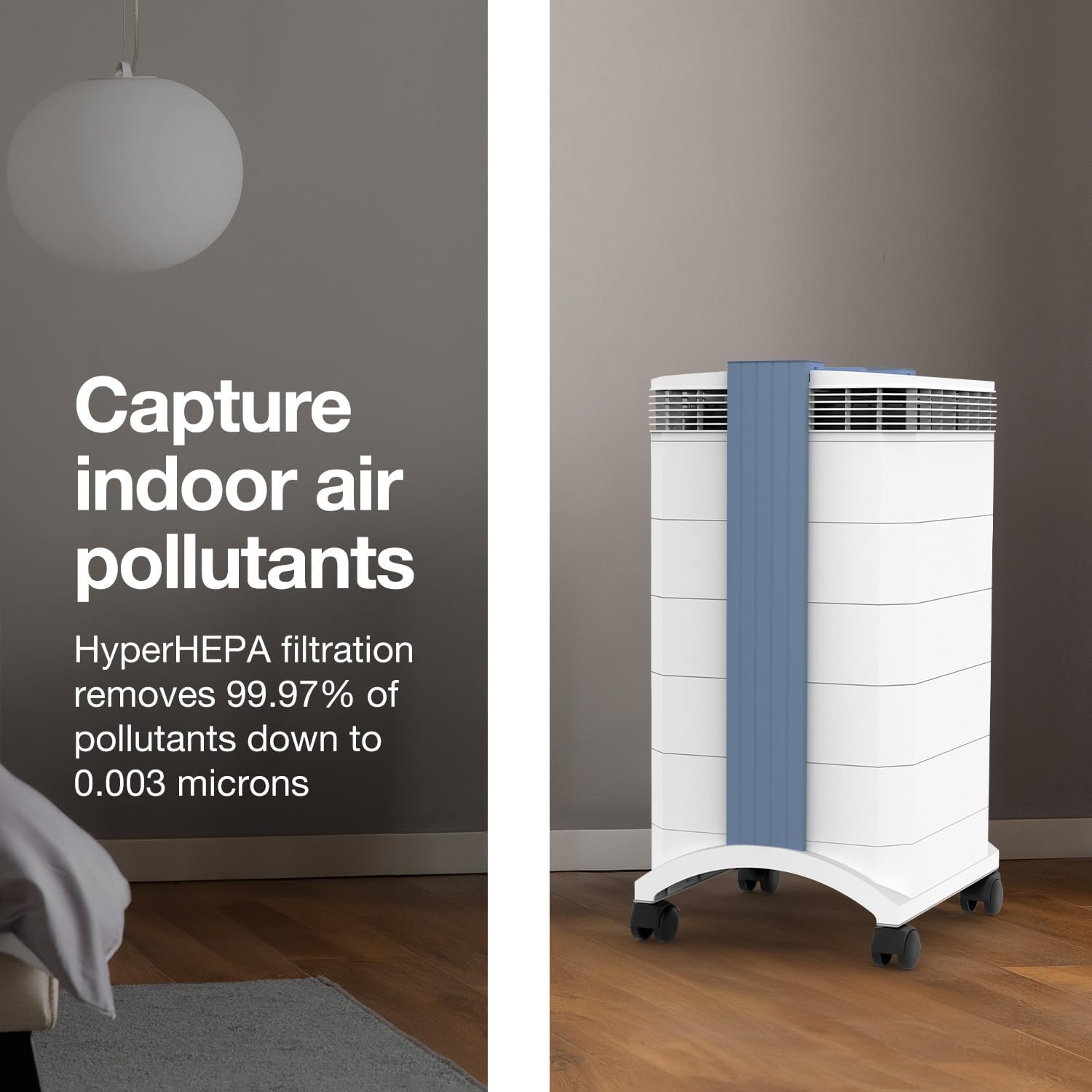
The IQAir HealthPro Plus is the unit that shows up in medical-grade settings — hospital recovery rooms, allergy clinics — and the reason is consistent. Its HyperHEPA filtration is independently certified to capture particles down to 0.003 microns (significantly finer than standard HEPA’s 0.3-micron threshold), and Consumer Reports has rated it among the highest performers for allergy and asthma sufferers in multiple annual roundups. CADR is rated at 300 CFM for particles, which is moderate for the price — IQAir’s design prioritizes filtration depth over raw throughput speed. Best for: households with documented allergy, asthma, or immune-compromised residents where filtration quality matters more than room coverage speed. The tradeoff: no app, no smart-home integration, manual controls only. If you want HomeKit or Alexa, this isn’t your unit.
5-year TCO check: Filter kit replacement (the PreMax, V5-Cell, and HyperHEPA stack) runs approximately $250–$300 per kit, with IQAir recommending replacement every 12–18 months depending on use. At 18-month intervals: ~$800–$1,000 in filters over five years on top of the unit cost. Total 5-year spend: $1,700–$2,050.
Blueair Pro M (~$700–$800 street price, 2026)
Blueair’s HEPASilent technology — a combination of mechanical HEPA and electrostatic filtration — is the reason Blueair units consistently test quieter per unit of CADR than most competitors. The Pro M is rated for spaces up to 1,007 sq ft at 2 ACH (per AHAM methodology) with a CADR of approximately 360 CFM. App integration through the Blueair Friend app supports auto-mode, scheduling, and air quality history. Reviewers at Wirecutter note that the app is functional without being exceptional — no HomeKit support as of early 2026, Alexa integration available. Best for: large open-plan apartments, combined living/dining rooms, or anyone prioritizing quiet operation at high output. The tradeoff: filter costs are moderate but proprietary; generic replacements exist but aren’t certified.
5-year TCO check: Blueair particle + carbon filters for the Pro M run ~$100–$130 per set, recommended every 6 months. Five-year filter cost: ~$1,000–$1,300. Total 5-year spend: $1,700–$2,100.
AirDoctor 3500 (~$500–$630 street price, 2026)
The AirDoctor 3500 hits a specific sweet spot: genuine UltraHEPA filtration (rated to 0.003 microns per manufacturer documentation) plus a carbon/VOC gas trap, at a price point roughly 40% below the IQAir. CADR is rated at 335 CFM for particles. Owners across aggregated reviews consistently cite the auto-mode as responsive — the built-in air quality sensor drives fan speed adjustments that feel accurate rather than laggy. No dedicated smart-home platform integration (no HomeKit, no Alexa as of 2026), but the standalone app provides historical air quality logging. Best for: wildfire-affected regions, recently renovated spaces, or households concerned about gas-phase pollutants alongside particles who want capable filtration without the IQAir price tag. The tradeoff: coverage tops out around 850–900 sq ft at practical ACH; not a true whole-home solution for large floor plans.
5-year TCO check: AirDoctor replacement filters (combined HEPA + carbon) run approximately $130–$160 per set, with recommended replacement every 6–12 months. Five-year filter cost: $650–$1,600 depending on interval and use environment. Total 5-year spend: $1,150–$2,230.
Molekule Air Pro (~$999–$1,100 street price, 2026)
Molekule is the unit that generates the most editorial debate, and it’s worth addressing directly. Its PECO (Photo Electrochemical Oxidation) technology is designed to destroy pollutants at the molecular level rather than trap them. Consumer Reports testing has been critical of its particle CADR relative to price. However, Molekule has published third-party testing showing efficacy against specific VOCs and biological contaminants. Owners in long-run reviews polarize: some report noticeably cleaner air in renovated or chemical-sensitive environments; others are disappointed by particle filtration compared to HEPA alternatives. App integration is among the strongest in this tier — Alexa compatible, detailed air quality history, auto-mode generally reliable. Best for: chemical sensitivity, post-renovation off-gassing concerns, or smart-home-integrated households willing to accept moderate particle CADR in exchange for gas-phase and biological efficacy. The tradeoff: if raw PM2.5 and PM10 particle CADR is your primary metric, IQAir or Blueair Pro outperform it at similar or lower cost.
By the Numbers
| Unit | CADR (CFM) | Max Coverage (2 ACH rule) | 5-Year Filter Cost (est.) | Smart Home |
|---|---|---|---|---|
| IQAir HealthPro Plus | ~300 | ~750 sq ft | $800–$1,000 | None |
| Blueair Pro M | ~360 | ~1,007 sq ft | $1,000–$1,300 | Alexa |
| AirDoctor 3500 | ~335 | ~850 sq ft | $650–$1,600 | App only |
| Molekule Air Pro | ~250 (particle) | ~600 sq ft | $750–$1,000 | Alexa |
Coverage estimates apply AHAM’s 2-ACH sizing guideline. Street prices reflect May 2026 market conditions.
The Smart-Home Integration Gap You Should Know About
If you’re buying in 2026 and plan to keep a unit for five-plus years, app integration is a meaningful durability risk. Platforms get discontinued; manufacturer apps degrade without active development. ASHRAE’s guidance on ventilation and acceptable indoor air quality (Standard 62.1) doesn’t speak to consumer app ecosystems, but the practical pattern is clear: units with Alexa or Google Home integration are more likely to maintain software support because the integration dependency creates a commercial reason to keep apps functional.
The IQAir HealthPro Plus has no app at all — a deliberate choice that some buyers find refreshing and others find disqualifying. The Blueair and Molekule units sit on the stronger end of app integration in this tier. If auto-mode reliability matters to you (and it should, because that’s how these units actually get used), weight this more heavily in your decision than it might initially seem.
The Decision Rule
Here’s the honest framework for deciding whether this tier is right for you and which unit fits:
If your primary concern is particle filtration for allergy or asthma management, and you don’t need smart-home integration: IQAir HealthPro Plus. The filtration depth is unmatched in this tier and the unit has a demonstrated track record in medical contexts. Accept the manual controls and the $1,700–$2,050 five-year total spend if the health case justifies it.
If you have a large open-plan space (800–1,200 sq ft) and quiet operation is non-negotiable: Blueair Pro M. The HEPASilent output-to-noise ratio is the best in class here, and the coverage area is legitimate rather than marketing-inflated.
If you’re in a wildfire region, recently renovated, or cooking in a gas kitchen and need gas-phase filtration at sub-$700 entry: AirDoctor 3500. The VOC/carbon stage plus UltraHEPA filtration at this price point is genuinely differentiated. Note the filter cost range — if you’re running it in a high-pollution environment and replacing filters every six months, the five-year math climbs fast.
If smart-home integration and biological/chemical pollutant destruction matter more than raw particle CADR: Molekule Air Pro — with eyes open about the particle filtration tradeoff documented in Consumer Reports testing.
If none of these fit because your space exceeds 1,200 sq ft or you want true whole-home coverage without running multiple units: this tier isn’t your answer. The next step is HVAC-integrated systems — Lennox PureAir, Aprilaire 5000, or RGF REME HALO — where filtration happens at the air handler level and CADR scales with your system’s airflow. That’s a different article and a different (higher) budget, but it’s the honest next tier for serious whole-home coverage.
The $500–$1,600 range earns its price for specific, well-defined use cases. Know your use case first, then let the specs confirm the choice.