When smoke from a wildfire rolls into your neighborhood, the particles you’re breathing aren’t like ordinary dust. Wildfire smoke is a dense cocktail of ultra-fine particles — measured as PM2.5, meaning particles smaller than 2.5 micrometers across (roughly 1/30th the width of a human hair) — along with carbon monoxide and volatile organic compounds (VOCs). These particles are small enough to bypass your nose and throat entirely and lodge deep in your lungs. The good news: the right filtration strategy can cut your indoor exposure dramatically, and a lot of what works is already within reach. This guide covers pre-season preparation, what to do when smoke is actively in the air, and how to clear your home after an event passes — with real product options, honest tradeoffs, and the math you need to make a confident decision.
Before Smoke Arrives: Pre-Season Prep That Actually Matters
The single biggest mistake people make with wildfire smoke is treating it like a surprise. In most of the Western U.S. — and increasingly in the Pacific Northwest, the mountain West, and even parts of the Southeast — wildfire smoke season is as predictable as allergy season. Planning before the air turns bad is the difference between a protected home and a frantic Amazon order that arrives three days too late.
Audit your HVAC filter first. Your home’s HVAC system is your first line of defense, and most homeowners are running filters that aren’t up to the job. The MERV rating (Minimum Efficiency Reporting Value) is a standardized scale from 1–16 that tells you how well a filter catches small particles. The EPA’s wildfire smoke guidance recommends MERV 13 or higher for capturing PM2.5 effectively. Most builder-grade filters are MERV 6–8 — they catch large dust but let smoke particles sail through. Swapping to a MERV 13 filter before smoke season is a low-cost, high-leverage move. TruFilter’s MERV 13 filters have a strong following among buyers who discovered them during the 2023 Canadian wildfire events and continue running them year-round.
Buy your room purifier before you need it. Reviewers who purchased during an active smoke event consistently report delayed shipping and depleted stock. If you’re in a high-risk region and don’t already own a capable unit, May through June is the right window to buy for a July–October smoke season. Look for units with a CADR (Clean Air Delivery Rate — a standardized measure of how much filtered air the unit produces per minute, in cubic feet per minute) of at least 200 CFM for a standard bedroom, and at least 300–400 CFM for a larger living room.
Stock extra filters. During a heavy smoke event, your purifier’s HEPA filter can reach end-of-life in weeks rather than months. Order one replacement filter set alongside your unit — or if you’re already a purifier owner, check your filter status now.
During an Active Smoke Event: Layered Protection by Room
When an air quality alert is active and AQI (Air Quality Index — a 0–500 scale used by the EPA where anything above 150 is unhealthy for all groups) climbs above 100 outdoors, your strategy shifts to containment and filtration.
Seal the envelope first. Even a high-end purifier can’t compensate for a house that’s actively pulling in smoky outdoor air. Close windows and doors. If you have a mechanical ventilation system with a fresh-air intake, switch it to recirculation mode. Weatherstripping gaps under exterior doors with a door draft stopper is a quick, cheap upgrade that makes a measurable difference.
Match purifier to room size. The CADR number is your anchor. The California Air Resources Board’s guidance on reducing wildfire exposure suggests matching CADR to roughly 2/3 of the room’s square footage at minimum — so a 350 sq ft bedroom needs at least a 230 CFM CADR unit. Here’s how a few well-documented units stack up:
| Unit | CADR (smoke) | Rated Room Size | Filter Type |
|---|---|---|---|
| Coway AP-1512HH (Mighty) | 246 CFM | ~360 sq ft | True HEPA + carbon pre-filter |
| Winix 5500-2 | 243 CFM | ~360 sq ft | True HEPA + carbon |
| Blueair Blue Pure 211+ | 350 CFM | ~550 sq ft | HEPASilent + carbon |
| IQAir HealthPro Plus | 300 CFM | ~1,125 sq ft | HyperHEPA |
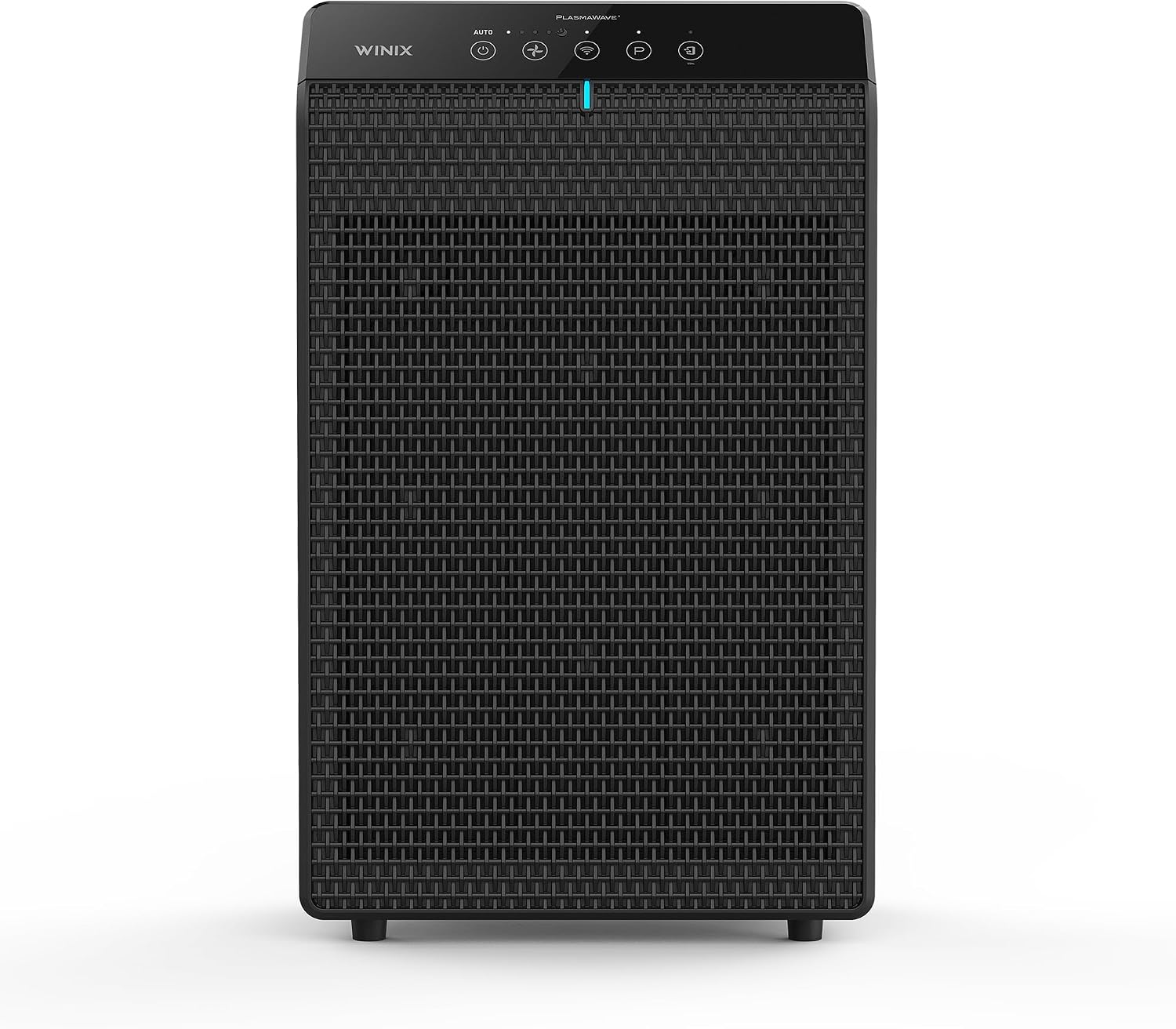
Owners of the Coway AP-1512HH consistently report it as one of the most reliable smoke-season workhorses in its price range. One frequently cited reviewer narrative involves a NYC resident who replaced a slower, noisier unit with the Coway specifically after the 2023 Canadian wildfire smoke blanketed the Northeast — and noted the visual odor reduction within hours. The Winix 5500-2 draws similar praise, with its PlasmaWave technology a point of debate (some users disable it; the HEPA + carbon layer is the core value regardless).
Run at high speed, at least initially. Purifier manufacturers rate CADR at maximum fan speed, but many owners default to a quiet low setting. During an active smoke event, the EPA recommends running at high speed for the first hour when you arrive home from outdoors or when smoke infiltration is detected — then dropping to a medium setting once the room is cleared. Noise is a real tradeoff here: the GermGuardian AC5350B 5-in-1 tower is one unit that owners who purchased post-LA fire events say surprised them with immediate odor improvement, though it runs louder at high speed than the Coway or Winix.
Don’t neglect activated carbon. A HEPA-only filter — even a high-quality one — captures particles but does not meaningfully reduce VOCs and gaseous pollutants from wildfire smoke. Activated carbon (sometimes called “activated charcoal”) is the filter layer that adsorbs these gases. Any purifier you rely on during smoke season should include a substantial carbon layer, not just a thin carbon pre-filter mesh. The Winix 5500-2, Blueair Pro series, and IQAir HealthPro Plus all have meaningful carbon stages. Budget units with only a thin carbon sheet will help with particles but leave VOCs largely unaddressed.
The DIY box fan option. For a laundry room, garage workspace, or secondary bedroom where you don’t want to invest in a dedicated unit, a box fan + MERV 13 filter is a legitimate emergency setup. Tape the filter to the intake side of the fan (the side pulling air in), confirm the airflow direction arrow on the filter points toward the fan, and run it on medium. This setup won’t match the CADR of a purpose-built purifier with a sealed filtration path, but published testing by the EPA and academic researchers has confirmed it reduces PM2.5 concentrations meaningfully in a pinch. Owners who have run this in laundry rooms and basement work areas report it as surprisingly effective for the cost. Use MERV 13 minimum — MERV 8 or lower will not capture PM2.5 adequately.
After the Smoke Clears: Recovery and Reset
Once AQI returns to safe levels outdoors, your work isn’t done. Smoke particles and VOCs settle into upholstery, carpet, curtains, and HVAC ducts and continue off-gassing.
Run your purifier for 24–48 hours after outdoor air quality recovers. Settled particles get re-suspended every time you walk across carpet or move furniture. Keeping your purifier running helps clear the secondary wave.
Replace or inspect filters immediately post-event. A HEPA filter that’s been running at high speed through a week-long smoke event may be visually darkened and significantly loaded — meaning airflow is restricted and efficiency is dropping. The Levoit Core 300, popular among first-time buyers who came to air purification during the 2023 fire events, has a notably loyal long-term user base, with multiple owners reporting daily use for two or more years — but those owners note they replaced filters more frequently during active smoke periods than the standard annual recommendation.
Flush your HVAC. Replace your MERV 13 HVAC filter after a prolonged smoke event even if it’s not technically at its rated end-of-life. Smoke loads filters faster than ordinary dust. For whole-home systems like the Aprilaire 5000 or Lennox PureAir, consult your installer about post-event filter inspection — these systems have higher-capacity media but aren’t immune to smoke loading.
By the Numbers: Filter Replacement Math During Smoke Season
Normal use: Most HEPA filters rated for 6–12 months of use. Active smoke event (AQI 150+ for 7+ days): Expect to replace in 4–8 weeks. 5-year TCO impact: Budget ~$60–$120/year extra in filter costs for smoke-region owners vs. the manufacturer’s standard estimate. MERV 13 HVAC filters: ~$15–$30 each; replace after each major smoke event regardless of time elapsed.
Frequently Asked Questions
How quickly can a room air purifier actually clear wildfire smoke from a bedroom-sized space?
Based on published CADR methodology and EPA guidance, a properly sized unit (CADR ≥ room sq footage × 0.67) running on high speed can reduce PM2.5 concentrations by 50–80% in a standard 300–400 sq ft bedroom within 30–60 minutes, assuming the room is reasonably sealed. A unit that’s undersized for the space — or running on low speed — may take 2–3 hours to achieve the same reduction. Source: EPA Indoor Air Quality wildfire guidance documents.
Do I need a separate carbon filter layer or does a HEPA-only purifier handle smoke adequately?
HEPA alone handles the particle problem but not the VOC and odor problem. Wildfire smoke contains acrolein, benzene, formaldehyde, and other gaseous compounds that HEPA media does not adsorb. For smoke season, a meaningful activated carbon layer is not optional — it’s the difference between filtered air and truly cleaned air. Units marketed with only a thin carbon pre-filter mesh offer limited gas-phase protection.
Will my HVAC whole-house filter help during wildfire smoke or should I seal vents?
A MERV 13 or higher HVAC filter actively running in recirculation mode is genuinely helpful — it cycles your whole home’s air volume multiple times per hour. ASHRAE’s filtration position document confirms MERV 13 as the practical minimum for PM2.5 capture. The risk: if your HVAC system has a fresh-air intake and you can’t disable it, you may be actively pulling outdoor smoke in. Confirm your system is in recirculation mode before running it during an event.
How often should I replace my purifier filter during an active smoke season compared to normal use?
Manufacturers typically rate filters for 6–12 months under normal conditions. During sustained smoke events (AQI 100+ for extended periods), plan to inspect filters monthly and replace every 4–8 weeks of heavy use. A darkened, visibly loaded filter is past its efficient range regardless of time elapsed.
Can I use a box fan with a MERV 13 filter as an emergency air purifier and does it actually work?
Yes — with realistic expectations. EPA-partnered academic research (notably from UC Davis and University of Michigan environmental health programs) has documented 50–90% PM2.5 reduction in single rooms using a 20-inch box fan with a MERV 13 filter. The setup is not equivalent to a sealed, purpose-built unit with a motor-to-filter matched airflow path, but it meaningfully outperforms an unfiltered room during a smoke event. Use MERV 13 minimum, confirm filter airflow direction, tape edges to reduce bypass, and replace the filter after the event ends.